
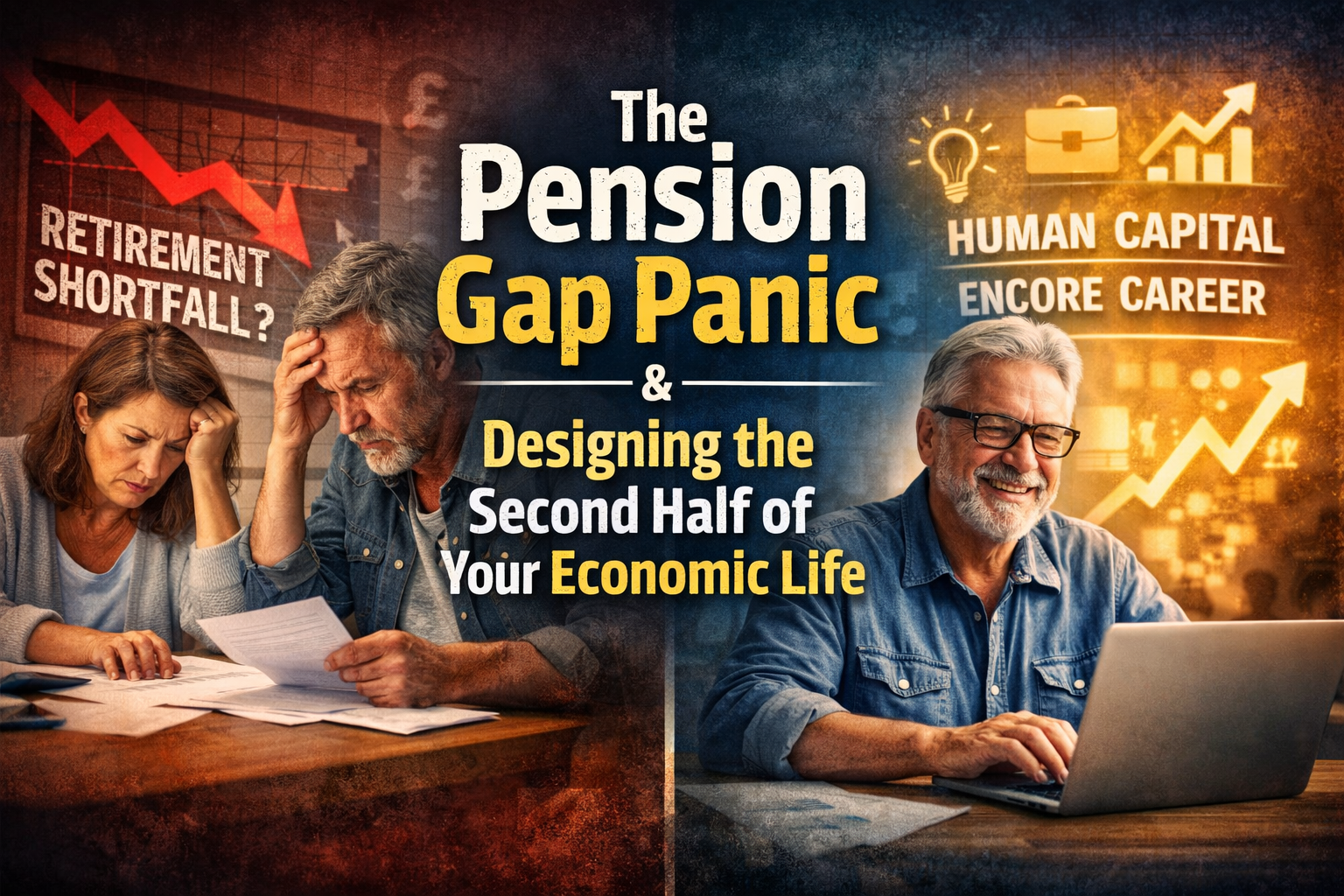
Half of Gen X savers now say they fear running out of money in retirement.
That statistic has been widely reported across financial media.
But something important is missing from the conversation.
The narrative assumes that retirement security depends almost entirely on financial capital — the size of your pension pot.
For millions of people in their 40s and 50s, that framing creates understandable anxiety.
Yet it ignores the largest asset most Gen X individuals still possess:
their human capital.
Until we bring that asset back into the conversation, the retirement debate will continue to frighten people unnecessarily — and overlook practical solutions.
The Story Gen X Keeps Hearing
Most pension gap reports follow the same pattern.
They begin with statistics showing that:
- Average pension pots are relatively small
- Retirement could last 25–30 years
- Contributions may be insufficient
- Many people lack confidence about their future
The implied conclusion is clear.
You probably won’t have enough.
For Gen X — the generation now entering their peak earning years — this message can feel overwhelming.
Many people are managing:
- mortgages
- caring responsibilities
- career transitions
- economic uncertainty
And the message they repeatedly hear is that their retirement savings are inadequate.
No wonder confidence is falling.
But there is a deeper problem with this narrative.
It treats retirement as a purely financial capital problem.
The Missing Asset: Human Capital
Economists define human capital as the present value of future earnings.
For most people in midlife, it is still their largest asset.
Consider a typical Gen X professional earning £40,000 per year.
If they continue working for 20 years, their future earnings potential could exceed:
£800,000
Even allowing for discounting and career changes, remaining human capital often sits between:
£600,000 and £1 million.
Now compare that with the typical pension pot for someone in their late 40s or early 50s.
Approximately:
£80,000 – £120,000
The contrast is striking.
Financial planning discussions usually focus on the smallest asset on the balance sheet, while ignoring the largest.
Why the Traditional Retirement Model Is Breaking Down
For most of the twentieth century, the retirement model looked like this:
40 years work → 30 years retirement
This model depended on several assumptions:
- generous defined benefit pensions
- shorter life expectancy
- stable career paths
- limited opportunities to work later in life
Those conditions no longer exist.
Defined benefit pensions have largely disappeared.
Longevity has increased.
Technology now enables flexible work later in life.
The result is that the old model no longer fits the economic reality many people face.
Designing the Second Half of Economic Life
A more realistic structure for many people today may look like this:
40 years work → 10 years encore career → 20 years retirement
This “encore phase” is already emerging across the economy.
It can take many forms:
- consulting
- teaching
- mentoring
- advisory roles
- entrepreneurship
- part-time professional work
- portfolio careers
For someone earning even £20,000 per year during this period, ten years of encore work produces:
£200,000 of additional income.
In many cases, that can equal or exceed the value of their pension pot.
The implication is profound.
Retirement security may depend less on the size of the pension pot than on how effectively individuals deploy their human capital in later life.
Active Income → Passive Income
Encore income can also serve another important purpose.
It can become the bridge between active income and passive income.
During the encore phase, individuals can:
- build investment portfolios
- create income-producing assets
- develop digital products
- build businesses that generate recurring income
The sequence becomes:
Active income → capital accumulation → passive lifetime income
This is very different from the traditional model of:
Save → retire → withdraw
It reflects a more dynamic relationship between work, capital, and life design.
Why Gen X Feels So Anxious
The anxiety reported in pension surveys becomes easier to understand when viewed through this lens.
Many people sense that the traditional model is failing.
They see pension projections that look inadequate.
But they have not been shown a clear framework for designing the second half of their economic life.
So the story they hear is simply:
“You don’t have enough.”
When the more accurate message may be:
“You haven’t designed the next phase yet.”
The Role of Total Wealth Planning
Total Wealth Planning approaches this challenge from a different perspective.
Rather than focusing solely on financial assets, it integrates multiple forms of capital, including:
- financial capital
- human capital
- social capital
- intellectual capital
- emotional and psychological capacity
This broader perspective allows planners and clients to ask a different set of questions.
Not just:
How large does the pension pot need to be?
But:
- What capabilities will I continue using in later life?
- How might I generate meaningful income during an encore phase?
- How can active income be converted into long-term passive income?
- What combination of work and capital supports the life I want?
In this framework, retirement is not an abrupt endpoint.
It becomes a designed transition between phases of life and work.
A New Opportunity for Financial Planners
This shift also creates a profound opportunity for the profession.
For decades, much of financial advice has focused on serving wealthy Baby Boomers.
That work remains valuable.
But the next generation faces a different challenge.
Millions of Gen X professionals do not need product sales.
They need clarity, structure, and strategic thinking.
They need someone on their side of the table helping them integrate:
- life goals
- career evolution
- human capital
- financial capital
In other words, they need professionals who help restore human agency.
Restoring Human Agency
Agency is the capacity to act intentionally in shaping one’s life.
It requires more than money.
It also requires:
- confidence
- capability
- knowledge
- decision-making clarity
- the ability to navigate complex institutions
When people feel they lack agency, fear increases.
When agency is restored, possibilities expand.
Financial planning becomes less about predicting the future and more about helping people design it.
The Generation That Needs This Most
Gen X sits directly in the middle of this transition.
They are:
- too young to rely on traditional pensions
- too experienced to stop contributing
- too capable to be defined solely by financial assets
What they often lack is a framework for integrating their capabilities into a coherent economic plan for the second half of life.
This is where the profession can make its greatest contribution.
A Different Conversation About Retirement
If we want to help this generation, the conversation needs to change.
Instead of focusing only on pension gaps, we should also be asking:
- What capabilities do you still want to use?
- What forms of work will remain meaningful?
- How can those capabilities create income in later life?
- How can that income support long-term financial security?
When these questions are asked, the story of retirement begins to look very different.
From Fear to Design
The pension gap narrative has one unintended consequence.
It frightens people who may simply not have designed the next phase of their economic life yet.
But once human capital is brought back into the equation, a more constructive message emerges.
Retirement security is not just about accumulating capital.
It is about designing a life where capability and capital work together.
That shift transforms the conversation from fear to possibility.
The Planner’s Choice
For financial planners, the opportunity is clear.
The profession can continue focusing primarily on the wealth accumulated by the previous generation.
Or it can begin helping the next generation design the future.
That work requires new skills:
- life planning
- human capital strategy
- career transition support
- behavioural insight
- long-term economic design
In short, it requires planners willing to move beyond managing money toward helping people shape their lives.
If we fail to plan, we plan to fail.
But when individuals are supported to design the second half of their economic lives with clarity and intention, the picture becomes far more hopeful.
And that is where the next chapter of financial planning may truly begin.
Appendix: Key Statistics on Gen X Retirement Confidence
The following statistics are drawn from research reported by pensions consultancy Barnett Waddingham, published in the industry press on 12 March 2026.
1. Confidence in Retirement Income
The research highlights growing anxiety about retirement security among UK workers.
- 48% of workers aged 45–54 say they are not confident they will have a comfortable retirement income.
- Across all UK workers, 32% lack confidence about their retirement prospects.
- Among workers over age 55, around 40% report a significant lack of confidence about their financial future.
Confidence among mid-life savers appears to be declining:
- In 2024, the equivalent figure for those aged 45–54 was 42%.
- By 2026, it had risen to 48%.
2. Engagement With Retirement Planning
The research also reveals relatively low levels of engagement with retirement planning among UK workers.
- 28% of workers have set no retirement goals, up from 13% in 2024.
- 17% of people expecting to retire within 10 years still have no retirement goals.
- 19% of workers have never checked the value of their pension.
- Only 27% review their pension annually.
Even among those approaching retirement:
- More than one quarter of people less than a year from retirement have never checked their pension value.
3. Gender Differences
The research identified a notable difference between men and women in retirement confidence.
- 27% of men say they worry about retirement income.
- 42% of women express concern about their retirement prospects.
4. Interpretation
Researchers described the experience of retirement planning for many people as:
“staring at a foggy horizon.”
In other words, people know retirement is approaching, but lack a clear sense of where they stand or what steps they should take.
A Conversation for Financial Planners
If you are a financial planner reading this, you may already sense the shift taking place in the profession.
For decades, much of financial advice has focused on managing the accumulated wealth of the Baby Boomer generation.
But the next wave of clients faces a different challenge.
Gen X often needs help integrating:
- human capital
- financial capital
- career transitions
- life design and long-term planning
In other words, they are looking for professionals who can help restore clarity, confidence, and human agency.
For advisers, this requires a subtle but important transition — from product-led advice toward Total Wealth Planning.
If you are curious about what that transition could look like in your own practice, the first step is simply a conversation.
You can choose between two options:
15-Minute Clarity Call (Free)
A short, focused conversation to explore whether transitioning toward Gen X–focused Total Wealth Planning could make sense for you.
60-Minute Strategy Meeting (£200)
A deeper working session where we explore your positioning, opportunities in Gen X planning, and practical next steps.
Includes written notes you can use to guide your thinking afterwards.
Both options are designed for thoughtful professionals who want to step back and reflect on the future direction of their work.
If that sounds useful, you are welcome to book a time.
Book a 15-Minute Clarity Call
or
Book a 60-Minute Strategy Meeting (£200)
 Academy of Life Planning