
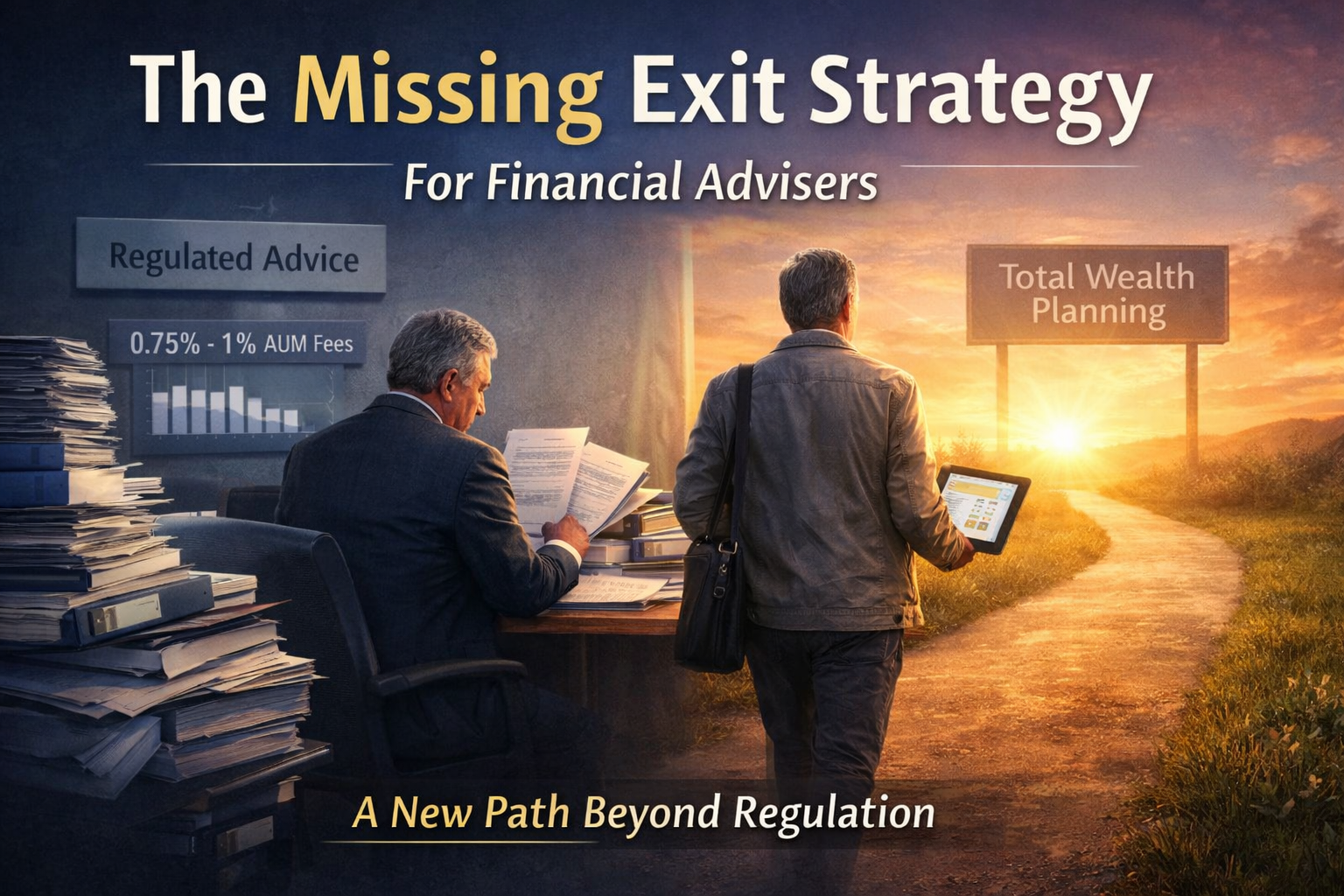
Why many advisers feel trapped between selling their firms and walking away — and what a better path might look like
For many financial advisers, the end of their career raises a difficult question.
What happens to the clients?
After decades of building trust, guiding families through life decisions, and helping people navigate financial complexity, the final step in a traditional advice career is often surprisingly blunt.
Sell the firm.
Merge with another practice.
Or simply retire and walk away.
None of these options sit comfortably with advisers who have built relationships over decades.
Yet the industry offers very little else.
The profession has developed sophisticated models for building advice businesses, but remarkably little thinking has gone into how advisers can gracefully transition out of regulated practice while preserving the client relationships that matter most.
This gap is becoming increasingly visible.
The Industry’s Default Exit Route
In today’s financial advice market, most exits follow a predictable pattern.
An adviser eventually sells their firm to:
- a consolidator
- a national advice business
- a private equity backed group
- or another local firm seeking growth
The valuation is usually based on recurring revenue, often tied to ongoing adviser charges.
Once the deal completes:
- clients are transferred
- the buyer integrates them into their service model
- fees and service structures may gradually change
Sometimes this works well.
But many advisers worry about what happens next.
They wonder whether their clients will become assets in a revenue model, rather than people in trusted relationships.
That concern is understandable.
Advisers often spend years building relationships based on:
- trust
- careful advice
- personal understanding of family circumstances
Handing those relationships to a new owner can feel uncomfortable.
Not because the buyer is necessarily predatory — but because the system itself is built around scale and revenue optimisation.
The Pricing Equilibrium
Recent discussions within the profession suggest that most firms operate within a narrow pricing band.
Ongoing advice charges commonly sit somewhere between:
0.75% and 1.0% of assets under management.
This range has effectively become the industry’s equilibrium.
Why?
Because the regulatory system is expensive.
Running a regulated advice firm requires:
- compliance infrastructure
- professional indemnity insurance
- regulatory reporting
- technology platforms
- administrative staff
- supervision and oversight
To sustain this structure, firms converge toward similar pricing.
This is not necessarily about value.
It is about survival within the regulatory model.
The Quiet Tension Many Advisers Feel
Many experienced advisers are beginning to ask deeper questions.
Questions such as:
- Do clients really need to pay an annual percentage fee forever?
- Is ongoing advice always necessary?
- Could planning be delivered differently?
- Could technology empower clients to understand more themselves?
These questions are becoming more relevant as artificial intelligence and financial technology evolve.
Tools now exist that can:
- analyse financial statements
- build cashflow projections
- interpret pension information
- model financial scenarios
Tasks that once required specialist software and professional interpretation can increasingly be done with AI-assisted tools.
This changes the landscape.
Not because advisers become irrelevant.
But because the nature of advice may evolve.
A Different Role for Financial Planners
If technology can help people understand more about their finances, the role of the planner shifts.
Instead of acting primarily as:
product intermediary
the planner becomes more of a:
thinking partner and decision guide.
In this model, the planner helps clients with:
- life transitions
- major financial decisions
- complex scenarios
- behavioural guidance
- strategic thinking
The relationship becomes more human and less transactional.
Planning becomes something clients engage with when needed, rather than paying for continuously.
The Missing Exit Strategy
This shift opens the door to something the profession has rarely discussed.
A gradual transition from regulated adviser to planning mentor.
Instead of selling the firm immediately, an adviser could move through stages.
Stage One — Planning First
During the final years of regulated practice, the adviser gradually shifts their conversations.
Less focus on:
- product management
- portfolio maintenance
- platform administration
More focus on:
- life planning
- financial clarity
- long-term thinking
- human capital decisions
Clients begin engaging more actively with their own planning.
Stage Two — Empowered Clients
As tools improve and planning becomes more accessible, clients begin taking greater ownership of:
- investment platforms
- financial modelling
- planning scenarios
The adviser still supports them — but the relationship becomes more collaborative.
Clients gain agency.
Stage Three — Regulatory Exit
Eventually the adviser may choose to step away from regulated activity.
At this point, the adviser no longer provides regulated financial advice.
But the relationship with clients does not have to end.
Instead, the adviser can continue supporting clients through:
- financial coaching
- planning facilitation
- strategic discussions
- major life decision guidance
The service becomes intellectual and relational, rather than regulatory.
Fees can move from percentage of assets to hourly or project-based engagement.
A More Human End to a Career
For many advisers, this path may feel more natural.
Instead of abruptly selling their firm and disappearing from clients’ lives, they transition into a different role.
A role where they continue contributing experience and wisdom.
A role that preserves the relationships built over decades.
And importantly, a role that reduces the regulatory burden many advisers feel toward the end of their careers.
Why This Matters for the Profession
Financial planning is evolving.
Technology will increasingly help people understand their finances.
Clients will become more capable of managing aspects of their financial lives themselves.
This does not eliminate the need for planners.
But it does reshape their role.
The planner of the future may spend less time managing products and more time helping people navigate life decisions.
For advisers approaching the later stages of their careers, this creates an opportunity.
Not just an exit.
But a glidepath into a different form of practice.
A Profession That Evolves
Every profession evolves over time.
Medicine evolved from general practitioners to specialist fields.
Law evolved from simple legal representation to strategic advisory roles.
Financial planning is likely to follow a similar path.
As tools improve and clients gain access to better information, the planner’s value will increasingly lie in:
- wisdom
- judgement
- empathy
- experience
These are qualities that do not disappear when someone retires from regulation.
In fact, they often deepen with time.
A Different Question for the Future
Instead of asking:
“How do advisers sell their firms?”
The profession may need to start asking:
“How can advisers transition their wisdom into the next chapter of their careers?”
Because for many planners, the most valuable thing they have built is not a client bank.
It is something far more important.
Trust.
And trust does not have to be sold when a career evolves.
It can simply continue — in a different form.
 Academy of Life Planning