
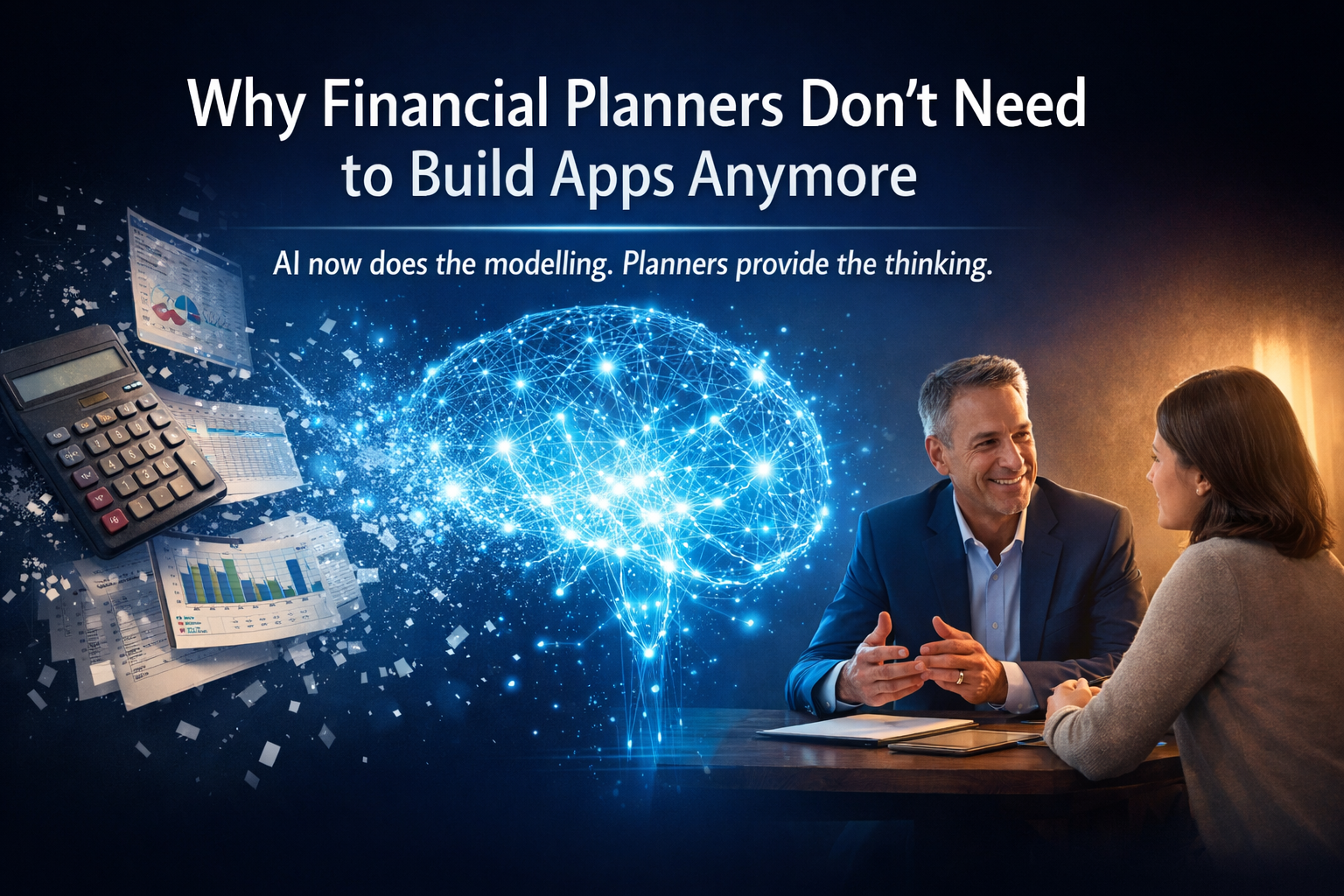
For most of the past thirty years, financial planning technology followed a predictable pattern.
If planners wanted to improve their service, they built software.
Cashflow modelling tools.
Retirement simulators.
Tax planning calculators.
Risk profiling engines.
Every innovation in financial planning seemed to involve building another application.
But that model is quietly becoming obsolete.
Not because technology has disappeared.
But because artificial intelligence has changed where the technology lives.
The Old Model: Software as the Planner’s Tool
Traditional financial planning software was built on a simple assumption:
The adviser owns the model.
Clients provide information.
The software produces calculations.
The adviser interprets the result.
This created an entire industry of planning tools.
But those tools came with constraints:
• They required rigid data formats
• They relied on predefined assumptions
• They were expensive to build and maintain
• They often created dependency on the planner to operate them
In many cases, planners were forced to adapt their thinking to the structure of the software.
The tool began shaping the advice.
The AI Shift: Intelligence Without the App
Artificial intelligence changes this dynamic completely.
Today, AI can already:
• Interpret wage slips
• Read pension statements
• Analyse income and expenditure
• Summarise balance sheets
• Model future financial scenarios
All without needing a dedicated financial planning application.
The intelligence no longer sits inside a piece of software.
It sits inside the AI.
Which means the value of building custom “cashflow apps” has rapidly diminished.
The Realisation Many Planners Are Having
For years, many planners dreamed of building their own software platform.
A custom client portal.
A personalised modelling system.
A proprietary financial planning engine.
But AI has quietly removed the economic justification for doing that.
Why spend years building a calculation engine when AI can already perform those calculations instantly?
The opportunity has moved somewhere else.
The Real Value of the Planner
In the age of AI, the planner’s value is not in operating a model.
It is in framing the thinking.
Clients do not struggle because they lack projections.
They struggle because they lack clarity.
They need help answering questions like:
• What does a meaningful life look like?
• What trade-offs matter most?
• How should they deploy their human capital?
• What risks truly matter?
• What choices will future-proof their wellbeing?
These are not software problems.
They are thinking problems.
And that is where a Total Wealth Planner creates value.
Total Wealth Planning Was Built for This Moment
The Total Wealth Planner model does not depend on software ownership.
It depends on client empowerment.
The planner sits on the client’s side of the table helping them interpret:
• life goals
• financial trade-offs
• human capital decisions
• uncertainty and risk
AI becomes the calculator.
The planner becomes the guide.
A Quiet but Profound Shift
For decades, planners asked:
“Which software should I buy?”
The better question today is:
“How do I use AI to empower the client while focusing my expertise on the decisions that truly matter?”
That shift may sound subtle.
But it fundamentally changes the role of the planner.
From software operator
to strategic thinking partner.
The Future of Planning
The planners who thrive in the coming decade will not be those who build the best apps.
They will be those who build the best conversations.
Because when technology becomes abundant, the rarest resource becomes wisdom.
And that is where real planning begins.
For further details visit, www.academyoflifeplanning.com.
 Academy of Life Planning
Iain’s reflections highlight something important about how clients experience planning tools.
In his own experimentation with AI-generated models, he found that visual sliders and graphics dramatically improved engagement. Clients respond well when they can adjust assumptions and immediately see the effect on outcomes.
He also noted that many clients simply need clarity rather than complexity. In a recent case, a client was “pension confused” and didn’t need a full planning process — just a clear explanation of choices and a simple model to support understanding.
His view is that AI-driven modelling creates a strong educational opportunity: planners can meet clients at different levels. Some may want deeper stochastic modelling and scenario testing, while others benefit from a simpler, stand-alone modelling exercise that helps them grasp their options.
In short, the role of the planner shifts from running the model to guiding understanding — horses for courses depending on the client.