
It isn’t their ISA.
It isn’t their pension.
It isn’t their property.
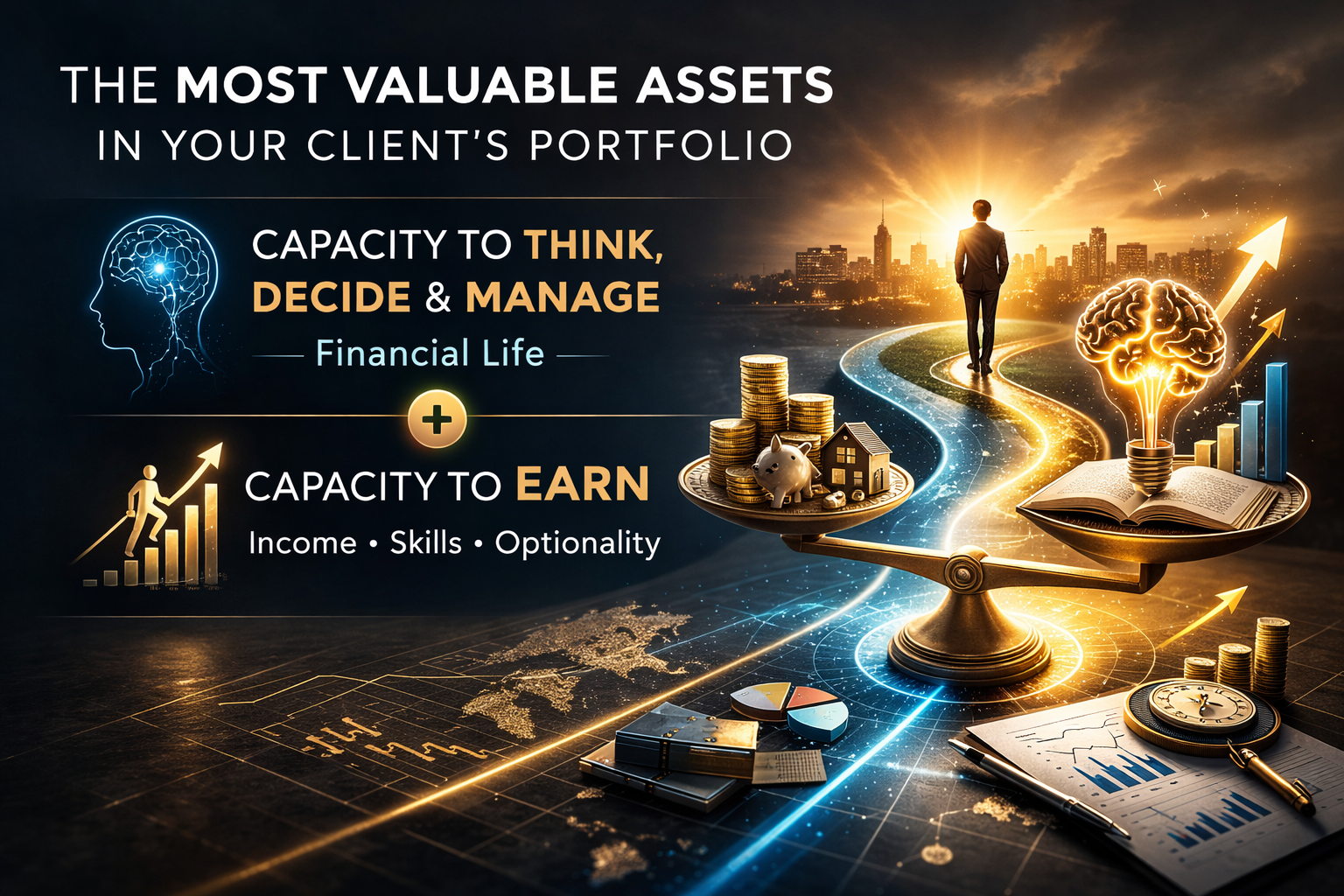
It’s their capacity to think, decide, and manage their own financial life.
And it’s their capacity to earn.
For financial planners who are genuinely curious about client agency, this is where the conversation becomes uncomfortable — and powerful.
Because if we are honest, most of the industry optimises financial capital… while underdeveloping human capital.
Human Capital Has Two Engines
Translated into personal finance, human capital has two core dimensions:
1️⃣ Earnings Capacity
2️⃣ Decision Capability
Most plans model the first as a fixed input.
Almost none intentionally develop the second.
Sources:
Significance of Human Capital for Economic Growth: Economic research has long treated education and skill development as investment — not consumption
Role of Human Capital formation for Economic and Human Development: Human capital formation drives productivity, income and long-term development
Human capital and effective development: More recent work argues we must also account for cultural and moral capital in assessing effective development
Earnings Capacity: The Largest Line Item
Over a lifetime, most people will earn many multiples of what they ever accumulate in savings.
A modest £10,000 annual uplift at age 35 can translate into hundreds of thousands of additional lifetime income. That dwarfs marginal asset allocation tweaks.
Yet how often do we:
- Strategise career glidepaths?
- Discuss sector positioning?
- Explore negotiation literacy?
- Model entrepreneurial optionality?
- Evaluate skill investment decisions?
If income is the engine of wealth, earnings strategy belongs at the top of the curriculum.
Decision Capability: The Compounding Multiplier
Now return to the original point.
If a client improves their:
- Budgeting accuracy
- Decision quality
- Investment understanding
- Risk interpretation
- Tax awareness
- Behavioural discipline
That skillset compounds.
Not just in markets.
In life.
Better decisions reduce frictional losses.
They prevent panic-selling.
They improve tax positioning.
They align money with values.
They increase confidence.
And importantly — they make earnings capacity more effective.
A client who earns more but makes poor decisions leaks capital.
A client who earns well and thinks well compounds advantage.
The Real Opportunity for Planners
The profession is at an inflection point.
AI can now generate first-pass cashflow models in minutes.
Portfolio construction is increasingly commoditised.
Product access is no longer scarce.
What remains premium?
- Interpretation
- Context
- Judgement
- Behavioural calibration
- Human capital development
The planner of the future is not primarily a portfolio allocator.
They are a human capital strategist.
They help clients:
- Increase income intelligently
- Make better financial decisions
- Strengthen behavioural resilience
- Navigate complexity
- Build intergenerational capability
From Dependency to Agency
There is a structural choice embedded in every client relationship:
Do clients become more capable over time —
or more dependent?
A capability-led model does not eliminate advice.
It elevates it.
When we help a client:
- Think clearly about money
- Earn strategically
- Decide wisely
- Understand risk
- Interpret trade-offs
…we are not replacing ourselves.
We are building stronger clients.
And stronger clients:
- Stay longer
- Refer more
- Panic less
- Value thinking over transactions
A Unified Human Capital Framework
If we are designing financial capability programmes — whether for retail clients or professional planners — both dimensions must be explicit:
1️⃣ Earnings Capacity
- Skills and credential investment
- Career positioning
- Income diversification
- Entrepreneurial strategy
- Negotiation capability
2️⃣ Financial Cognition
- Budgeting literacy
- Tax awareness
- Investment fluency
- Risk understanding
- Behavioural discipline
Together, they form the real balance sheet.
Financial capital is downstream.
The Provocative Question
If AI can model the numbers,
and passive funds can deliver market returns,
what exactly remains premium in financial planning?
Perhaps it is this:
Helping clients become economically stronger,
not just financially invested.
Helping them build wealth from the inside out.
The most undervalued assets in your client’s portfolio walk into the meeting every day.
Are we planning around them?
Curious how other planners balance earnings strategy with client capability development in their work.
 Academy of Life Planning