
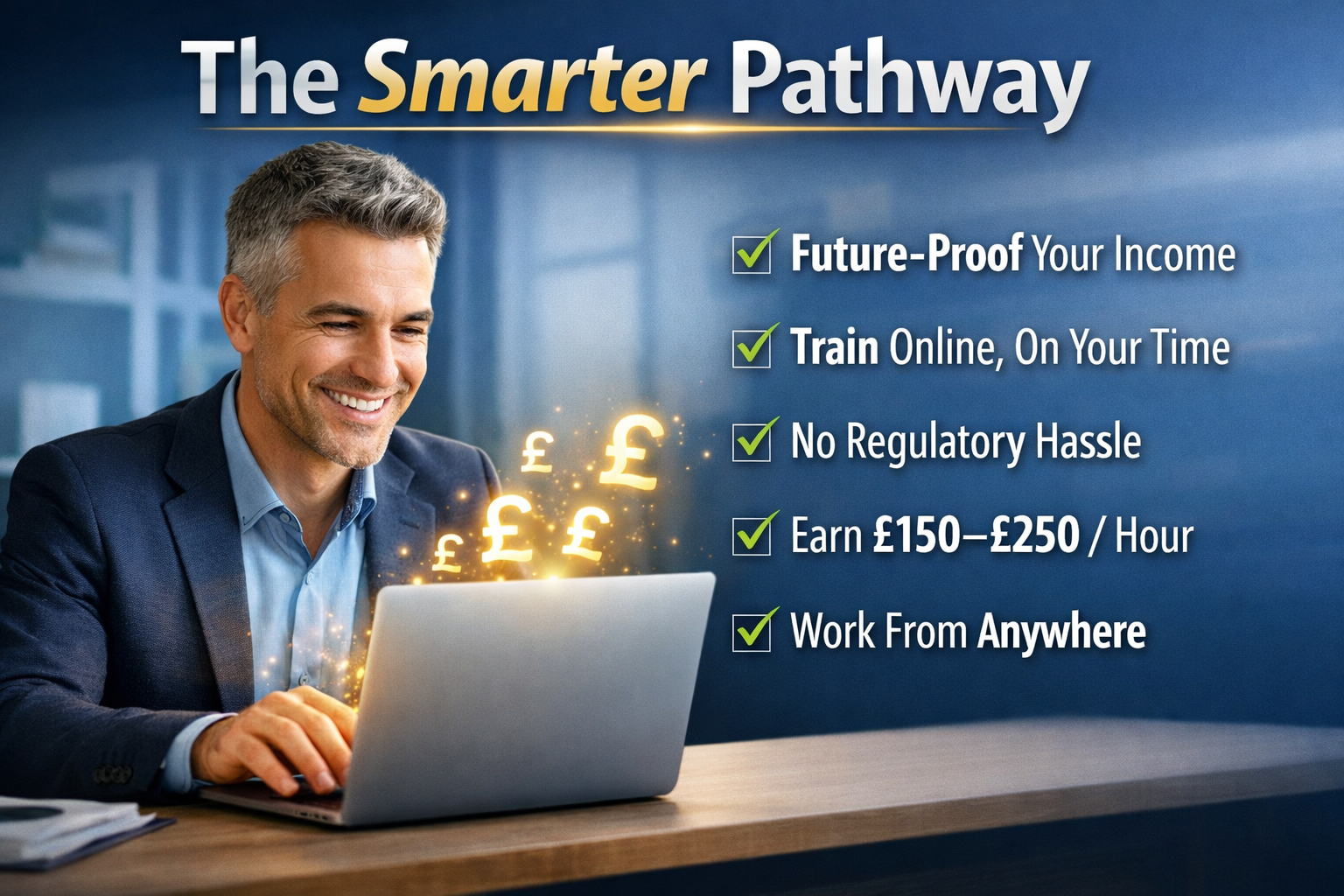
The financial profession is changing faster than at any point in its history.
Technology is accelerating.
Regulation is tightening.
Margins are compressing.
Clients are questioning value.
And beneath all of that sits a deeper truth:
The model that built yesterday’s careers will not build tomorrow’s security.
For many professionals, the instinctive response is to consider a full career shift. But that feels risky, disruptive, and time-intensive. Most don’t want to walk away from what they’ve built — they want a way to expand it.
That’s exactly where a smarter pathway exists.
A Different Kind of Opportunity
Imagine adding a second professional capability alongside your current role:
- No regulatory complexity
- No infrastructure build
- No need to quit your job
- No need to replace existing income
- No sales pressure
- No client chasing
Just a structured, professional, future-resilient skillset you can deploy immediately.
That is the premise behind becoming a Total Wealth Planner through the Academy of Life Planning.
Not a replacement career.
A parallel one.
Why a Side Path Is Now the Smartest Strategy
Most financial professionals are sensing three simultaneous shifts:
- Advice is becoming automated
- Compliance is becoming heavier
- Clients are becoming more self-directed
These forces don’t eliminate professionals.
They change what professionals are valuable for.
The future belongs to practitioners who can help people:
- think clearly
- make decisions
- structure their lives
- align money with meaning
Not just manage portfolios.
The Gap Most Professionals Don’t See
Traditional qualifications teach you how to manage financial capital.
They rarely teach you how to develop human capital — which is where most wealth actually originates.
Clients don’t primarily struggle with investments.
They struggle with:
- direction
- clarity
- prioritisation
- confidence
- life transitions
That is where demand is rising fastest.
And it’s where very few professionals are trained.
The Side-Hustle Model That Solves This
Here’s the model:
9 out of 10 people complete their Total Wealth Plan themselves.
1 out of 10 want support when life becomes complex.
Those clients book you for hourly guidance.
That means:
- no ongoing servicing burden
- no assets required
- no portfolio minimums
- no product dependency
Just paid expertise when it’s genuinely needed.
What You Actually Get
With a one-time £395 enrolment you receive:
- 12-month access to the training and accreditation programme
- self-paced online learning
- work-from-anywhere flexibility
- professional designation pathway
- practical frameworks you can use immediately
Optional membership (£24/month) adds:
- unlimited Q&A support
- extensive on-demand training library
- peer community access
- ongoing professional development
Income Reality (Not Hype)
Typical hourly Total Wealth Planning fees range:
£150–£250 per hour
That means:
- 2 hours of work can recover your initial investment
- Everything after that is margin
- No overhead structure required
This is not theory.
It is a professional service model already being used globally.
Why This Works So Fast
Most new professional ventures fail because they require:
- brand building
- marketing spend
- complex setup
- regulatory permissions
- long trust cycles
This pathway avoids all of that.
You can start by simply sharing the free Total Wealth Plan with people you already know.
Friends.
Family.
Colleagues.
Existing contacts.
No selling required.
You’re not persuading anyone to buy.
You’re offering them something genuinely useful at no cost.
The people who need help will naturally ask.
Who This Is Designed For
This pathway works best for people who already have transferable skills such as:
- financial advisers
- planners
- coaches
- accountants
- consultants
- educators
- analysts
- strategists
If you already help people think, decide, or plan — you are starting ahead.
Why It Sits Outside the Regulatory Burden
Traditional financial services sit within strict regulatory frameworks such as those overseen by the Financial Conduct Authority.
Total Wealth Planning operates in a different domain.
It focuses on:
- decision frameworks
- life architecture
- planning strategy
- behavioural insight
- structured thinking
Not product advice.
That distinction matters.
It means you can operate cleanly without entering regulatory complexity — while still delivering genuine professional value.
A Quiet Advantage Most Haven’t Noticed Yet
The profession is moving toward a split:
| Traditional Role | Emerging Role |
|---|---|
| Product specialist | Decision architect |
| Portfolio manager | Life planner |
| Compliance operator | Strategic guide |
Those who add the second column alongside the first will be the most resilient professionals in the next decade.
Why This Is a Low-Risk Move
This is not a leap.
It’s an addition.
You can:
- learn in your own time
- test with people you trust
- apply gradually
- earn immediately
There is no requirement to change careers.
Only the option to expand one.
The Strategic Question
The real question isn’t:
“Should I change what I do?”
It’s:
“Should I add a capability that protects my future?”
Because the safest professionals tomorrow won’t be those who stayed the same.
They’ll be those who adapted early.
The Simplest Way to Try It
Start with the same step your future clients take.
Complete a Total Wealth Plan yourself.
Experience the process.
See what it reveals.
If it resonates, you’ll instantly understand why others would value it too.
Professional resilience rarely comes from sudden change.
It comes from quiet expansion.
This is one of those expansions.
And it can start today.
Book a Free 15-Minute Clarity Call
If you’re curious whether becoming a Total Wealth Planner side-hustler is right for you, the simplest next step is a short conversation.
In this call, we’ll:
- understand your current role and goals
- assess whether this pathway fits your skills and ambitions
- explain how the model works in practice
- answer any questions you have
There’s no pressure and no expectation.
If it’s not right for you, we’ll tell you.
This is about clarity, not persuasion.
 Academy of Life Planning