
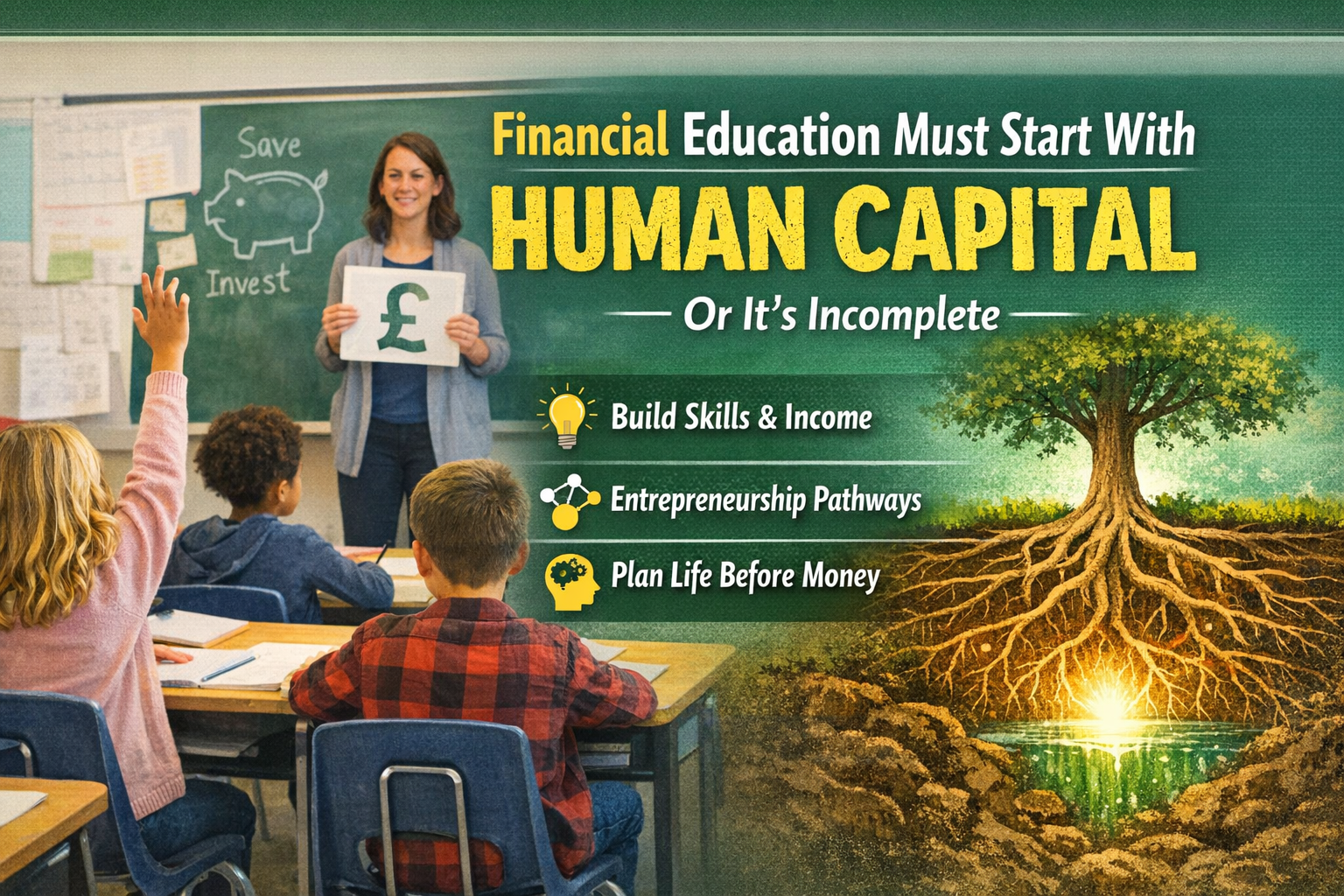
Only 1 in 10 adults in the UK are financially secure.
We can debate the statistics.
We cannot debate the direction of travel.
For decades, financial education has focused on managing money.
But money is not the starting point.
People are.
The Missing Asset in Financial Education
Most financial education programmes teach:
- Budgeting
- Saving
- Investing
- Pensions
- Debt management
- Tax efficiency
All important.
But something foundational is often absent:
Human capital.
Your skills.
Your earning capacity.
Your adaptability.
Your networks.
Your reputation.
Your capacity to generate value.
Human capital is the underground spring that feeds the financial reservoir.
Without it, there is nothing to manage.
Money Is a Reservoir. Human Capital Is the Spring.
We often teach people how to protect and allocate savings.
But if income is fragile…
If earning power is stagnant…
If career strategy is absent…
If entrepreneurial pathways are never explored…
Then we are managing dry wells.
No amount of optimisation can compensate for a weak income engine.
And yet, very little mainstream financial education asks:
- How do you increase your income over a lifetime?
- How do you design multiple income streams?
- How do you monetise emerging skills?
- How do you build resilience against automation?
- How do you future-proof your earning capacity?
In the age of AI, these are not optional questions.
They are existential ones.
Why Human Capital Is Often Overlooked
There is a structural reason.
Traditional financial systems are built around:
- Asset management
- Product distribution
- Intermediation
Human capital development does not sit neatly within product frameworks.
It cannot be wrapped.
It cannot be sold in a fund.
It cannot be platformed in a pension.
So it is sidelined.
But sidelining it does not make it less important.
It makes education incomplete.
Financial Education Should Teach Wealth Creation — Not Just Wealth Allocation
True financial education should include:
- Income architecture design
- Portfolio careers
- Entrepreneurial literacy
- Skills compounding
- Network capital
- Reputation management
- AI leverage for productivity
- Negotiation and value positioning
In other words:
How to build the spring.
Only then does saving, investing, and pension planning make strategic sense.
Without human capital literacy, financial education becomes risk management for a system people do not fully understand.
With it, financial education becomes empowerment.
Planning Life Before Planning Money
At the Academy of Life Planning, we teach:
Plan your life first.
Then design the financial architecture to support it.
That means asking:
- What future are you building?
- What work aligns with your values?
- What income model supports that future?
- What skills must be developed?
- What risks must be mitigated?
Money becomes the servant.
Not the master.
The Age of AI Changes Everything
AI is accelerating change in:
- Employment models
- Productivity
- Wealth creation
- Financial analysis
- Access to planning tools
If financial education does not include:
- AI literacy
- Self-directed planning capability
- Critical understanding of institutions
Then we are preparing young people for a world that no longer exists.
Human capital is no longer just education at 18.
It is lifelong skill evolution.
Financial Education Must Be Product-Neutral
To be complete, financial education must:
- Teach how institutions make money
- Teach when advice is useful — and when it isn’t
- Teach how to design self-directed plans
- Teach how to build income before allocating surplus
Anything less risks dependency.
And dependency is not empowerment.
What Complete Financial Education Looks Like
Complete financial education:
- Begins with identity and purpose
- Builds human capital strategy
- Designs income architecture
- Introduces risk management
- Then allocates financial capital
In that order.
Reverse the order, and people spend decades optimising scarcity.
Get the order right, and wealth becomes a by-product of capability.
The Opportunity Ahead
If the UK is serious about financial capability, we must widen the lens.
Managing money is important.
But building earning power is transformational.
Human capital is the first asset.
Financial capital is the second.
When education recognises that hierarchy, we move from financial survival to financial sovereignty.
And that changes everything.
If you are an educator, adviser, or policymaker who believes financial education must evolve beyond budgeting and wrappers, the Academy of Life Planning is building an open, product-free framework for Total Wealth Planning.
Because managing reservoirs is not enough.
We must teach people how to build springs.
 Academy of Life Planning