
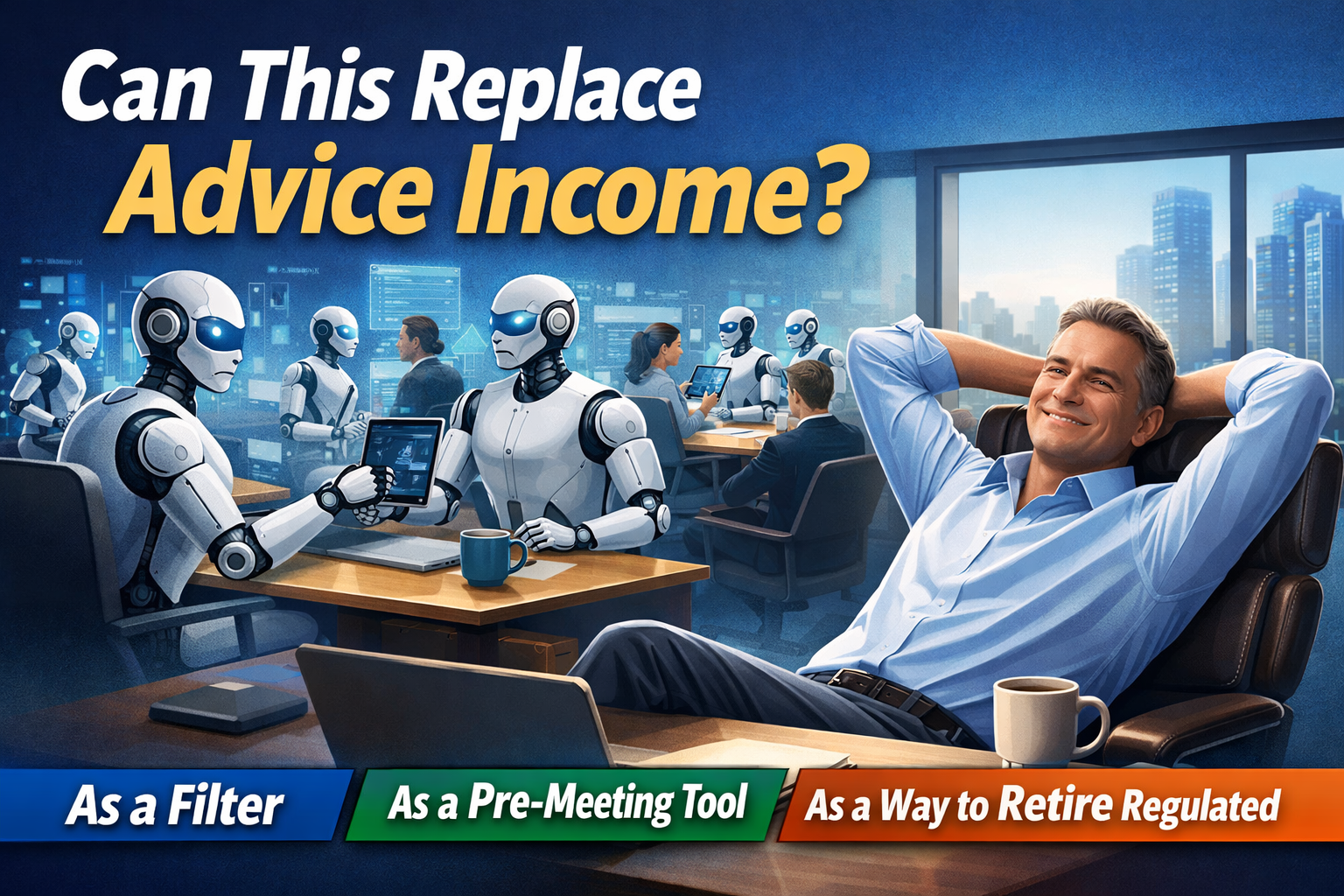
A practical answer for advisers thinking about what comes next
For many regulated advisers, the desire to step away from regulation isn’t ideological.
It’s practical.
- Rising compliance burden
- Shrinking emotional bandwidth
- Clients who need thinking space, not products
- And a quiet question that won’t go away:
“There must be a better way to do this.”
Yet one concern stops most advisers from crossing the bridge:
“Even if I leave regulation… can I actually make money?”
That’s the right question.
And it deserves a grounded answer.
The hidden inefficiency in the advice model
Here’s an uncomfortable truth most advisers recognise instinctively:
Most people don’t actually need ongoing advice most of the time.
What they need is:
- clarity
- structure
- reassurance
- somewhere safe to think
In reality:
- Around 9 in 10 people can manage their own finances when they are calm, informed, and supported with good tools
- Around 1 in 10 hit moments of complexity, anxiety, or change where human judgement genuinely matters
The problem is that the traditional advice model treats everyone as if they are permanently in the 1 in 10.
That’s inefficient.
And exhausting.
What happens when people do the thinking first?
The Total Wealth Plan was built to sit before advice.
It’s:
- self-directed
- AI-supported
- product-free
- outside regulation
There is no selling.
No optimisation theatre.
No compliance wrapper.
Advisers simply give it to people for free.
What happens next is revealing:
- Most people complete it, gain clarity, and carry on independently
- Some come back saying:
“This surfaced something I can’t quite hold on my own.”
Those are not cold prospects.
They are:
- calmer
- clearer
- better prepared
- emotionally regulated
- already invested in the process
In other words: ideal clients.
The leverage shift advisers don’t expect
This is where the commercial picture changes.
By letting people self-serve first:
- You stop spending time on unsuitable discovery meetings
- You reserve your energy for moments where you add real value
- You shift from volume-based effort to judgement-based work
In practice, advisers using this approach find they can:
- Serve up to ten times the client base
- With the same man-hours
- Without chasing, convincing, or selling
You are no longer paid for access to products or reports.
You are paid for sense-making, interpretation, and human support when it actually matters.
That is the natural role of a Total Wealth Planner.
“But can this really replace advice income?”
The honest answer is not theoretical.
It’s empirical.
Some advisers use the Total Wealth Plan:
- purely as a filter
- as a pre-meeting tool
- or as a way to remain useful after stepping back from regulation
Others discover it becomes the front door to a new practice:
- fewer clients
- deeper work
- cleaner boundaries
- lower cognitive load
The only way to know which it is for you is simple.
Try it. On yourself first.
Before theory, positioning, or business models:
- Use it yourself
- Notice what it surfaces
- Give it to a handful of people who already trust you
Then watch:
- who needs nothing further
- who comes back asking for help
- and how different those conversations feel
There is no cost.
No obligation.
No commercial hook.
Just a chance to test whether a post-regulation economics might actually work in practice.
👉 Free Total Wealth Plan registration:
https://www.kulahub.net/forms/webform/11710?cl=822
A quiet closing thought
Leaving regulation doesn’t mean leaving usefulness.
It doesn’t mean abandoning income.
And it doesn’t mean retreating from professionalism.
For some, it simply means moving upstream —
from selling answers
to supporting people as they find their own.
That shift isn’t for everyone.
But for those approaching the bridge,
it may finally make both human and commercial sense.
—
Steve Conley
Founder, Academy of Life Planning
 Academy of Life Planning