
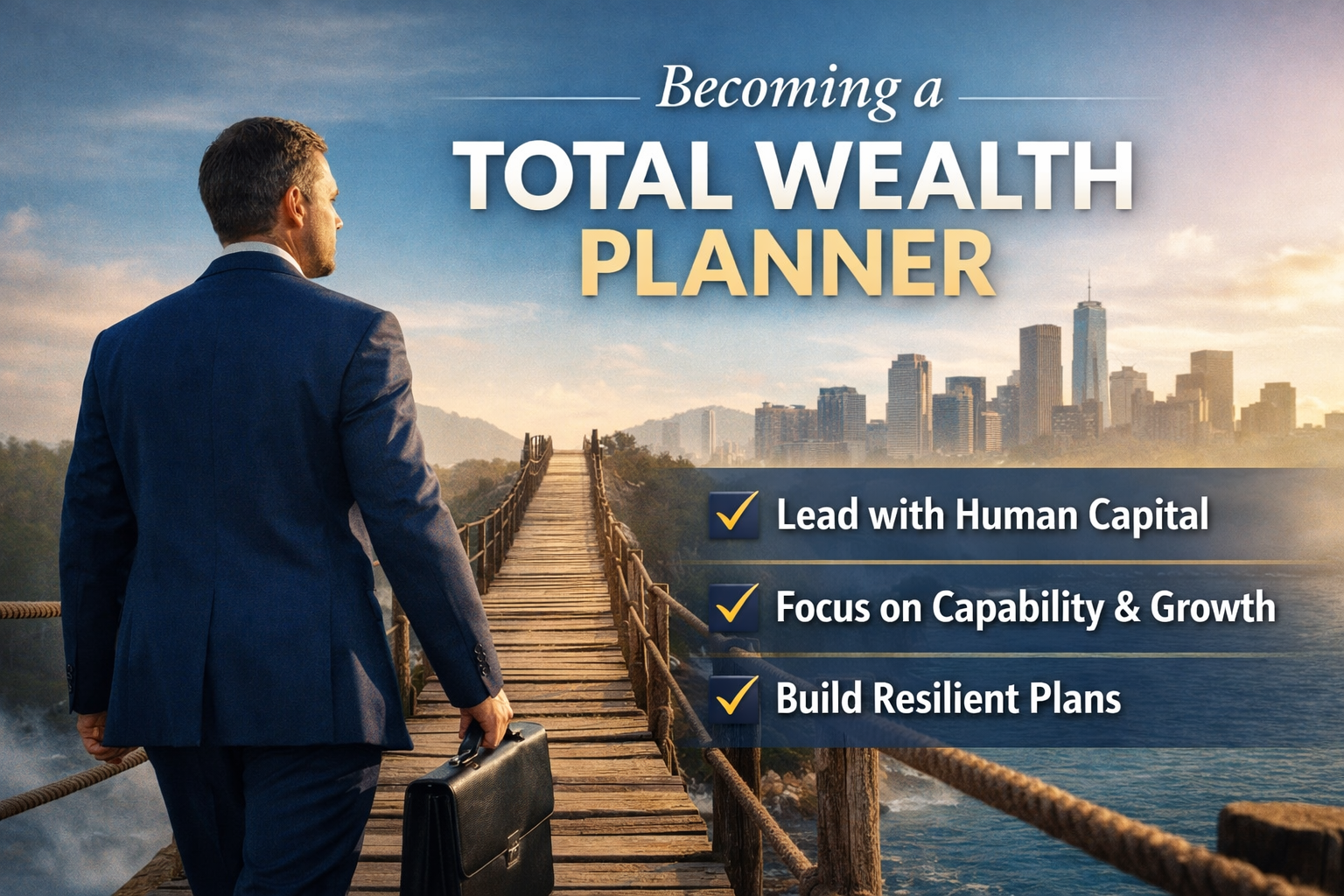
Most financial planners were trained to focus on capital.
Portfolios. Products. Structures. Optimisation.
But a lesser-discussed body of economic research points to a deeper truth:
Wealth is ultimately created by people, not by products.
A classic (but still relevant) study on the significance of human capital for economic growth makes this explicit: physical and financial capital are passive. Human capital is active.
It is people’s skills, judgement, adaptability, health, and motivation that generate sustainable value.
For planners standing near the bridge between traditional advice and Total Wealth Planning, this research carries some important professional lessons.
1. Assets Don’t Create Outcomes — People Do
The study is unambiguous:
capital on its own does nothing.
It only becomes productive when guided by:
- decision-making capability
- clarity of purpose
- learned skill
- and human effort
For planners, this raises a quiet but profound question:
Are we primarily managing money —
or enabling people to use money well?
Total Wealth Planning doesn’t discard financial expertise.
It re-anchors it in the human being it is meant to serve.
2. Capability Outperforms Information
The research distinguishes between:
- quantitative inputs (more resources, more complexity), and
- qualitative capability (better judgement, better application).
Returns come from the latter.
This mirrors what many planners now see in practice:
clients are rarely short of information —
they are short of clarity, confidence, and agency.
That subtly reframes the planner’s role:
from technical explainer
to educator, guide, and decision-making ally.
3. Foundational Work Delivers the Highest Return
One of the study’s most striking findings is that returns on foundational human investment are often higher than returns on advanced complexity.
In simple terms:
getting the basics right matters more than adding layers.
For planners, this validates a life-first sequence:
- goals before products
- purpose before projections
- behaviour before optimisation
These aren’t “soft extras”.
They are often the highest-impact interventions available.
4. Human Capital Becomes Critical When Systems Are Fragile
The research shows that human capital delivers particularly strong returns in environments marked by:
- uncertainty
- institutional fragility
- or rapid change
That should feel familiar.
Between regulatory shifts, demographic change, AI disruption, and declining trust, many planners sense that traditional models feel increasingly brittle.
A practice anchored in client capability, not just system optimisation, is naturally more resilient.
5. Planning Without Human Development Is Incomplete
The study closes with a warning:
economic planning that neglects human development eventually fails — regardless of technical sophistication.
For the profession, that lands gently but clearly:
Cash-flow models, tax structures, and portfolios remain valuable.
But on their own, they are no longer enough.
They belong inside a broader framework that integrates:
- human capital
- life design
- and financial architecture as one system.
Standing at the Bridge
Many planners are not looking to abandon their profession.
They are looking to evolve it.
Total Wealth Planning isn’t a rejection of financial planning.
It is its next, more complete expression — aligning professional skill with how wealth is actually created and sustained in the real world.
For those quietly exploring what that evolution could look like, there are structured, professional pathways available through the
Academy of Life Planning.
No pressure.
No product agenda.
Just space to explore whether this next chapter fits your values, your clients, and your future.
 Academy of Life Planning