
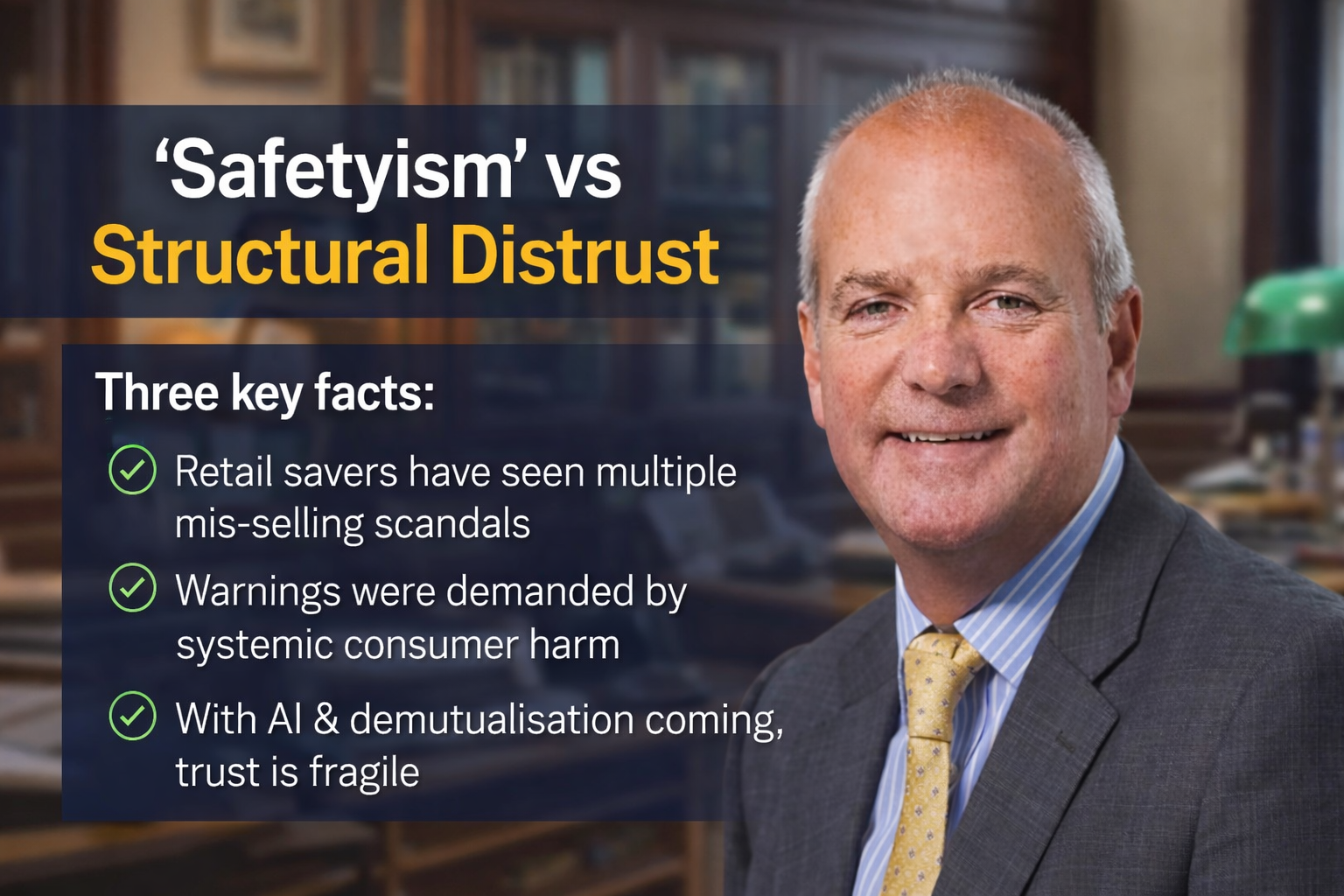
An Academy of Life Planning perspective on deregulation, retail investing, and what citizen investigators and future Total Wealth Planners need to understand now.
Executive Summary
The Investment Association’s call to defeat UK “safetyism” frames post‑crisis consumer protections as an obstacle to growth. But this diagnosis misses the real issue.
People aren’t irrationally risk‑averse. They are rationally distrustful.
After two decades of pension scams, mis‑selling, opaque charges, platform failures, regulatory drift, and weak redress, ordinary savers have learned a simple rule:
If I don’t understand it, can’t control it, and nobody is accountable when it goes wrong — don’t touch it.
That isn’t safetyism. That’s earned scepticism.
Deregulating risk warnings, expanding retail access to private markets, and running state‑backed campaigns to push people out of cash without rebuilding agency will not create prosperity.
It will manufacture the next generation of victims.
1. The Misdiagnosis: “Safetyism” vs Structural Distrust
The narrative that regulation has “protected people out of capital markets” implies that:
- People are overly cautious
- Warnings are the primary barrier to participation
- The solution is friction reduction
From a Total Wealth Planning lens, this is backward.
Participation is not falling because warnings exist.
It’s falling because trust has collapsed.
People don’t avoid markets because they are timid.
They avoid markets because:
- They’ve seen relatives lose pensions in scams
- They’ve watched advisers disclaim responsibility
- They’ve experienced platforms freeze or fail
- They’ve tried to complain and hit procedural walls
- They’ve learned redress is slow, uncertain, and exhausting
The absence of trust is the binding constraint — not the presence of warnings.
2. The Retail Investment Campaign: A Structural Conflict
A Treasury + FCA + Investment Association‑backed campaign to “get seven million adults out of cash and into markets” sounds benevolent.
Structurally, it is deeply conflicted.
a) It inverts the natural planning sequence
It pushes Execution before Goals and Means — the exact reversal our GAME Plan was designed to correct.
There is no requirement for:
- life‑goal clarity
- income resilience
- debt fragility assessment
- job security modelling
- trauma or cognitive load awareness
- financial literacy baselines
The message is simply:
You’re holding too much cash. You should be investing.
That’s extractive logic.
Not empowerment logic.
b) It externalises risk while weakening accountability
The industry wants:
- lighter warnings
- smoother onboarding
- broader retail flows
- access to private markets
- tokenised assets
- digital distribution
But it is not simultaneously offering:
- stronger redress rights
- faster ombuds processes
- fiduciary duty upgrades
- clear liability chains
- mandatory evidence‑based suitability
- consumer‑side AI literacy tools
That asymmetry guarantees future harm.
From a Get SAFE safeguarding perspective, this is a victim‑manufacturing policy.
3. “Democratising Private Markets”: A Familiar Red Flag
One of the most concerning phrases in the current deregulation narrative is:
“There’s a great shift to democratise private markets.”
This exact language preceded:
- Mini‑bond scandals
- Woodford’s liquidity mismatch
- LCF
- Connaught
- Blackmore
- QROPS feeder funds
- Esoteric EIS abuse
The pattern is consistent:
- Illiquidity risk is reframed as “long‑term”
- Valuation opacity is reframed as “patient capital”
- Gate risk is normalised
- Retail investors become exit liquidity
- Complexity is disguised as innovation
From a citizen‑investigator pattern‑recognition lens:
This is Phase 1 of the next mis‑selling cycle.
4. Tokenisation + Digital Assets + Deregulation = Risk Amplification
The industry is directionally right that finance is becoming digital.
It is institutionally unprepared for what that implies.
You cannot simultaneously:
- accelerate digital asset complexity
- weaken consumer warnings
- broaden retail participation
- expand private‑market exposure
- and maintain safeguarding integrity
…without:
- consumer‑side AI planning tools
- real‑time suitability diagnostics
- evidence‑logging of advice journeys
- audit‑grade explainability layers
- independent, non‑product‑led planners
Without those layers, the outcome is predictable:
Faster distribution of harder‑to‑understand products
to more vulnerable people
with weaker redress when it goes wrong.
That is not competitiveness.
That is systemic risk outsourcing.
5. The Real Reputation Problem Isn’t Politics — It’s Governance
The UK worries that international investors still associate it with:
- political instability
- Brexit uncertainty
- regulatory wobble
But the deeper reputational damage comes from:
- FCA enforcement weakness
- FOS delays and fee barriers
- chronic redress failures
- tolerance of grey‑market distribution
- revolving doors between trade bodies and regulators
From the outside, the signal is not:
This is a pro‑growth jurisdiction.
It is:
This is a jurisdiction that talks tough,
regulates late,
and struggles to clean up after damage is done.
Deregulating warnings while victims wait years for justice worsens that perception.
6. What a Planning‑First Capital Market Would Look Like
If the genuine goal is healthy market participation, the sequence must change.
a) Shift from product access to planning access
Before pushing anyone into markets:
- Give them a free, AI‑guided Total Wealth Plan
- Let them model downside scenarios
- Let them explore emotional sidetracks privately
- Let them stress‑test job loss, illness, and family shocks
- Let them see cash vs investing trade‑offs in context
That is empowerment.
Not nudging.
b) Replace blanket deregulation with intelligent warnings
Not fewer warnings.
Smarter warnings:
- personalised risk overlays
- dynamic suitability alerts
- lifecycle‑based volatility framing
- liquidity lock‑up simulations
- behavioural‑bias prompts
- regret‑minimisation modelling
This is where AI belongs — on the citizen side, not just the product side.
c) Separate capital formation from consumer exploitation
If the UK wants more growth capital:
- channel retail money into transparent public equity first
- not illiquid private structures
- not complexity‑as‑yield products
Private markets should remain:
- opt‑in
- suitability‑gated
- planning‑anchored
- with explicit redress escalation rights
7. What Citizen Investigators Must Watch For
For those engaged in self‑protection and post‑harm recovery, this deregulation wave creates predictable new risk patterns.
Watch for:
- Downplayed liquidity restrictions
- Reframed risk language (“patient capital”, “long‑term smoothing”)
- Hybrid retail/private fund structures
- AI‑powered onboarding with reduced human review
- Platform disclaimers expanding while warnings shrink
- Advisory firms quietly shifting liability onto clients
If you see these patterns emerging, document them early.
The mis‑selling cycle always starts with narrative shifts, not paperwork failures.
8. What Prospective Total Wealth Planners Must Understand
If you are building a future‑fit planning practice, this moment is a structural fork in the road.
You can either:
- become a high‑volume product conduit in a deregulated system
or
- become a sovereignty‑anchored Total Wealth Planner who:
- restores agency
- structures decisions before products
- documents suitability
- models downside risk
- protects client dignity
- and remains independent of sales pressure
The second path is harder.
It is also the only ethically durable one.
9. The Academy Position
From an Academy of Life Planning perspective:
- The diagnosis (“safetyism”) is shallow
- The remedy (deregulation + campaigns) is misaligned
- The sequencing (invest first, plan later) is backward
- The risk externalisation is escalating
- The safeguarding infrastructure is lagging
- The trust deficit is being ignored
This is not a pro‑consumer pivot.
It is a distribution‑first reset dressed up as democratisation.
10. A Better Way Forward
The future of UK investing does not lie in fewer warnings.
It lies in:
- planning‑first architecture
- AI‑enabled citizen tools
- documented suitability
- stronger redress rights
- trauma‑informed financial design
- and a new professional class of Total Wealth Planners
The choice is simple:
Build sovereign citizens first.
Or build the next generation of victims.
About the Academy of Life Planning
The Academy of Life Planning is building a new generation of planners and citizen tools designed to restore agency, transparency, and dignity to financial life.
We believe:
- Life should be planned before money
- Technology should empower citizens, not just institutions
- Trust must be structurally designed — not marketed
If you want to explore Total Wealth Planning or join our practitioner pathway, you’re welcome to start that conversation.
 Academy of Life Planning