

At the start of a new year, many professionals find themselves asking quiet but persistent questions.
Not “Am I successful?”
But “Is this still right for me?”
Often, nothing dramatic has gone wrong. Performance is solid. Income is acceptable. Reputation is intact. Yet something feels misaligned — not emotionally fragile, but structurally unresolved.
This is where Ikigai is often introduced.
Used properly, Ikigai is not about motivation or inspiration. It is a practical framework for evaluating whether a career is coherent, sustainable, and fit for the life you want to build.
And that distinction matters.
What Ikigai actually is (and what it isn’t)
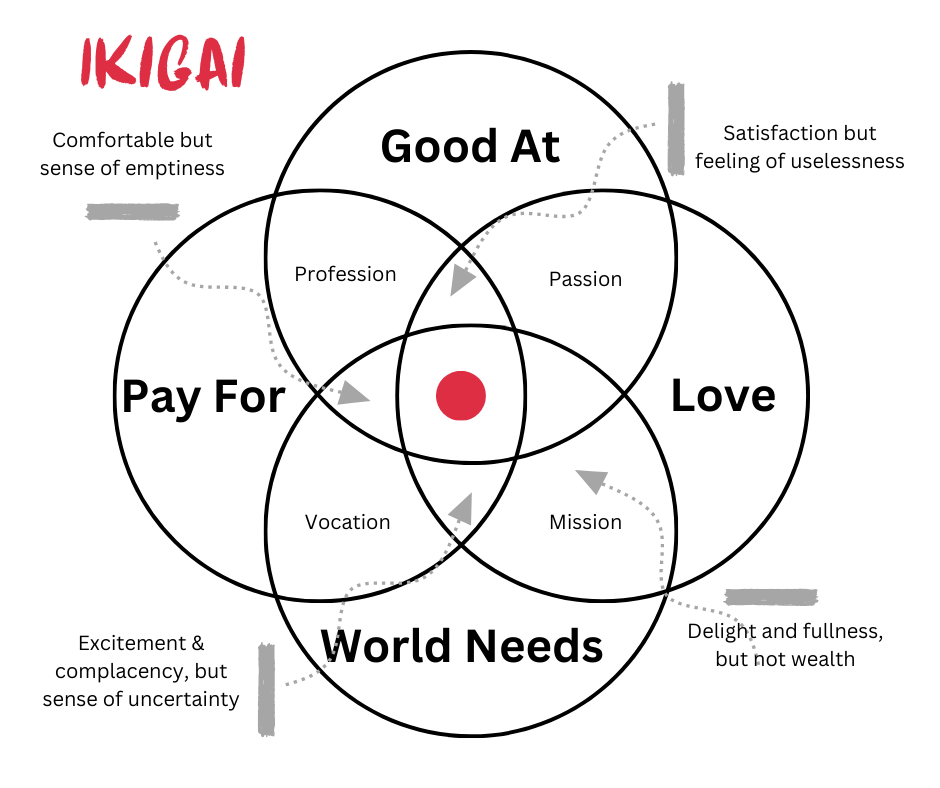
Ikigai is commonly summarised as the intersection of four questions:
- What am I good at?
- What do I enjoy?
- What does the world need?
- What can I be paid for?
These questions are useful — but only if they are treated as design constraints, not emotional prompts.
Ikigai is not about:
- Loving every day of your job
- Finding a perfect role
- Chasing meaning without examining structure
Used superficially, it becomes a narrative about how work feels.
Used rigorously, it becomes a test of how work functions.
The missing question: does the structure support the purpose?
Most career conversations stop at role fit.
Ikigai asks for something deeper: system fit.
Two roles can look identical on paper — same title, same income, same client impact — yet deliver very different long-term outcomes depending on:
- Who controls the client relationship
- Who owns the plan, data, and intellectual capital
- How advice or expertise is constrained
- How success is defined under pressure
- What happens when values and incentives diverge
Ikigai without this analysis risks becoming emotional alignment inside a misaligned structure.
That’s where many professionals later experience friction — not because they chose badly, but because they were never encouraged to examine the system they were entering.
Career fulfilment is not just personal — it is architectural
True fulfilment is not something you feel into and hope survives.
It is something you design for.
A career that supports long-term wellbeing typically allows you to:
- Apply your strengths without distortion
- Serve real human needs without conflict
- Be fairly rewarded without dependency
- Adapt as your priorities change
- Retain agency over how your work evolves
Ikigai helps surface these requirements — but only if the conversation includes how the career is built, not just what it promises.
Career change doesn’t mean starting again — it means re-architecting
Many professionals considering change worry they are “walking away” from experience.
In reality, most career transitions fail not because skills don’t transfer — but because the same structural constraints are recreated in a new setting.
Ikigai reminds us that direction is not fixed.
But it also asks whether the container you place your skills into allows growth, autonomy, and resilience over time.
That’s the difference between redirection and reinvention.
Using Ikigai well: a practical approach
If you are using Ikigai to reflect on your next step, consider adding one final lens:
Does this path increase or reduce my long-term agency?
Ask not only:
- Can I do meaningful work here?
But also:
- Who decides how that work is done?
- Who benefits when conditions change?
- What freedoms do I gain — and what do I give up?
When Ikigai is used this way, it becomes a tool for clarity, not persuasion.
A quieter, more durable definition of success
Success is not just alignment today.
It is coherence over time.
A fulfilling career is one where:
- Purpose is clear
- Skills are respected
- Impact is real
- Reward is fair
- And the structure supports all four — even under strain
That is the conversation worth having at the start of a new year.
Not “What should I do next?”
But “What kind of system do I want to build my work within?”
That’s where Ikigai does its real work.
At the Academy of Life Planning, we work with professionals who want to explore these questions carefully — without pressure, without ideology, and without assuming there is only one right path.
Because purpose isn’t found by changing roles alone.
It’s sustained by choosing structures that let it endure.
 Academy of Life Planning