
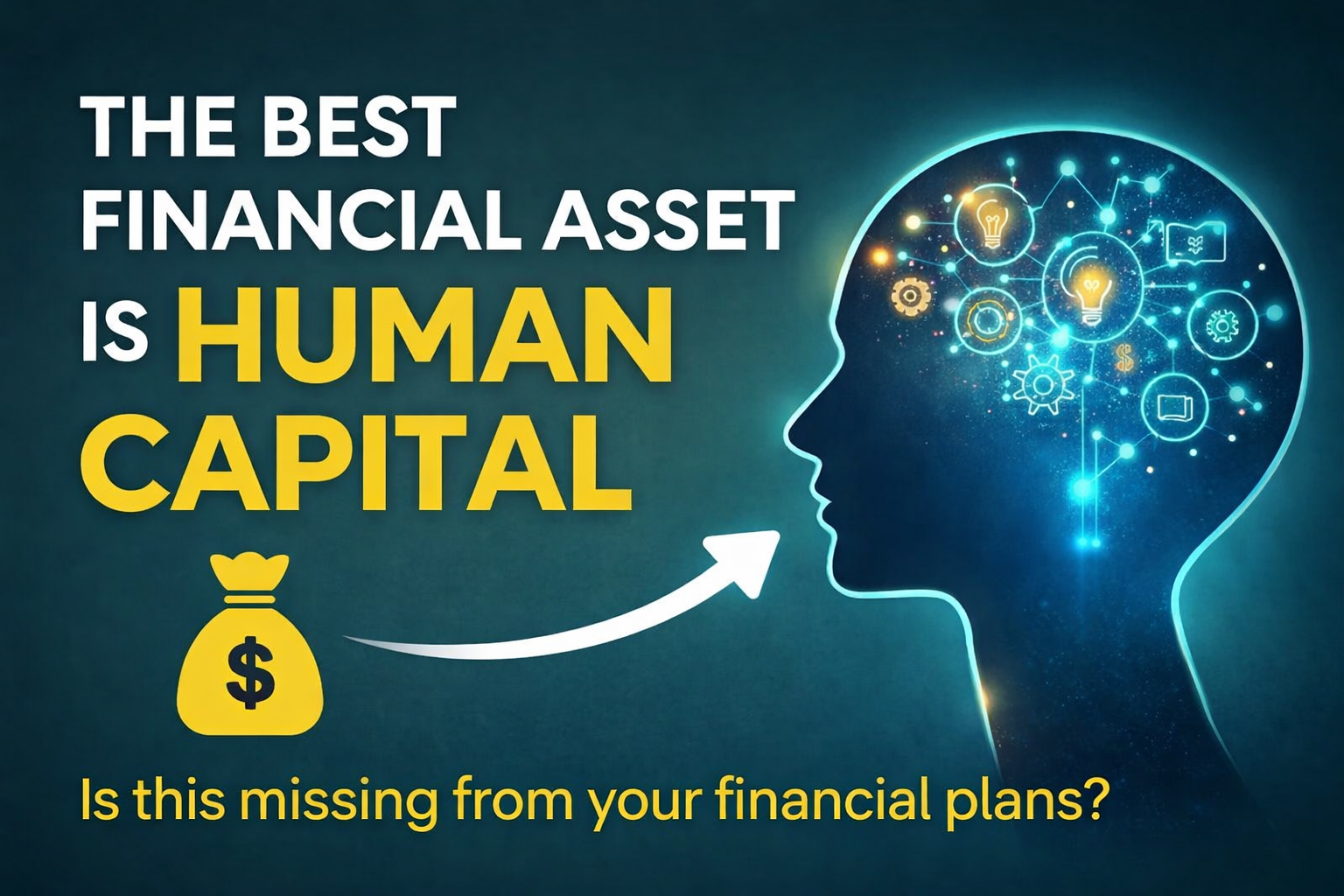
For decades, financial planning has treated people as inputs to portfolios rather than the primary source of value itself.
This study on The Impact of Stimulating the Development of Human Capital on Economic Development quietly dismantles that error—and in doing so, reinforces why Total Wealth Planning must start with people, not products.
While written from a macro-economic perspective, the implications for planners working with individuals, families, and communities are profound.
Below are the key lessons Total Wealth Planners should take from this research—and how to apply them in practice.
1. Human Capital Is Not a “Soft” Concept — It Is the Dominant Asset Class
The study confirms what many planners intuitively know but rarely operationalise:
- Over 60% of long-term economic growth is attributable to human capital, not financial or physical capital.
- Education, health, skills, creativity, and adaptability consistently outperform traditional capital investment over time.
Planning implication
Total Wealth Planners must stop treating human capital as an appendix to a financial plan.
Human capital is the growth engine. Financial capital is the by-product.
This means:
- Life plans should precede financial projections
- Career, capability, energy, and learning pathways deserve the same rigour as investment modelling
- “Return on effort” matters as much as return on capital
2. Education Is Necessary — But Not Sufficient
The study is clear that formal education alone does not explain outcomes. Countries (and people) with similar years of schooling diverge sharply in productivity and wellbeing.
What matters is:
- Quality of learning
- Relevance to real economic activity
- Ability to adapt skills over time
The research highlights a recurring gap between years of education and usable capability.
Planning implication
Total Wealth Planners must move beyond qualifications and ask better questions:
- What can you actually do with what you know?
- Where is your knowledge becoming obsolete?
- What skills convert most efficiently into income, autonomy, or optionality?
This validates:
- Portfolio careers
- Re-skilling mid-life
- Non-linear professional journeys
- Paid and unpaid capability building
3. Health Is an Economic Asset, Not a Lifestyle Choice
One of the strongest findings is the direct link between health and productive lifespan.
The study treats health as:
- A productivity multiplier
- A determinant of earning longevity
- A constraint on learning, creativity, and resilience
Poor health isn’t just a personal issue—it systematically erodes economic potential.
Planning implication
Health must be integrated into planning architecture, not relegated to “wellbeing chat”.
For Total Wealth Planners this means:
- Recognising burnout, stress, and chronic illness as financial risk factors
- Designing plans that protect energy, recovery time, and sustainability
- Valuing rest, margin, and flexibility as wealth-preserving tools
A client who lasts 10–15 productive years longer often needs less financial capital, not more.
4. The Biggest Risk Is Not Market Volatility — It’s Capability Decay
The study repeatedly identifies under-utilised or wasted human capital as the primary drag on development.
This happens when:
- Skills go unused
- Talent is trapped in misaligned structures
- People remain in roles that no longer fit their abilities or values
At a national level, this creates stagnation.
At an individual level, it creates quiet despair.
Planning implication
Total Wealth Planners should actively look for trapped value in clients’ lives:
- Unused experience
- Suppressed creativity
- Skills priced too cheaply
- Identities that have outgrown their structures
This reframes planning as liberation of value, not accumulation of assets.
5. Economic Security Comes from Optionality, Not Accumulation
The research shows that societies with strong human capital are more resilient—not because they are richer, but because they are more adaptable.
Human capital creates:
- Faster recovery from shocks
- Greater employability across cycles
- Lower dependence on single income streams
Planning implication
Security is not about hitting a number—it’s about preserving choice.
Total Wealth Planners should therefore:
- Design multiple income pathways
- Normalise reinvention and career transitions
- Reduce dependency on any single employer, product, or institution
- Help clients step away from structurally untrustworthy systems
This is especially critical in an age of AI, automation, and institutional fragility.
6. Growth That Ignores Human Capital Is Extractive, Not Sustainable
One of the study’s most important insights is that economic growth divorced from human development eventually collapses.
Growth that:
- Damages health
- Depletes skills
- Concentrates rewards
- Accelerates burnout
…is not progress. It is deferred harm.
Planning implication
Total Wealth Planning must reject growth-at-any-cost thinking.
Instead, it should prioritise:
- Sustainable earning capacity
- Meaningful contribution
- Long-term vitality
- Intergenerational benefit
This aligns planning with ethics, ecology, and lived reality—not just spreadsheets.
What This Means for the Role of the Total Wealth Planner
This study reinforces a simple but radical truth:
Planners are not managers of money. They are architects of human potential.
A Total Wealth Planner:
- Plans lives before money
- Designs adaptive life architectures
- Treats people as appreciating assets
- Builds wealth that lasts because the person lasts
In a world facing volatility, automation, and institutional trust deficits, this is no longer optional.
It is the future of planning.
A grounded invitation
If you’re a planner who senses that traditional financial planning no longer goes far enough—and that your clients need help navigating work, purpose, resilience, and reinvention as much as investments—then you’re already thinking like a Total Wealth Planner.
The Academy of Life Planning exists to support that transition.
Not by adding complexity.
But by restoring coherence.
 Academy of Life Planning