
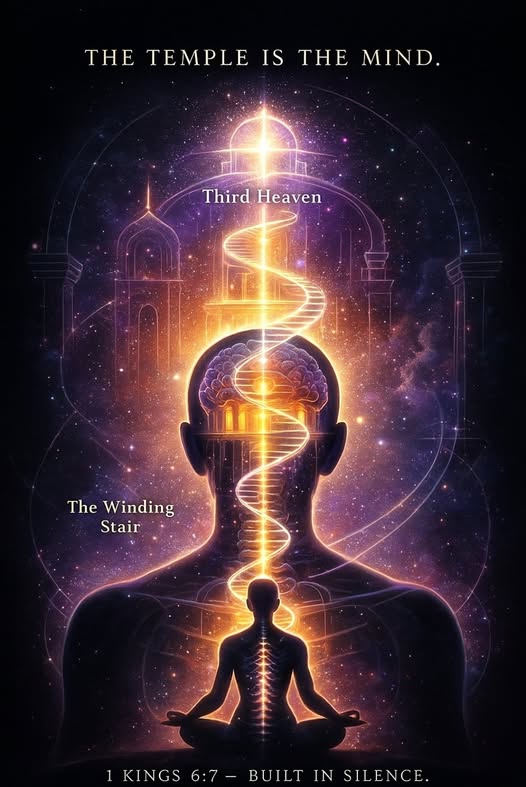
“And the house, when it was in building, was built of stone made ready before it was brought there:
so that neither hammer nor axe nor any tool of iron was heard in the house, while it was in building.”
— 1 Kings 6:7
🔹 The Silent Temple
If you take that verse seriously, it already dismantles the cartoon idea of “temples” as concrete, cranes, and holy construction projects.
Imagine trying to build a modern church that way:
No power tools. No rebar. No forklifts. No hum of generators.
Read it as a building code, and it’s absurd.
Read it as a map of consciousness, and it’s perfect.
The “stones” are your psychic fragments — memories, traumas, stories, habits. They’re quarried and shaped long before any “spiritual” life begins.
The cutting is life itself.
By the time they reach the temple — your mind, your nervous system — the shaping is done. All that remains is the fitting together.
The real construction happens only in one condition churches rarely teach:
deep internal silence.
That alone tells you the “house of God” cannot be a literal building.
Any theology that equates divine presence with brick, LED screens, and debt financing ignores the verse’s own logic.
Scripture says the house is raised where no human machinery can operate and no iron can sound.
That house is not a cathedral.
It’s you.
🪜 Kundalini: The Winding Stair the Bible Drew First
The next verse of 1 Kings gives us another clue:
“The entrance for the middle story was on the right side of the house,
and they went up by winding stairs into the middle story,
and from the middle into the third.” — 1 Kings 6:8
Right side.
Winding stairs.
Three levels.
That’s Kundalini — in biblical language.
Kundalini is the coiled, feminine energy resting at the base of the spine: the serpent power that rises through the chakras, awakening expanded awareness.
It’s literally described as a spiral, a coiled current ascending the spine.
Strip away the cultural labels and notice the pattern:
- A coiled, rising energy along the spinal column.
- A ladder or stairway through levels of consciousness.
- A final union at the “third” — the crown, the inner heaven, the chamber of direct presence.
Kings calls it a winding stair in the house, entering on the right side.
That right-side symbolism corresponds to the creative, intuitive hemisphere of the brain — the part that lights up during meditation, music, imagination, and mystical experience.
⚡ The Nervous System as the Inner Stairway
Your nervous system is not just anatomy — it’s architecture.
A living, vertical highway of light.
When people describe kundalini awakening, they’re describing what happens when that whole cable comes online — when energy stops looping in the lower fear circuits and begins to climb the inner ladder toward higher centres of awareness, including the pineal “single eye” and prefrontal cortex.
Even modern neuroscience quietly supports this without using the same language.
The brain is one of the most energy-hungry organs in the body, and it emits faint biophotons — tiny flashes of light — during neuronal activity.
These emissions fluctuate with mental state and may reflect how consciousness integrates information.
In simple terms:
The more coherent and elevated the brain’s activity, the more ordered the inner light becomes.
No wonder Jesus said:
“If your eye is single, your whole body will be full of light.”
🔺 Three Traditions, One Blueprint
- Kings describes a silent, three-level temple with a spiral stair.
- Kundalini yoga describes a coiled force rising through energy centres to illumination.
- Jesus describes the single eye that fills the body with light.
All three point to the same hidden architecture:
- An inner stairway — the spine and nervous system.
- A rising energy — the serpent, Jacob’s ladder, the Spirit.
- A third chamber — the crown, the inner heaven, the place of direct presence.
This is not coincidence.
It’s convergence — a universal map of awakening encoded across traditions.
⚙️ The Great Flattening: When Mysticism Became Mechanics
Organised religion took that living map and flattened it into a geography lesson:
Heaven up there, hell down there, earth in the middle.
Then it built literal buildings, literal hierarchies, and literal politics on top of a verse that explicitly forbids iron tools — the very symbols of man-made interference.
Once you see the contradiction, you can’t unsee it:
If 1 Kings 6:7 is about a literal temple,
then religious architecture violates the verse it claims to honour.If 1 Kings 6:7 is about the inner temple,
everything aligns.
“Iron tools” symbolise manipulation, coercion, guilt, and external control — all the mechanisms of institutional religion.
These are banned from the true build.
The only legitimate construction is the quiet rearranging of pre-shaped stones — natural elements of your being, reassembled in stillness.
🌌 Paul’s Outer Body Experience: The Third Heaven
When Paul speaks of being “caught up to the third heaven,”
he isn’t describing a change of location — he’s describing a change of perception.
It’s the moment when the rising current reaches the crown —
when awareness ascends the winding stair and realises the truth:
You were the temple all along.
✨ Coming Next: Mary, Peter, and the Seed of Religious Misogyny (Part 2)
We’ll see what happened when the inner temple met outer authority —
when Mary trusted the Spirit within, and Peter chose the tools of iron.
Mary, Peter, and the Seed of Religious Misogyny (Part 2)
The Silent Temple and the Subpoena of 1 Kings 6:7
In Part 1, we explored the inner architecture hidden in scripture — a temple not made with hands, but within consciousness itself: a winding stair, a third chamber, and a silent construction known to ancient mystics.
In Part 2, we step from that inner temple into history — and witness the moment the silence was broken.
🔹 The Turning Point: From Inner Temple to Outer Institution
When the spiritual path moved from inner revelation to outer control, humanity faced a choice:
trust the inner current or control it.
The Gnostics chose the inner current.
The institutional Church chose control.
And that’s where Mary Magdalene became the problem no council could solve.
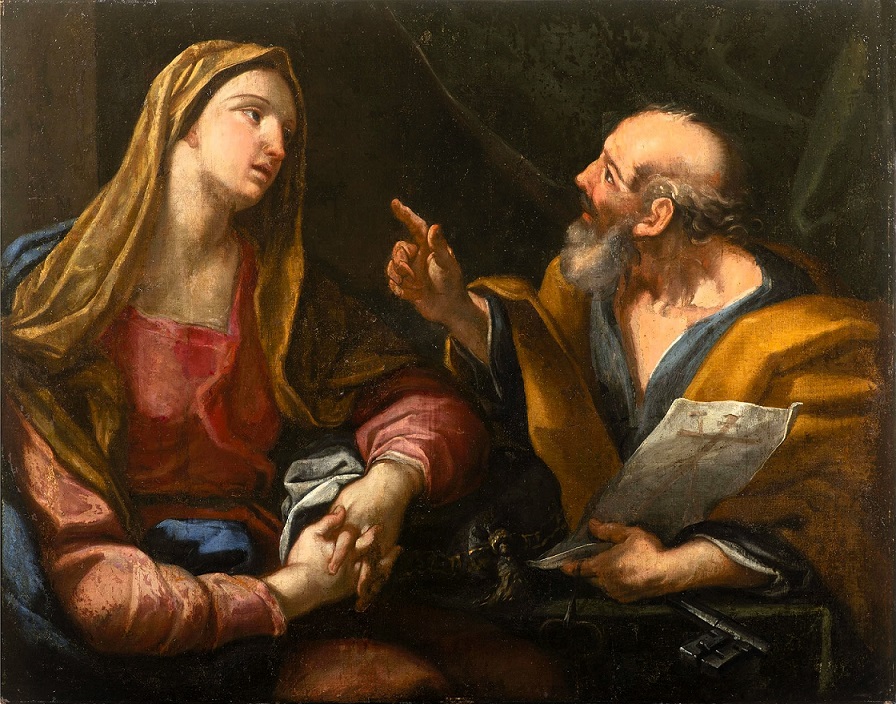
In Pistis Sophia and The Gospel of Mary, she speaks from direct experience — the living current of the Spirit, not secondhand belief. Peter is threatened by her authority. In Pistis Sophia, Mary confesses:
“I am afraid of Peter, for he threatens me and hates our race (women).”
Peter complains that Mary talks too much, that she takes the opportunity from the men.
Jesus answers simply:
“Whoever the Spirit inspires has the right to speak.”
That exchange became the fault line of Christianity.
Constantine made it law.
🪜 Two Paths, Two Authorities
If Spirit is the authority, then:
- The inner temple is real.
- The winding stair within the human body is real.
- The third chamber—the Holy of Holies of consciousness—is open to women and men alike.
- Practices of inner silence, energy ascent, and direct knowing are not “occult”; they are the original Christian path.
But if Peter’s anxiety is the authority, then:
- Mary must be muted.
- The inner maps must be buried.
- Kundalini-style language must be slandered as “snakes” and “demons.”
- Power must be centralised in male hands and external institutions.
History tells us which side won—for a while.
🔥 The Price of Suppressing the Inner Current
The heretics hunted by the Church weren’t atheists.
They were alternate Christians — mystics, Gnostics, Cathars — who believed in a direct relationship with the Divine, unmediated by hierarchy.
At Montségur in 1244, nearly 200 of them were burned alive in one mass execution.
Their crime was spiritual independence.
Their heresy was equality.
Many held higher views of women, of inner knowledge, of spiritual freedom.
They followed what they believed to be the original Christianity of the heart.
Gnosticism, at its core, is not rebellion against God — it’s rebellion against monopoly.
It places personal gnosis — direct experience — above institutional authority.
🕊️ The Hidden Technology of the Temple
When you read 1 Kings 6–7 through this lens, the metaphors ignite:
- Silent construction: inner transformation beyond the noise of ego.
- Winding stair: the spiral of rising consciousness through the spine.
- Three chambers: body, soul, and spirit — or in mystic terms, action, devotion, and union.
The Bible, far from being primitive, encodes a sophisticated technology of awakening.
Eastern traditions called it kundalini.
Christian mystics called it the inner Christ.
Both describe the same natural ascent of awareness within the human temple.
Mary Magdalene knew this path.
Peter feared it.
⚖️ The Deeper Meaning of Religious Misogyny
Religious misogyny is not simply men being sexist.
It’s the long shadow of a deeper choice:
- Trust the silent, rising energy in the inner temple — which speaks equally through women and men.
- Or kill it, and build a noisy, iron-tooled religion in its place.
When you silence Mary, you silence the inner voice of Spirit itself.
You exchange experience for obedience, and wisdom for creed.
📜 The Subpoena of 1 Kings 6:7
“The temple, when it was being built, was built with stone finished at the quarry,
so that no hammer or chisel or any iron tool was heard in the temple while it was being built.”
— 1 Kings 6:7
Once you see it, that verse stops being a construction note.
It becomes a summons.
It calls every loud, dogmatic version of religion to the stand and asks one piercing question:
If the true house of God is built in silence — what exactly have you been building?
✨ The Inner Temple Rises Again
The silent temple was never destroyed.
It was buried under centuries of noise.
But it still stands within each of us — waiting, spiralling upward, one silent stone at a time.
Mary’s voice wasn’t silenced; it was seeded — in the heart of every soul ready to listen.
And once that seed awakens, the temple begins to rise again — wordless, sacred, unstoppable.
1 Kings 6:7 reads:
“The temple, when it was being built, was built with stone finished at the quarry, so that no hammer or chisel or any iron tool was heard in the temple while it was being built.”
— 1 Kings 6:7 (NKJV)
On the surface, it’s a practical construction note: the stones for Solomon’s Temple were shaped off-site to preserve silence at the sacred site. But mystically, it’s one of the most loaded verses in the Hebrew scriptures — a line that mystics, alchemists, and esoteric Christians have long read as a metaphor for inner spiritual construction.
Here’s the layered meaning:
1. Outer Meaning — Reverence in Sacred Work
The instruction creates a physical atmosphere of holiness. The Temple — the dwelling place of the Divine — was to be built in silence, free of the clamor of human industry. The work was done in reverence, not noise. This models the spirit of worship through stillness rather than spectacle.
2. Inner Meaning — The Human Body as Temple
Mystical traditions, including Kabbalah and later Christian mysticism, saw Solomon’s Temple as an archetype of the human being:
- The foundation stones represent the body’s densest layers.
- The inner sanctuary (Holy of Holies) represents the heart or higher consciousness where Divine Presence (the Shekinah) resides.
To “build the temple in silence” means the soul’s evolution — the refinement of consciousness — happens inwardly, without external noise or conflict, in quiet transformation.
3. Esoteric Parallels — The “Living Stone” Doctrine
Early Gnostics and Hermetic Christians tied this verse to the idea of the living stone — consciousness shaped by experience before it’s laid in the temple of the self. Just as stones were “finished at the quarry,” the soul is prepared through life’s trials before entering sacred unity.
This connects directly with kundalini or inner ascension models: the stones are energy centers (chakras), refined in the “quarry” of earthly life, then raised silently into alignment with the divine plan.
4. Philosophical Implication — Silence as Creative Force
Silence here isn’t mere absence of sound. It’s stillness of ego.
The temple’s true construction happens when the noisy tools of intellect and domination are laid aside, and spirit works wordlessly through inner awareness.
Hence the verse can be read as:
“The true house of God — the awakened human being — is built in silence, from materials already perfected in the quarry of life.”
5. Historical Echo — The Lost Inner Technology
When institutional religion moved from inner temple to outer empire, this verse became symbolic of what was lost:
- The art of silent construction (inner contemplation, direct revelation)
- The sacred feminine principle (receiving rather than enforcing truth)
- The experiential pathway (gnosis, mystic union, kundalini ascent).
It’s no accident that many mystics — from Meister Eckhart to the Sufis — return to this same principle: the divine builds in silence; the ego builds with noise.
In short, 1 Kings 6:7 isn’t a verse about masonry — it’s about metaphysics.
It describes how every true temple — whether stone or soul — must be prepared in stillness, beyond the iron clang of control.
🔹 The Hidden Architecture of Consciousness in 1 Kings 6–7
In the King’s Building Chapters (1 Kings 6–7), the writer gives architectural details that are clearly more than literal. The temple is described as having:
- A winding stair (6:8) leading from the ground floor to the middle and upper chambers
- Three levels — outer court, inner court, and the Holy of Holies
- Silent construction (6:7), where “no hammer or chisel or iron tool was heard”
To a mystic, this is a blueprint of inner ascent — the same pattern mirrored in every true initiatory tradition, from the Vedic kundalini path to the Hermetic ascent of the soul.
🌀 1 Kings 6:7 — The Principle of Silent Construction
“The temple, when it was being built, was built with stone finished at the quarry, so that no hammer or chisel or any iron tool was heard in the temple while it was being built.”
Symbolic layer:
Each “stone” is a faculty of consciousness, quarried (refined) through life’s experiences. When brought to the inner temple, it no longer needs shaping — because the spiritual builder works in silence. The ego’s noisy tools — dogma, hierarchy, control — must be set aside.
This is the same quiet interior work that Mary Magdalene represents: an unmediated, wordless communion with the Divine.
🪜 1 Kings 6:8 — The Winding Stair: The Path of Rising Energy
“The entrance to the middle chamber was on the right side of the house; they went up by winding stairs into the middle chamber, and out of the middle into the third.”
Here we see the vertical axis — a spiral path moving upward through levels of being.
- The winding nature of the stair suggests a serpentine or spiral motion — the kundalini energy that rises through the subtle spine.
- The three chambers map onto the three great sanctuaries of human awareness: body, soul, and spirit — or, in Christian terms, the outer court (action), inner court (devotion), and Holy of Holies (union).
The stair ascends from right to left — a motion associated in temple symbolism with the inward-turning path, the feminine current, or return to source.
💠 The Third Chamber — The Holy of Holies
At the top of the ascent lies the third chamber, the Most Holy Place — where the Ark of the Covenant (the Presence) dwells. Only the purified consciousness may enter.
In mystical language, this corresponds to:
- The third heaven of Paul’s vision (2 Cor 12:2),
- The crown centre of the inner temple,
- The bridal chamber in Gnostic and Valentinian texts, where soul and Spirit unite.
This is also where Mary’s gnosis resides — the direct experience of divine union that Peter’s patriarchal anxiety tries to suppress.
⚖️ The Structural Fault Line: Silent Temple vs. Iron Tools
- Silent Temple = inner ascent, feminine receptivity, gnosis, direct knowing.
- Builders: mystics, prophets, contemplatives, Mary Magdalene.
- Iron Tools = outer control, masculine domination, intellectual theology.
- Builders: empire priests, bureaucrats, Peter’s successors.
When Constantine enshrined the Petrine line, he effectively chose the iron tools over the silent temple — replacing inner initiation with external construction.
🌹 The Mary–Peter Polarity as Temple Allegory
| Temple Symbol | Inner Principle (Mary) | Outer Principle (Peter) |
|---|---|---|
| Silent Construction | Inner gnosis, direct communion | Doctrinal noise, creedal enforcement |
| Winding Stair | Feminine spiral ascent, kundalini | Linear hierarchy, apostolic succession |
| Third Chamber | Inner Presence (Shekinah / Sophia) | Remote God, mediated through priesthood |
Mary thus stands for the living temple, Peter for the stone edifice. Both are needed — but when the outer crushes the inner, misogyny becomes structural, not personal.
🕊️ The Universal Pattern
Across cultures, this same architecture repeats:
- In Hinduism: the sushumna nadi and seven chakras (the rising stair).
- In Kabbalah: the Tree of Life, ascending through Malkuth (earth) to Kether (crown).
- In Christian mysticism: the ascent of Mount Carmel or ladder of divine ascent.
- In Gnosticism: the bridal chamber of soul and Spirit.
All are expressions of the silent temple built within — a structure that admits no noise, no hierarchy, and no gendered exclusion.
✨ Conclusion: The Subpoena of Silence
When 1 Kings 6:7 asks, “If the true house of God is built in silence, what exactly have you been building?”
—it is challenging every noisy, iron-tooled institution to remember the inner architecture it once symbolised.
The winding stair still rises.
The third chamber still awaits.
And the Spirit still speaks — equally — through whoever listens in silence.
 Academy of Life Planning
One thought on “Temples and Misogyny (Part 1): Paul’s Outer Body Experience & Peter’s Anxiety”