
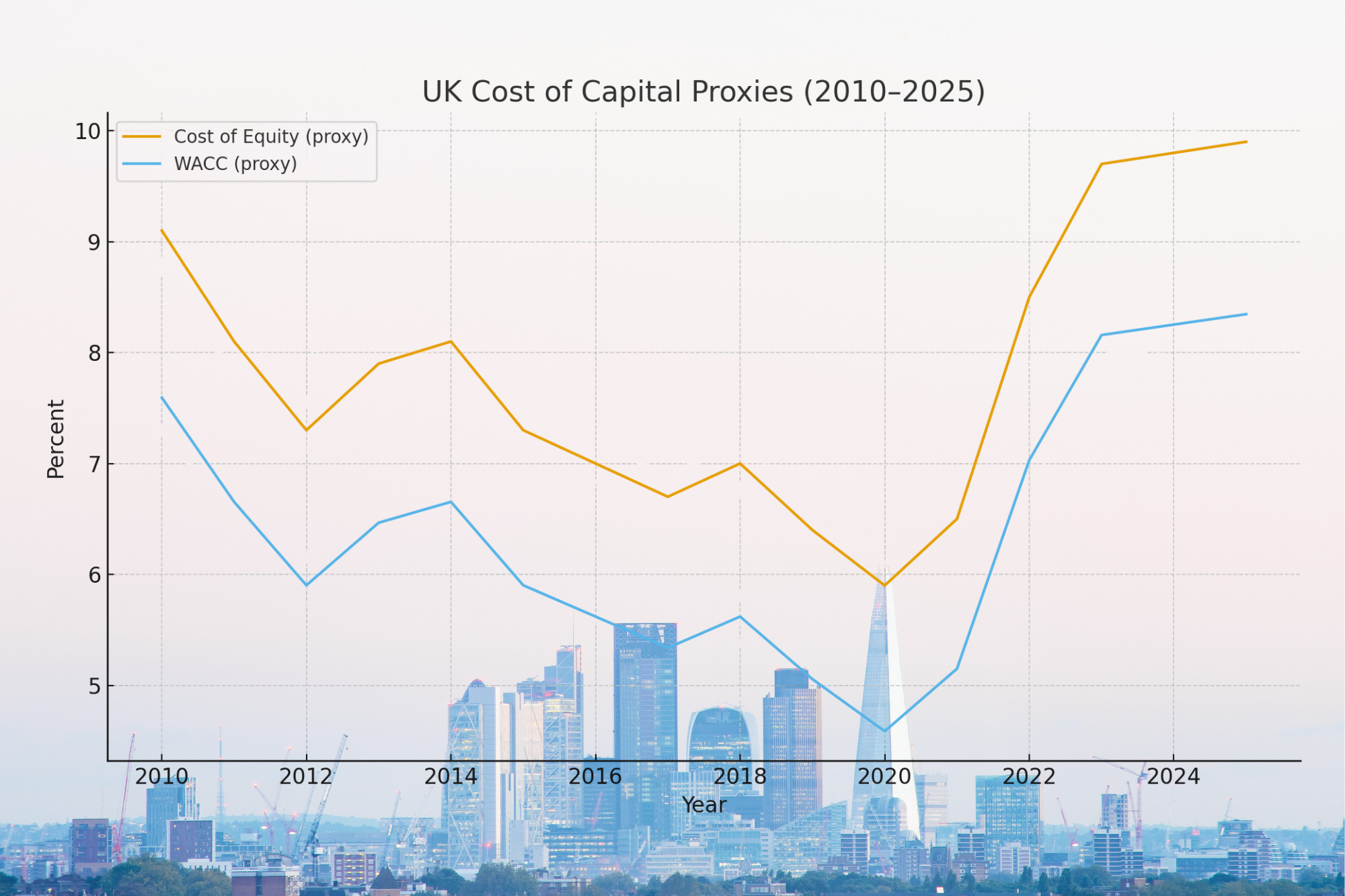
Over the past five years, Britain’s weighted average cost of capital (WACC) — the average rate of return businesses must offer to attract debt and equity — has quietly surged from around 5% to over 8%, and could rise to 10% or more under a full-scale deregulation agenda.
This shift matters far more than most headlines suggest. It’s not just a technical metric for accountants — it’s the heartbeat of the economy, influencing everything from business investment and job creation to household borrowing costs and government taxation.
What WACC Really Means
WACC represents the price of trust.
It reflects how much risk investors perceive in a nation’s markets and institutions. When trust is high, investors are willing to accept lower returns; when trust erodes, they demand a premium — driving up the cost of capital.
A high WACC signals that money in Britain is expensive. Firms must generate higher profits to justify new projects. Governments must pay more to borrow. Consumers ultimately face higher prices and fewer opportunities as businesses delay or cancel investments.
From 5% to 8%: A Structural Shift
For much of the 2010s, Britain enjoyed a historically low cost of capital — around 5% — buoyed by near-zero interest rates and relative political stability.
That era is over.
- Rising interest rates have pushed up the baseline “risk-free” cost of borrowing.
- Inflation volatility and policy uncertainty have raised risk premiums.
- Erosion of institutional trust — from banking scandals to inconsistent regulation — has increased perceived governance risk.
Together, these factors have lifted the national hurdle rate for productive investment to 8% or more, roughly matching the upper end of advanced economies such as the US, Germany, and Australia.
Under current trends, analysts warn that further deregulation — removing checks, transparency, and fiduciary standards — could lift that cost to 10% or beyond, as investors price in greater misconduct risk.
What This Means for Businesses
A higher WACC changes the calculus for every enterprise decision.
- Investment slows. Projects that once looked profitable at 5% now fail at 8–10%.
- Start-ups struggle. Venture and impact capital become more selective, and purpose-driven ventures face funding headwinds unless they can demonstrate exceptional governance and transparency.
- Consolidation accelerates. Larger firms with cheaper credit crowd out smaller innovators.
- Short-termism deepens. When the cost of capital is high, firms chase quicker paybacks instead of long-term, sustainable growth.
In short: a high WACC is an invisible tax on innovation.
What This Means for Consumers
The effects ripple through society:
- Higher prices and slower wage growth. When businesses invest less, productivity stagnates, reducing real income growth.
- Fewer ethical choices. Smaller, trustworthy enterprises find it harder to raise funds, leaving consumers dependent on dominant, less transparent providers.
- Increased taxation. As private investment weakens, governments fill the gap through borrowing and taxes — citizens pay for the trust deficit twice: once as consumers, again as taxpayers.
A 2-pence rise in income tax, for example, might plug a fiscal hole that could have been avoided if Britain’s financial system were structurally trustworthy.
A Better Path: Building the Trust Premium
If a structurally untrustworthy system imposes a Trust Discount, then the antidote is clear: build a Trust Premium.
Empirical research shows that high-trust organisations deliver 15–30% greater productivity and profitability. Scaled across an economy, that uplift translates to tens of billions in GDP.
Policies that legislate fiduciary duty, enforce transparency by design, and reform redress architecture could reduce Britain’s systemic risk premium — effectively lowering its national cost of capital without printing a single pound.
That’s not just good ethics; it’s good economics.
The Real Agenda: From Deregulation to Trust
Britain doesn’t need a “growth agenda” that deregulates risk into the system.
It needs a trust agenda — one that replaces opacity with openness, extraction with empowerment, and short-term gain with long-term flourishing.
Reducing the cost of capital through structural trustworthiness is the most sustainable growth policy we could pursue.
Because in the end, trust is cheaper than tax.
Join us at the Academy of Life Planning.
Let’s raise capability and integrity — together.
Because only when products and services are structurally trustworthy can consumers truly be free.
Get SAFE Exists to Support After Financial Exploitation
Get SAFE (Support After Financial Exploitation) is building a national lifeline for victims — providing free emotional recovery, life-planning, and justice support through our:
- Fellowship: peer-to-peer recovery and community.
- Witnessing Service: trauma-informed advocacy for those seeking redress.
- Citizen Investigator Training: empowering survivors to uncover truth and pursue justice.
Our Goal: Raise £20,000 to Rebuild Lives
Your contribution will help us:
Register Get SAFE as a charity (CIO)
Build our website, CRM, and outreach platform
Fund our first year of free recovery and justice programmes
Every £50 Changes a Life
Each £50 donation funds a bursary for one survivor — giving them access to the tools, training, and community that restore confidence, purpose, and hope.
This Isn’t Just a Fundraiser — It’s a Movement
We’re reclaiming fairness and rebuilding trust, one life at a time.
Support the Crowdfunder today
Be part of the movement to rebuild lives and restore justice.
 Academy of Life Planning
One thought on “The Cost of Capital: Britain’s Hidden Economic Pressure Point”