
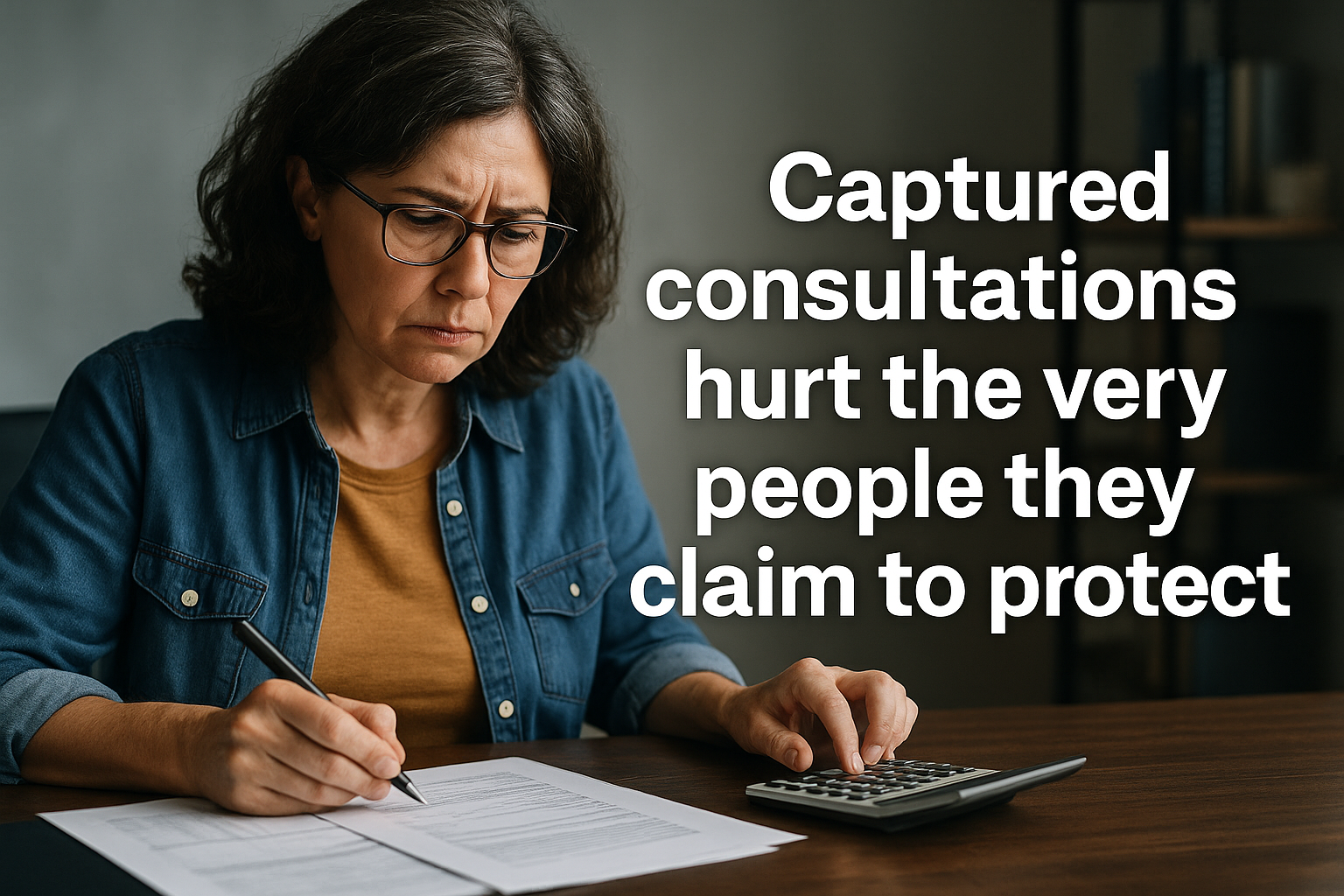
Government consultations are supposed to give voice to all stakeholders. In practice, however, they tilt heavily towards those with the deepest pockets. Market participants — asset managers, pension providers, and financial institutions — routinely spend client money lobbying for policy changes that serve their commercial interests. Consumers, meanwhile, are largely absent from the debate. Why? Because they’re skint. They don’t have lobbying budgets, research teams, or PR consultants. The result is a captured government — one that too often hears only the loudest, most well-funded voices.
A case in point: on Pension Awareness Day (15th Septemeber 2025), PensionBee urged the government and the newly revived Pensions Commission to extend auto-enrolment to the self-employed and gig economy workers. Its proposal? Use the tax system to deduct pension contributions automatically from these workers’ income.
On the surface, this may sound like a progressive measure. After all, why shouldn’t the self-employed enjoy the same protections as traditional employees? But dig deeper, and the flaws become clear.
- Unaffordable for the majority: PensionBee’s own research admits that 60% of self-employed and freelance workers cannot afford to contribute to a pension. Forcing them to do so risks deepening financial stress rather than alleviating it.
- Financial capital bias: The entire proposal assumes that the only path to future security is through saving in financial products. Yet this ignores the most important source of wealth for self-employed and gig workers: their human capital.
- Invisible assets: Human capital — skills, knowledge, networks, entrepreneurial drive — is precisely what self-employed workers are already leveraging to create sustainable incomes. By focusing narrowly on pensions, policymakers risk missing the bigger picture of how this “invisible workforce” actually builds resilience and wealth.
This isn’t to dismiss pensions. They are one tool among many. But when lobbying efforts frame financial products as the only solution, they distort the policy conversation. The truth is that self-employed people and gig workers need policies that support their entrepreneurial journeys, help them grow their productive assets, and allow them to convert their human capital into sustainable livelihoods.
That means:
- Access to affordable training and re-skilling.
- Fair tax treatment that recognises investment in business and education.
- Safety nets that reflect fluctuating incomes.
- Encouragement of diversified asset strategies — not just funneling money into financial markets.
The real tragedy is this: the groups most affected — self-employed and gig workers — are least likely to have their voices heard in the consultation process. Meanwhile, pension companies have every incentive to use client funds to push for policies that will expand their customer base.
If the Pensions Commission is serious about tackling poverty in old age, it must break free from capture and broaden its lens. That means giving equal weight to financial capital and human capital. Otherwise, we risk perpetuating a system where the needs of the cash-rich financial sector drown out the realities of the cash-poor invisible workforce.
About Get SAFE
Get SAFE (Support After Financial Exploitation) was born from a simple truth: too many victims of financial abuse are left to suffer in silence.
We exist for people like Ian—for the ones who did everything right, only to be failed by the systems they trusted. We know that behind every vanished pension, every ignored complaint, and every stonewalled letter is a person—frightened, exhausted, and too often alone.
Get SAFE offers more than sympathy. We offer structure, support, and solidarity.
We provide a voice where there’s been silence, and clarity where there’s been confusion.
We stand beside those who have been exploited, not just to help them recover—but to help them reclaim their story and rebuild their future.
Because financial justice is not a luxury.
It’s a human right.
If you or someone you know has been affected by financial exploitation, we are here.
You are not alone.
Learn more at: Get SAFE (Support After Financial Exploitation).
 Academy of Life Planning