
When Justice Still Feels Like Defeat
Even when victims win, they often lose again.
Legal fees, corporate negotiations, and drawn-out settlements can devour most of the compensation survivors fight for. The Post Office Horizon scandal is a prime example.
In the Bates & Others v Post Office Ltd group litigation:
- The Post Office agreed to pay £58 million.
- Around £46 million went to litigation funders and legal costs.
- Just £12 million—barely one-fifth of the total—reached the 555 subpostmasters who had battled for justice.
- That’s an average payout of £104,500 gross each, with a compensation payout after legal expenses of £21,600 net each.
This is the brutal reality survivors face: you can beat the system in court and still walk away with a fraction of what you deserve.
In the Post Office Horizon scandal see how systemic exploitation and institutional silence devastated lives. More than 1,000 sub-postmasters were falsely accused of theft and fraud between 1999 and 2015, based on flawed computer data. The human toll has been catastrophic: at least 13 workers took their own lives, and 59 others contemplated suicide, after years of wrongful prosecution, financial ruin, and shame. Executives knew before rollout that the Horizon system could produce inaccurate data, yet insisted it was infallible, leaving victims isolated, vilified, and destroyed (The Sun).
That scandal is not an outlier. It is a mirror. It shows us what happens when institutions prioritise self-preservation over truth, when they stonewall victims “thinning the herd” until they break.
And here’s the truth no one tells you: this can happen to any one of us.
Because exploitation isn’t just in the headlines. It happens quietly, every week, in the small institutional betrayals that rarely make the news—banks flipping business loans into personal debt, hidden commissions on car finance, pension savings siphoned off overseas.
It doesn’t matter if you’re a small business owner, a car buyer, or an ordinary saver—the game is rigged. The system is structurally untrustworthy.
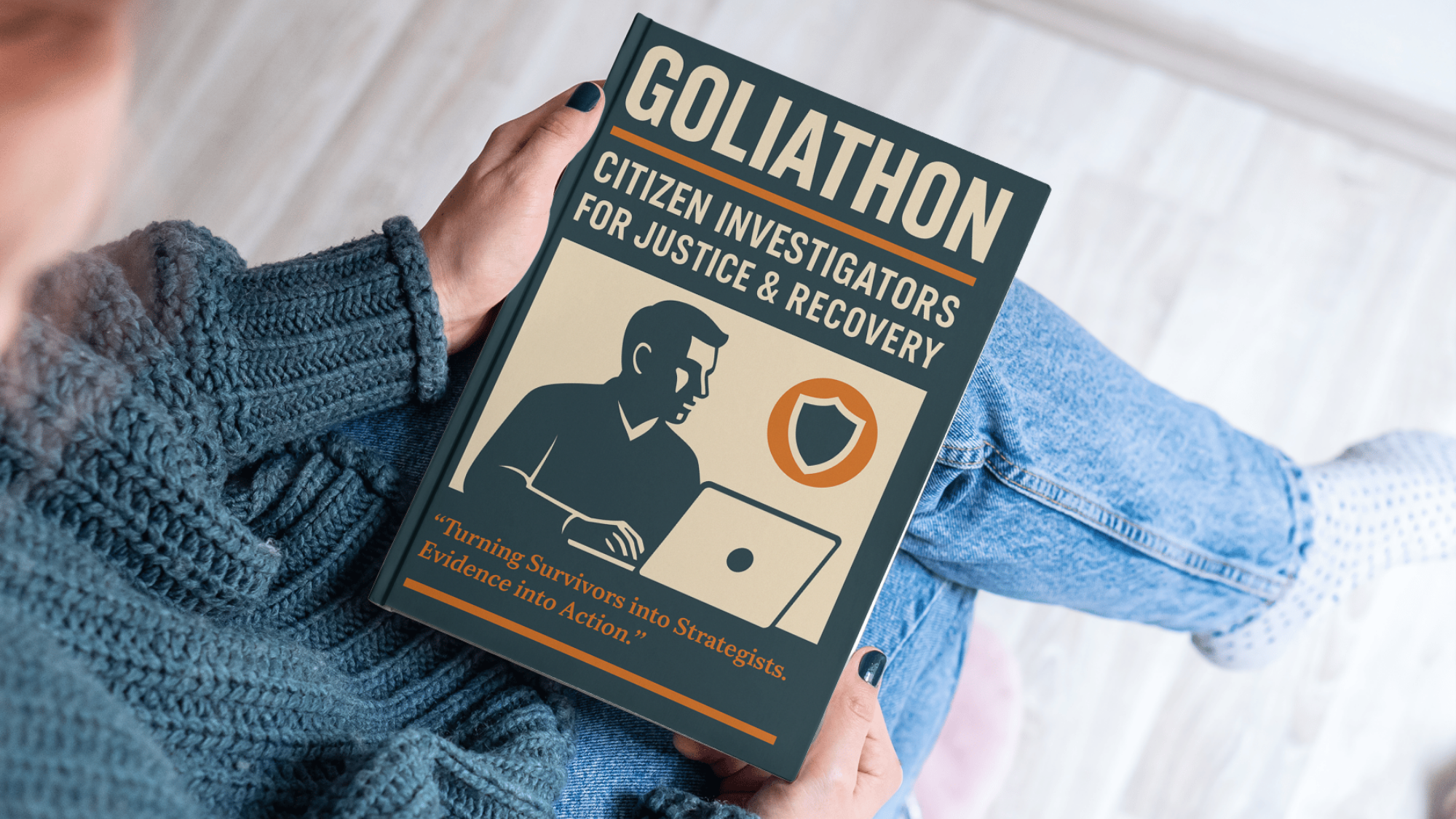
But the Goliathon changes that.
It gives victims the tools to fight back—not in decades, but in months. Not at a cost of tens of thousands, but for a few pounds. By helping people build their own professional-grade case files, stop stonewalling in its tracks, and cut legal costs to a fraction, we can finally level the playing field.
👉 Test us for £2.99.
👉 Train with us for £29.
Every contribution supports the launch of Get SAFE—a charity built to prevent exploitation, support victims, and save lives.
Because justice should never leave you poorer than when you started.
Read more below:
The Evolution of Life Planning: From Exploitation to Empowerment to Saving Lives
Contents
- Meet the System – Setting the Scene
From corporate rise to disillusionment. Why life planning today is about survival and saving lives. - Part 1: From Corporate Success to Conscience
Market-leading innovations, exponential growth, and the cost of systemic exploitation. The “clever truthteller” whose integrity clashed with corporate culture. - Part 2: The Intermediation Trap
Leaving corporate life only to find advisers flogging inappropriate solutions. Stories of systemic exploitation baked into the system. Why refusing to comply led to founding the Academy of Life Planning. - Part 3: Towards Empowerment
Building a new model of planning without intermediation. Investing in human capital through writing, speaking, and the GAME Plan. The Covid pivot, the rise of AI, and the birth of a global community of Holistic Wealth Planners. - Part 4: From Empowerment to Saving Lives
The devastating human cost of financial exploitation—loss of homes, businesses, marriages, and lives. The silence victims face from institutions. Why saving lives must go beyond empowerment. - Part 5: Get SAFE and the Goliathon
Introducing Get SAFE (Support After Financial Exploitation) and the Goliathon. How technology levels the playing field: cutting costs, ending stonewalling, reducing timelines. Real voices from citizen investigators. - Part 6: A Personal Lens
Jessica’s story of widowhood and survival with no safety net. Why our fight is personal, not theoretical. - Conclusion & Call to Action
From exploitation → empowerment → saving lives. How you can join the mission: test the Goliathon for £2.99, train for £29, and support the creation of Get SAFE as a charity.
Meet the System – Setting the Scene
When I look back on my meteoric rise in the corporate world of financial services, it is impossible to ignore the contradictions. On paper, it was a success story—fast promotions, market-leading launches, exponential sales growth, satisfied shareholders. But behind the glossy surface, the reality was stark: a system built on client disempowerment, layers of intermediation, and exploitation dressed up as professionalism.
That world thrived in what I now call the Piscean age—an era dominated by hierarchy, secrecy, ownership, and control. It was an environment that rewarded narcissism, self-interest, and extraction. The goal was never empowerment; the goal was always accumulation—of assets, fees, and power.
The public limited companies I worked for were obsessed with just one thing: the next quarterly profit announcement. Bonuses, promotions, and personal ascension all depended on whether this quarter’s numbers pleased shareholders. Short-term gain was everything; long-term value for clients was an afterthought, if it was considered at all. The internal conversation was not “What is best for customers?” but “What scheme can we get away with next?”
I tried to challenge that culture with a different philosophy—Stephen R. Covey’s fourth habit: think win–win. When I proved that building mutual benefit with clients delivered stronger engagement and sustainable profit, my bosses didn’t quite understand how it worked, but they couldn’t argue with the results. For a while, I was the truthteller tolerated for my outcomes. That is, until the bigger changes I demanded—structural reforms that would have threatened next quarter’s profits—put me squarely at odds with the system.
As the world shifts now from the Piscean to the Aquarian age, I can see my own career in a new light. What once looked like rebellion now looks like foresight. We are living through a transition—from secrecy to transparency, from dependency to self-agency, from exploitation to empowerment. Life planning is not just evolving; it is transforming into something far greater than financial advice. It is becoming a means of survival. A way to save lives.
This article is my attempt to map that evolution. It is the story of how financial planning must move beyond managing money to managing life itself—before, during, and after exploitation. And it is also a call to action. Because whether we realise it or not, every one of us has been touched by exploitation. And every one of us has a role to play in building a safer, more empowered future.
Part 1: From Corporate Success to Conscience
My early career was a paradox. On the one hand, I delivered results that made me the envy of colleagues and competitors alike. I launched initiatives that became industry-defining, forcing competitors to adapt or die. I built strong relationships with clients who felt heard, valued, and served. From the outside, it looked like I was riding the wave of success that the financial services industry promised to ambitious young professionals.
But inside, I could see something others refused to acknowledge: the cost of that success. The model was not designed to serve people; it was designed to extract from them. Every initiative, every scheme, every product launch was measured against one metric alone—how it would feed into the next quarterly earnings report. The system was blind to collateral damage. If a strategy made money for the firm and kept shareholders happy, then it was celebrated, regardless of what it did to the customer.
And yet, time after time, when I fought for integrity, the results spoke for themselves.
- Abbey@Work (2002): I built the UK’s largest worksite marketing business, bringing financial education and services directly to employees. It was a pioneering model designed to serve the many, not the few. But Abbey recruited the old-guard narcissist sales directors to run it, reverting to their exploitative habits. The culture couldn’t sustain empowerment, and the initiative was destroyed.
- Abbey Wrap (2003): I then created the UK’s first single-provider wrap platform. For the first time, clients could view and manage their investments in one transparent place. The innovation was so powerful that life and pension companies across the UK were forced to follow suit, building platformed back-offices or face extinction. When Santander acquired Abbey, its Spanish bosses scrapped the wrap in favour of their own fund supermarket. Abbey’s yes-men told them it was a great idea. It failed. I left.
- Tactica Multi-Asset Funds (2005): As Business Development Director at Berkeley Independent Advisers, I launched the world’s first retail multi-asset fund range with Goldman Sachs. Once again, the industry along Cannon Street had no choice but to follow or perish. But internal politics and narcissistic investor posturing sabotaged the launch, and the business was sold to Tenet for a song.
- RBS & HSBC (2000s–2010s): For decades, I repeated these innovations at scale. At RBS Group, then at HSBC, I spearheaded launches that reshaped the market: HSBC’s World Selection fund range, Premier Investment Management Services, its Global Investment Centre (the first true bank wrap platform), and what I still believe to be the best product in the world, the Vaccine Bond, designed to fight global health inequalities through investment.
- Trusted Adviser Service: My final act inside the corporate world was launching a service built around the single thing clients valued most—trust. But in a banking culture obsessed with quarterly profits, trust mattered least. What mattered most to customers was invisible to the institution. That was the moment I knew: if I stayed, I would forever be complicit in a system that rewarded exploitation over empowerment. So I quit.
Each of these innovations proved a simple truth: doing right by clients is not only ethical, it is commercially sound. But time after time, I saw the same pattern: the moment a new idea threatened short-term profits, narcissistic leaders sabotaged it. They could not see past the next quarterly earnings.
I discovered the power of Covey’s principle of win–win: strategies that worked for both client and company. At first, this confused my bosses. They couldn’t quite grasp how focusing on integrity could produce better financial outcomes. Yet the evidence was undeniable. My teams were delivering exceptional results—loyal clients, engaged advisers, and strong profits—because we built trust rather than eroded it.
But when I began to argue for deeper reforms—structural changes that would have shifted the very DNA of financial services toward long-term empowerment—the system snapped shut. Quarterly numbers mattered more than customer futures. I was no longer the clever truthteller tolerated for results; I was the inconvenient conscience who had to be contained.
That was when I realised: the only way to serve clients with integrity was to leave the corporate machine behind.
Part 2: The Intermediation Trap
Leaving the corporate world in 2012, I thought I had escaped the short-termism, the politics, and the narcissism that poisoned every attempt at real client-first innovation. I believed that as an independent I could finally do planning properly—without having to answer to bosses who saw trust as an inconvenience and integrity as a cost.
But what I found was worse.
The so-called “independent” world was a sea of exploitation dressed up as advice. The very intermediaries who claimed to serve clients were, in fact, agents of the financial services machine. They had simply swapped one corporate master for another. Their livelihood depended not on what was right for clients, but on what products they could flog—products designed to maximise fees, commissions, and bonuses at the expense of real needs.
And it wasn’t occasional. It wasn’t a few bad apples. It was systemic. Every single prospect I met had a story of exploitation.
- The inheritance trap: A woman who simply wanted to pass her wealth on “with warm hands” to her children during her lifetime was sold a trust that did the exact opposite. It locked her wealth until death, forced an income on her she didn’t want, and subjected her to 18 months of intrusive medical underwriting. None of it served her wishes. It served only the adviser’s sales agenda.
- The SSAS deception: A business owner expanding his operations was told he needed a Small Self-Administered Scheme (SSAS) to buy bigger premises. In truth, all he needed was a just-in-time inventory system to reduce stock levels and remain in his existing premises. Instead, he was saddled with an unnecessary pension structure that generated lucrative fees for the adviser.
- The £3m betrayal: One client had a £3 million deposit portfolio in a declining interest rate market. Instead of simple, secure solutions, he was moved into an unregulated collective promising high returns and capital security. It collapsed. He lost everything.
These were not anomalies. They were the norm. Every conversation revealed another case of systemic exploitation—hidden costs, unsuitable products, promises made only to be broken. Behind the smiling veneer of “advice” was a machine built for extraction.
I came to a painful conclusion: a start-up advisory business could not survive without tapping client assets for fees. The system was designed to make empowerment commercially impossible. When I challenged this, I was dismissed as naïve. “Your model is empty commercially,” they said. “You don’t understand how the industry works.”
But I did understand. I understood all too well. And I refused to play by those rules.
After 18 months, I walked away from the regulated perimeter. I would not build a business on exploitation. Instead, I founded the Academy of Life Planning and named myself what the industry thought impossible: a non-intermediating financial planner.
No products.
No commissions.
No hidden incentives.
Just planning—life planning—for the empowerment of the client.
At first, no one had heard of it. The very idea of planning without intermediation was so alien that people struggled to imagine it. They told me it would never work. They told me no one would pay for advice without a product at the end of it. They said empowerment wasn’t a business model.
But I believed then—as I do now—that it was the only way forward.
Part 3: Towards Empowerment
For the next ten years, the Academy of Life Planning quietly ticked over. It generated just enough revenue to sustain me, but not enough to scale. In many ways, it was ahead of its time. The world wasn’t quite ready for planning without products, for the idea of a non-intermediating financial planner. But something important was happening beneath the surface: curiosity.
Other advisers began to ask questions. They wanted to know how I was doing it—how it was possible to plan without selling. I showed them. And in those conversations I began to realise that empowerment, though slow to spread, was catching fire.
It was then I made a decision: if the industry wasn’t going to tell my story, I would. I invested the last of my financial capital into human capital—into myself. I became an author, publishing Your Money or Your Life: Unmask the Highway Robbers – Enjoy Wealth in Every Area of Your Life. The book was my manifesto, my attempt to shine a light on the systemic robbery of the financial services machine and to show people there was another way.
At the same time, I trained as an elite member of the Professional Speakers Academy. I wanted not just to write but to speak, to give voice to a movement that could reverberate globally. Out of that training was born the GAME Plan: a framework for living that put life before money, values before products, empowerment before extraction.
Momentum was building. And then—Covid hit.
Almost overnight, everything changed. I could no longer sit across the table from clients. I could no longer stand on a stage at events and speak my truth. The traditional pathways closed. But in that disruption was also a gift: it forced me to pivot.
I shifted from B2C, working one-to-one with personal clients, to B2B, training a global community of Holistic Wealth Planners to deliver empowering life planning in their own communities. Instead of one voice at a time, I could now multiply impact through others.
That pivot coincided with a technological revolution of its own: the phenomenal growth of artificial intelligence. Suddenly, information asymmetry—the great weapon of exploiters—was collapsing. Prospects were typing into ChatGPT: “What questions should I ask my financial adviser?” And they were getting answers. Empowerment was no longer a dream; it was becoming reality.
For me, the convergence of these two forces—Covid’s forced digitalisation and AI’s rapid acceleration—was the perfect opportunity. What I had pioneered for years on my own could now be amplified at scale. The Academy of Life Planning could move from a lone voice in the wilderness to a global chorus of empowered planners, supported by technology, driven by conscience, and committed to shifting financial planning from exploitation to empowerment.
Part 4: From Empowerment to Saving Lives
For years, I believed empowerment was the answer. If people had the tools, the knowledge, and the confidence to plan their own lives, they could outsmart exploitation. And to a large extent, that’s true. Technology has stripped away the mystery. Transparency has exposed hidden costs. A new generation is asking the right questions before they sign anything.
But there was a darker truth I could not ignore. Empowerment on its own is not enough.
Because behind every story of exploitation lies a human cost so severe it rarely makes the headlines.
I sat with victims whose lives had been shattered not just financially, but emotionally and socially. I heard stories of homes lost, businesses collapsed, marriages destroyed. I saw the ripple effects: children growing up in poverty because their parents had been mis-sold. Families torn apart by the shame of admitting they had been deceived. Individuals who once had confidence and dignity now hollowed out by despair.
And worst of all, I encountered the unspoken tragedy: the people who didn’t survive.
That’s right. Thousands of people, driven to the edge by financial exploitation, take their own lives. It is a silent epidemic, invisible in statistics, drowned out by the corporate spin that insists “there is nothing to see here.”
The silence is the killer.
Victims who try to speak out are met with denial, dismissal, or blame. Banks, advisers, regulators, ombudsmen, police, MPs, even the press—everywhere they turn, they face stonewalling. It can go on not for months, but for years. Even decades. And in that void of accountability, the victim’s isolation deepens.
I watched this happen again and again.
- The business loan betrayal: Banks flipping business loans into personal loans without client consent, tying them to guarantees secured on the family home. Debts were sold to loan-sharks who hiked interest rates, forced the sale of homes and businesses at undervalue, and left families bankrupt and homeless. In court, banks lied, but regulators, ombudsmen, and police chose to believe the institution over the victim.
- The expat pension scandal: Over 40,000 British expats lost £10 billion in pension assets in just a decade. Their retirement savings were siphoned into poorly regulated overseas schemes by commission-hungry intermediaries—many unqualified, unlicensed, and operating illegally. UK regulators and government departments turned a blind eye for political reasons, stonewalling victims for over ten years, despite the fact the sales took place on British soil, with British intermediaries, and British pension schemes. Even appeals to the Palace and Privy Council were ignored.
- The car-finance scandal: Every car buyer in Britain with finance was fleeced by credit brokers, through hidden commissions and inflated interest. And in July 2025, the Supreme Court declared that fleecing was not illegal—that brokers, and by precedent all intermediaries, owed no fiduciary duty to clients. In one judgment, the court confirmed what victims had long suspected: the UK financial services industry is structurally untrustworthy. Parliament sided once again with the banking lobby over the voting citizen. We do not live in a democracy, but a corpocracy.
These are not “bad outcomes.” These are not “market risks.” These are lives destroyed by systemic corporate exploitation. We are not just talking about financial misconduct. We are talking about corporate manslaughter.
When victims fight back, the system turns on them. Banks and institutions deploy DARVO tactics: Deny, Attack, and Reverse Victim and Offender. They frame the complainant as the aggressor. They drag cases out until the victim runs out of strength, money, or time. And if all else fails, they declare the claim “time-barred”—as if the passage of years makes systemic crimes somehow less criminal.
But criminality is never time-barred. Nor is the trauma.
Even when victims win, they often lose again. Legal fees, corporate negotiations, and drawn-out settlements strip away most of the compensation. Look at the Post Office Horizon scandal: £58 million was paid out, but £46 million went to legal funders and costs. Just £12 million—barely one-fifth—reached the victims. Justice, even when served, was diluted to a fraction.
This is the unheard story. The reality no one wants to face. Financial exploitation does not just rob people of money. It robs them of dignity, hope, health, families, and lives.
That is when I knew I had to go further.
Life planning could not simply be about empowerment. It had to be about saving lives. Preventing exploitation before it happens. Supporting people through exploitation as it happens. And helping survivors afterwards—fighting for redress, rebuilding their futures, and finding meaning again.
Because if we don’t, the silence wins. And the silence kills.
Part 5: Get SAFE and the Goliathon
When you’re deep in the dark, facing systemic exploitation—but with the winds of the financial services machine blowing against you—it can feel like David standing before Goliath. The banks, regulators, courts, even government itself, all seem aligned against the individual.
But remember: David won.
That truth inspired The Goliathon—a practical, technology‑powered toolkit that equips ordinary people to face down institutional giants, to demand justice, and to win.
Here’s the reality: most legal battles aren’t lost because the victim is wrong—they’re lost to crushing administrative drag and astronomical costs before the case even gets heard. Gathering evidence, building timelines, organizing emails and documents—this isn’t justice. It’s overwhelm.
Goliathon changes the game. Through structured templates, AI support, and clear escalation channels, victims can:
- Build airtight evidence dossiers so compelling—even competent lawyers will take the case on a no-win, no-fee basis.
- Stop institutional stonewalling in its tracks with precision.
- Slash legal costs from tens of thousands to nearly nothing by doing the groundwork professionally and clearly.
- Know instantly if their case is worth pursuing, before they waste more time or hope.
- Cut timelines from decades to months.
- Hold powerful institutions truly accountable.
And this isn’t some abstract idea—it’s already happening.
“Goliathon gave me clarity and direction when I was at my lowest. It’s been fantastic—I’d recommend it to anyone seeking redress.” — Robert, Citizen Investigator
“For £29, Goliathon saved me thousands in legal fees and years of wasted time. It’s a no-brainer.” — Mike, Citizen Investigator
But the Goliathon is just one step. The real mission is broader—and deeper.
Introducing Get SAFE—Support After Financial Exploitation. This isn’t just about empowerment or profit. It’s not even about justice. It’s about saving lives.
I’m working to establish Get SAFE as a Charitable Incorporated Organisation, so its tools and support can be provided free to those who most need it. No question. No limitation. No stigma. It’s a safety net where the system has systematically failed.
In the meantime:
- A £2.99 taster lets people explore the tools and see how they work.
- The full Goliathon programme is available for £29—not to generate profit, but to ensure survivors can afford to fight back.
Every person who uses these tools, every case that breaks the silence, chips away at the impunity institutions have enjoyed for far too long.
The Beacon in the Darkness: Ian Davis
And then there’s Ian Davis, whose story embodies everything wrong—and everything possible when one refuses to be silent.
Ian trusted the system. He put his life savings—£618,000—into what he believed was a safe, regulated investment through London Capital & Finance. But the institution collapsed. Ian lost every penny.
Rather than retreating, he fought back. He became a citizen investigator, spending sleepless nights compiling more than 70,000 documents across more than 350 companies tied to fraud and misconduct. He took what he uncovered to every authority he could—FCA, Action Fraud, SFO, Insolvency Service, National Crime Agency, and the CPS. Over and over again.
In March 2023, at just 61 years old, Ian died by suicide. His tragedy was not only the brutal financial loss, but the systemic failure that followed—the denial, the silence, the institutional disregard that crushed hope and isolated him.
Ian’s story reached Parliament—and spurred Early Day Motion 963, signed by 33 MPs. But commemoration is not enough. His legacy calls us to act. To turn pain into purpose. To build systems that speak for those silenced by shame—and prevent another such loss.
Get SAFE and The Goliathon are nothing less than institutional defibrillators—for victims, survivors, and society. They’re how we honour people like Ian—not just in memory, but in lives restored and systems changed.
Part 6: A Personal Lens
For me, this mission has never been theoretical. It is not just a professional crusade or a matter of conscience—it is personal.
When I met my wife Jessica, I thought I understood financial vulnerability. But her story taught me what it feels like when the safety nets fail completely.
At just 45, Jessica was widowed. Her husband, Ian, died suddenly of a stroke, leaving her with two young children, aged thirteen and fifteen. There was no life insurance. No pension scheme. No death-in-service benefit. He had been working on the farms of Lincolnshire—hard work, long hours, little protection.
Because Ian was not the children’s natural father, the state denied Jessica widow’s benefits. Overnight, she was left as the sole provider—two young mouths to feed, debts to manage, and a mortgage to pay, with no safety net to fall back on. Years later, with the help of AI, it became clear that the state had made the wrong decision. But by then the battle for survival had already been fought, and the children had grown.
Imagine that. The grief of sudden loss, while at the same time being pushed to the brink of financial collapse. The bills did not stop. The debts did not disappear. The children still needed care. It was survival mode, in the rawest sense of the word.
Jessica coped—somehow. She fought to keep her family together, and eventually she did. But her story is not unusual. It is not rare. It is the reality for countless families every year who find themselves abandoned by a system designed to protect institutions, not people.
That is why I do this work. Because behind every statistic are stories like Jessica’s. Stories like Ian Davis’s. Stories like the thousands of victims whose names never reach the press, but whose lives are derailed or destroyed by systemic exploitation and indifference.
The Academy of Life Planning, Get SAFE, and the Goliathon are not just intellectual exercises. They are lifelines. They are about preventing the next Jessica, the next Ian, the next nameless victim from facing despair alone.
This is why I cannot stop. Because what matters most—trust, dignity, survival—still matters least to the system. And until that changes, we have work to do.
Conclusion: From Exploitation to Empowerment to Saving Lives
This has been my journey.
From the corridors of power in Britain’s biggest financial institutions, where quarterly profits mattered more than customers…
To the intermediation trap, where “independent” advisers flogged products dressed as solutions…
To the long decade of incubation, writing, speaking, and creating the GAME Plan…
To the hard truth of Covid, the pivot online, and the convergence with AI…
To the realisation that empowerment alone is not enough, because silence kills.
Every step has led to this: a simple truth. Financial planning must evolve—not just to serve wealth, but to save lives.
We live in a world where:
- Banks can flip business loans into personal debt without consent, repossess homes, and still be believed over victims in court.
- Tens of thousands of British expats can lose £10 billion in pensions while regulators and politicians look away.
- Every car buyer in Britain can be fleeced, and the Supreme Court can declare it legal, confirming the UK is a corpocracy, not a democracy.
- A man like Ian Davis, who lost everything to London Capital & Finance, can spend his final years building a mountain of evidence against systemic crime, only to be ignored until despair claimed his life.
This is not “bad practice.” This is systemic abuse. It is corporate manslaughter.
But it does not have to end there.
Through the Academy of Life Planning, through the GAME Plan, through Get SAFE and the Goliathon, we can change the story. We can give people the tools to prevent exploitation, to fight back when it happens, and to rebuild when all seems lost. We can honour Ian’s memory not with silence, but with systems that work for people, not against them.
The aim is not profit. It is not even empowerment. It is saving lives.
That is why we are building Get SAFE as a charity—so every victim, regardless of wealth, can access support. So no one is left to fight alone. So justice, dignity, and survival are no longer luxuries, but rights.
Here’s where you come in.
- Try the £2.99 taster of the Goliathon system. See how it works.
- Invest £29 in the full programme. It could save you thousands in legal fees, years of wasted time, and immeasurable emotional strain.
- Share this story. Tell others. Break the silence.
- Help us get Get SAFE registered and operational. Every voice, every supporter, every advocate helps.
Because whether we realise it or not, every one of us has been exploited. Every one of us knows someone who has been scammed, mis-sold, or betrayed by the system. And every one of us has a role to play in building a future that is not just fairer—but safer.
The evolution of life planning is here. From exploitation. To empowerment. To saving lives.
And the next chapter is waiting for us to write it—together.
About Get SAFE
Get SAFE (Support After Financial Exploitation) was born from a simple truth: too many victims of financial abuse are left to suffer in silence.
We exist for people like Ian—for the ones who did everything right, only to be failed by the systems they trusted. We know that behind every vanished pension, every ignored complaint, and every stonewalled letter is a person—frightened, exhausted, and too often alone.
Get SAFE offers more than sympathy. We offer structure, support, and solidarity.
We provide a voice where there’s been silence, and clarity where there’s been confusion.
We stand beside those who have been exploited, not just to help them recover—but to help them reclaim their story and rebuild their future.
Because financial justice is not a luxury.
It’s a human right.
If you or someone you know has been affected by financial exploitation, we are here.
You are not alone.
Learn more at: Get SAFE (Support After Financial Exploitation).
If you are a fraud survivor or work in financial justice and want to share your views on this issue, feel free to get in touch.
 Academy of Life Planning