

“The river does not argue with the rock. It flows around it—and wears it away.”
As I sat in yet another Mansion House discussion this week—an Aquarian task force dissecting the hardened contours of a Piscean financial system—I felt a deeper truth stir beneath the surface noise of economic reform and regulatory rhetoric.
It’s not just the policies that need transforming. It’s the consciousness behind them.
The End of an Era, the Birth of a New One
We are living at the cusp of two great ages:
- The Piscean Age, built on control, hierarchy, secrecy, and blind belief.
- The Aquarian Age, flowing with transparency, decentralisation, collaboration, and conscious awakening.
In the Piscean paradigm, power flowed downwards. Decisions were made in distant boardrooms, and compliance replaced conscience. But the Aquarian current is rising. It flows not from leaders to followers, but from within each of us, upward and outward.
The old system may still speak with authority—but its voice is brittle. Its stone foundations are being quietly reshaped, not by force or rebellion, but by a million tiny acts of awakening.
“There is a crack in everything. That’s how the light gets in.”
—Leonard Cohen
From Compliance to Conscience
You don’t need permission to wake up.
You don’t need a degree in economics to see injustice.
And you certainly don’t need to wait for regulators to grow a backbone before acting on your truth.
The transformation we seek—towards fairer finance, towards just systems, towards lives of meaning and wholeness—does not begin in policy. It begins in people.
In you.
What Does It Mean to Awaken?
It doesn’t mean you reject all that’s come before. It means you begin to notice where your beliefs, actions, and choices no longer feel like yours.
Ask yourself:
- “Who taught me what success looks like?”
- “Where am I still waiting to be rescued?”
- “What would my life look like if I trusted my inner knowing?”
These are not academic questions. They are invitations—to remember who you are, not what you’ve been told to be.
“The intuitive mind is a sacred gift and the rational mind is a faithful servant.”
—Albert Einstein
You Are the River
The Piscean system is the rock—solid, loud, immovable in appearance.
But you, dear reader, are the river. Quiet. Persistent. Unstoppable.
You do not need to argue with the rock. You only need to flow. To keep flowing. To keep choosing conscience over convenience. Connection over conformity. Courage over comfort.
And over time, like all rivers do, you will wear down the walls of separation, deception, and control.
What You Can Do Today
This is not a call to revolution. It is a call to remember.
🌀 Pause daily. Reflect. Journal. Breathe. Ask: “What is mine to do today?”
🌀 Trust yourself. If something feels wrong, it probably is. If something feels freeing, explore it.
🌀 Find your people. Join or build communities of shared values. Collaborate without ego. Learn without hierarchy.
🌀 Speak truth gently. Not to argue, but to awaken. Your voice matters.
🌀 Flow forward. Be a steward of change—not by pushing against the rock, but by embodying what comes after it.
A Final Word
This blog isn’t just about financial reform. It’s about the spiritual architecture of a new world.
The systems of the past are cracking, not because we shouted them down, but because their foundations no longer hold up under the weight of our awakening.
This is your time. Not to lead with force, but with frequency.
Not to wait for rescue, but to be the remedy.
Welcome to the river. The flow is strong. The current is clear.
Let’s move forward—together.
“You are not here to fix a broken system. You are here to remember the truth that makes systems obsolete.”
🧬 Welcome to The Transformation Lab: Evolving Through Presence and Practice
A Zoom-based space for personal and collective awakening, inspired by MIT’s Theory U and the Aquarian age of conscious systems change
Inspired by MIT’s Presencing Institute and the work of Dr. Otto Scharmer, Senior Lecturer at MIT Sloan School of Management, The Transformation Lab draws on Theory U—a globally recognised framework for personal, organisational, and societal change. Rooted in systems thinking and deep listening, this approach invites us to shift from ego-system awareness to eco-system awareness, and to lead from the emerging future rather than reacting to the past.
🔹 PURPOSE
To co-create a living laboratory where change begins from within. The Transformation Lab is a non-hierarchical space where individuals exploring personal, professional, and societal transformation gather to slow down, sense deeply, and allow new insight to emerge. It’s not about advice-giving. It’s about listening, stillness, and subtle shifts that ripple outwards.
🧭 What It Is
The Transformation Lab is not a webinar.
It’s not a masterclass.
It’s a living space where people come to listen deeply, reflect inwardly, and allow something new to emerge—within themselves and in the world.
Inspired by Otto Scharmer’s Theory U, this lab invites you to move from downloading and reacting, to presencing and regenerating.
“The future enters into us, in order to transform itself in us, long before it happens.”
—Rainer Maria Rilke
🔹 Who It’s For
- Conscious changemakers, planners, citizen investigators, seekers
- Those navigating the shift from ego to eco, from old system to new
- People who don’t want answers—but presence, pattern, and possibility
🔹 STRUCTURE
📍 Frequency: Monthly (Fourth Friday, 2:00–3:00 PM UK time)
📍 Duration: 60 minutes
📍 Size: 6–12 people (to preserve intimacy)
📍 Format: Zoom Meeting (not Webinar)
📍 Host: Steve or rotating facilitator (Aquarian, non-directive)
🔹 FLOW OF THE SESSION
Opening (5 mins)
Welcome & grounding (breathwork, quote, or short silence)
Agreements: Confidentiality, no fixing, no hierarchy, listen with full presence
Round 1: Check-In (15 mins)
Each person answers:
“Where am I right now—physically, emotionally, spiritually?”
Round 2: Reflection & Sensing (30 mins)
Each person is invited to share:
- A recent insight, tension, or quiet knowing
- A pattern they are noticing in themselves or the world
- A quote, practice, or intuitive image they’re sitting with
Round 3: Resonance (5 mins)
Anyone may briefly offer:
“What stayed with me today…”
Closing (5 mins)
Simple gratitude round: “I’m leaving with…”
Optional follow-up link to blog/resource/inquiry tool
🔹 GROUND RULES
- No advice, no fixing. We honour sovereignty.
- Speak from the “I”. No teaching, only truth-telling.
- Confidentiality is sacred. What’s shared stays in the Lab.
- Silence is welcome. You are not required to speak.
- We listen for what wants to emerge, not what we want to control.
🔹 TECH SETUP
Zoom Settings:
- Enable gallery view
- Enable waiting room
- Disable recording by default
- Optional: Use a soft branded Zoom background or AoLP logo
Naming Format:
Participants are encouraged to rename as:Steve C (he/him) or Jess – M-POWER
🔹 OPTIONAL FOLLOW-UP
After each session:
- Email a reflection prompt or “What emerged in the Lab?” summary
- Invite participants to contribute to a shared Notion page
- Offer links to relevant AoLP articles, blog posts, or tools
- Optional WhatsApp group for ongoing resonance
🔹 INVITATION
✨ The Transformation Lab: From Reaction to Resonance
A monthly space for deep reflection, conscious connection, and inner-led action.
This is not a meeting. It’s a moment—held gently, together.
No lectures. No hierarchy. Just presence, listening, and transformation.
🔹 Slow down to sense.
🔹 Share what’s real.
🔹 Let something new emerge.
🗓 Fourth Friday Monthly | 🕑 2:00–3:00 PM UK | 📍Zoom
🎟 Free to attend | Inspired by MIT’s Presencing Institute
👉 [Register now]
First meeting Friday 25th July 2025 2:00 PM UK.
🌀 What Is Theory U?
Developed by Otto Scharmer at MIT, Theory U maps the journey of change not as a linear process, but as a U-shaped curve—moving from downloading old patterns, through deep inner reflection, to emerging new possibilities and co-creating the future.
It invites us to “lead from the emerging future” rather than reacting to the past.
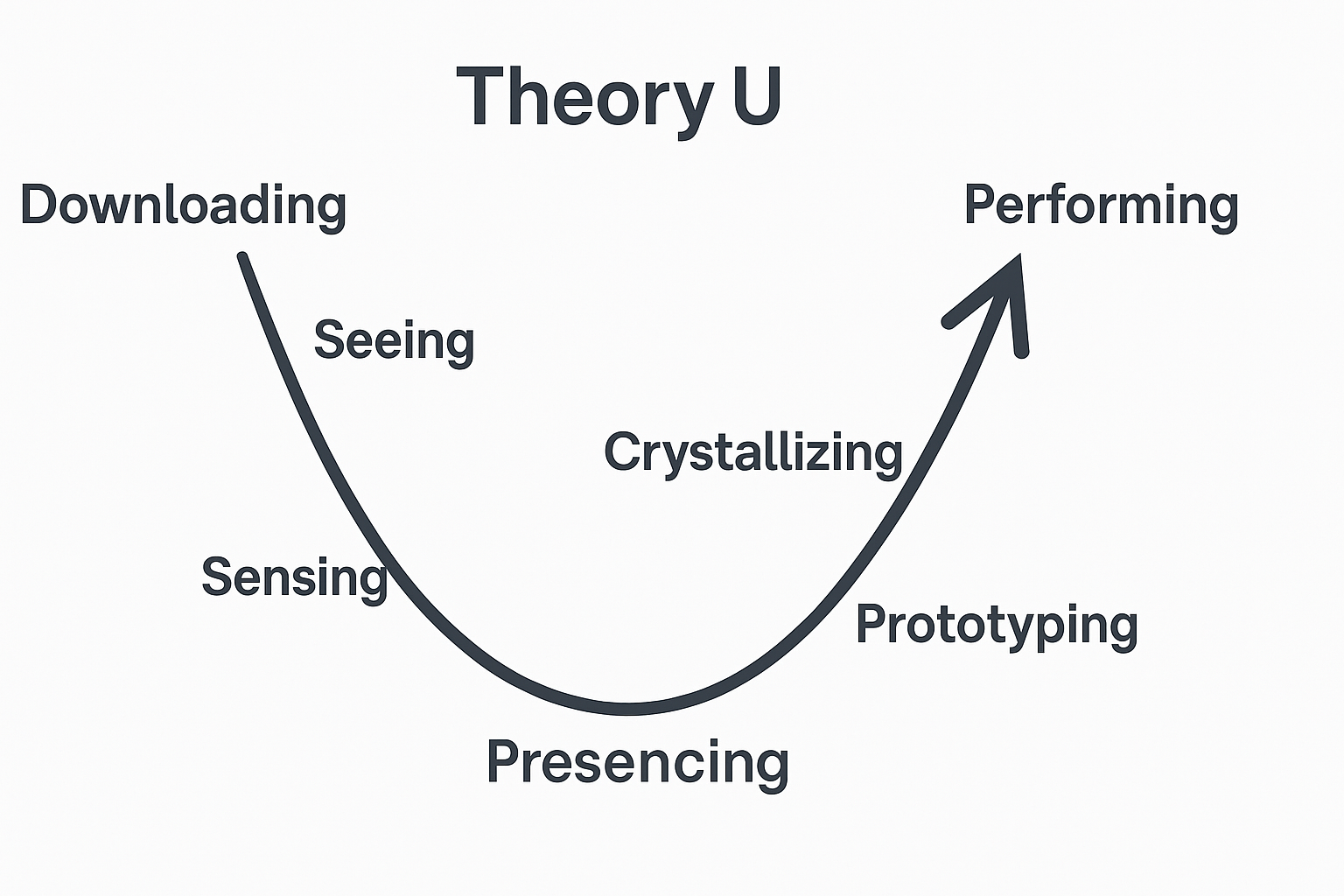
🔻 The U Process: A Journey Through 5 Fields
1. Downloading (Top left of the U)
- What happens: We operate from habitual thinking, replaying old stories.
- Piscean mindset: Top-down, reactive, system-maintaining.
2. Seeing (Moving down)
- We suspend judgment, becoming aware of deeper patterns.
- This step requires listening with fresh eyes—to others, to self, to the system.
3. Sensing
- We immerse ourselves in the field of experience.
- Engage with reality through empathy, embodiment, presence.
- You connect to source—the deeper knowing beneath words.
4. Presencing (Bottom of the U)
- The heart of Theory U: presence + sensing = Presencing.
- Here, ego dissolves, and we access deeper intuition.
- This is your Aquarian inner river—where wisdom emerges.
“The most important tool in that journey is not a book or a method.
It is the quality of your attention.” —Otto Scharmer
5. Crystallizing (Moving up the right side)
- From the inner stillness, vision and intent emerge.
- Ideas become aligned with your highest future potential.
6. Prototyping
- You begin to act—not from reaction, but from resonance.
- Small, safe experiments bring the vision into form.
7. Performing
- The new system is embodied and scaled through collaboration.
🧭 Core Principles of Theory U
- “The success of an intervention depends on the interior condition of the intervener.”
– Transformation begins within. - Listen with the whole self—not just ears, but heart and soul.
- Let go to let come—release what no longer serves to make space for the emerging future.
- Systems change starts with personal change.
“We are not human beings having a spiritual experience;
we are spiritual beings having a human experience.”
—Pierre Teilhard de Chardin
🌊 Alignment with the Aquarian Age
| Theory U | Aquarian Principles |
|---|---|
| Presencing | Inner awakening |
| Co-creation over control | Decentralised leadership |
| Listening as activism | Conscious communication |
| Holding space for emergence | Flow over force |
| Systems seen as living | Whole-systems transformation |
🌱 How We Might Use It in AoLP or M-POWER
- In workshops: Guide planners or citizen investigators through the U journey to design system-changing solutions from within.
- As a life planning tool: Pair with the GAME Plan’s cyclical model—aligning “Goals” with presencing and “Means” with prototyping.
- In peer gatherings: Use the three movements (observe > retreat > act) as the rhythm of a group session.
🧘♂️ Final Thought
“The quality of results produced by any system depends on the quality of awareness from which people in the system operate.”
—Otto Scharmer
In other words: Systems don’t change because we fix them.
They change because we show up differently—with awareness, courage, and collective soul.
🌌 Facilitator Guide: Theory U Hour on Zoom
A conscious journey from reflection to emergence in 60 minutes
🕰️ Overview of the Hour (60 minutes)
| Phase | Theory U Stage | Duration | Mode |
|---|---|---|---|
| Arrival | Landing & Agreements | 5 mins | Welcome |
| Descent | Seeing & Sensing | 15 mins | Group reflection |
| Bottom of U | Presencing | 10 mins | Silence or journaling |
| Ascent | Crystallising | 10 mins | Share insights |
| Experimenting | Prototyping & Performing | 15 mins | Vision & Next Steps |
| Close | Return & Gratitude | 5 mins | Check-out |
🌀 Before the Session
- Set Up Zoom:
- Enable gallery view
- Disable recording (to preserve psychological safety)
- Use breakout rooms only if the group is >10
- Optional: Custom Zoom background with soft imagery
- Prepare the Space:
- Your presence matters more than your script.
- Be rested, centred, and open.
- Keep a gentle bell or timer nearby.
📜 Session Script and Prompts
🔹 1. Arrival & Agreements (5 mins)
“Welcome. You’ve entered a space not to fix or figure things out—but to sense what’s alive in you, and what’s emerging through you.”
Invite participants to:
- Mute or unmute freely
- Turn cameras on (if safe to do so)
- Honour these agreements:
- Deep listening
- Speak from the “I”
- No interrupting or fixing
- Embrace silence
🔹 2. Descent: Seeing & Sensing (15 mins)
“Let’s begin by gently becoming aware of what we’re noticing—in the world, in ourselves, in this moment.”
Prompt:
- “What’s a pattern I’m seeing in myself or the world?”
- “What feels stuck? What is asking to be seen?”
➡️ Invite 2–3 minutes of reflection, then go around the Zoom room with each person sharing briefly (~2 mins each).
Facilitator’s role: Hold space, affirm presence, do not comment or interpret.
🔹 3. Bottom of the U: Presencing (10 mins)
“Now we pause. Nothing to fix. Just space to listen—to self, to source.”
Offer a gentle guided moment:
- “Close your eyes. Breathe. Let go of analysis. What does your soul want to say to you today?”
➡️ Then 5–7 minutes of silence or journaling (they choose).
Display a soft timer or visual.
🔹 4. Ascent: Crystallising (10 mins)
“From this stillness, what new insight, image, or sense of direction is emerging?”
Prompt:
- “If something wanted to be born through me, what might it be?”
- “What truth am I ready to speak or live?”
➡️ Invite 2–3 participants to share. Let it flow. No response required.
🔹 5. Action: Prototyping & Performing (15 mins)
“Let’s gently ask: what’s one step I might take to bring this insight into the world?”
Prompt:
- “What’s my next smallest, most aligned action?”
- “Who do I need to become to move forward?”
➡️ You can break into pairs if time allows, or invite 3–4 shares. Encourage specificity but no pressure to act.
🔹 6. Closing Circle (5 mins)
“Let’s close by each naming what we’re leaving with. A word, an image, a feeling.”
Each person offers:
- “I’m leaving with…”
Thank them.
“Thank you for showing up. This space exists because you brought your whole self to it.”
🧭 Tips for the Facilitator
- Be the space, not the answer. Your role is to witness and hold—not direct or conclude.
- Embrace silence. It is generative.
- Don’t fill the space. Let emergence happen.
- Name the energy. If grief, tension, joy, or insight is felt—gently acknowledge it.
🕊️ Optional Touches
- Play soft instrumental music during presencing (optional)
- Share a reflection email after the session (with a journaling prompt or quote)
- Invite co-hosts to rotate facilitation
🧠 Who Is Otto Scharmer?
Dr. Claus Otto Scharmer is a senior lecturer at the MIT Sloan School of Management, co-founder of the Presencing Institute, and a leading voice in organisational learning, systems thinking, and innovation.
He’s best known for developing Theory U, a model that blends personal transformation with systemic change. His work helps leaders and changemakers move beyond reactive responses to tap into deeper sources of awareness and collective intelligence.
📚 Key Books by Otto Scharmer
1. Theory U: Leading from the Future as It Emerges
- Published: 2007 (original), updated edition in 2016
- Publisher: Berrett-Koehler
- Overview:
A deep dive into the U-curve framework, this book outlines how individuals and organisations can shift from reactive decision-making to generative action. Scharmer introduces “presencing”—the fusion of presence and sensing—as the core transformational tool.
“The quality of results produced by any system depends on the quality of awareness from which people in the system operate.”
2. Leading from the Emerging Future: From Ego-System to Eco-System Economies
- Co-authored with: Katrin Kaufer
- Published: 2013
- Focus:
This book expands Theory U into the realm of economic and societal transformation, advocating for a shift from self-serving “ego-systems” to life-serving “eco-systems.”
Ideal for leaders tackling global inequality, climate breakdown, and systemic injustice.
“We are collectively creating results nobody wants, yet we continue to do so.”
3. Essentials of Theory U: Core Principles and Applications
- Published: 2018
- Overview:
A more concise, accessible version of his main work, perfect for practitioners, educators, and facilitators. It includes real-world applications and tools.
4. Presence: Human Purpose and the Field of the Future
- Co-authors: Peter Senge, Joseph Jaworski, Betty Sue Flowers
- Published: 2004
- Overview:
A precursor to Theory U, this book explores collective presence, intuition, and the invisible field of innovation. It’s poetic, spiritual, and deeply philosophical.
🔬 Influence and Recognition
- MIT Impact: Leads executive education and research on deep innovation at MIT Sloan.
- Presencing Institute: Founded to support global communities in applying Theory U to real-world systems transformation—from education to health to finance.
- Global Work: Collaborated with governments, NGOs, businesses, and grassroots movements worldwide.
🌍 Why Otto Scharmer Matters to Our Work
Scharmer’s model doesn’t impose change from above. It awakens change from within—which mirrors our GAME Plan’s philosophy of aligning life and money with personal purpose and societal wellbeing.
We could integrate his work by:
- Framing Presencing as a parallel to your inner “Goal” setting
- Using Theory U in M-POWER group processes or coaching
- Collaborating with Presencing Institute models like Societal Transformation Labs
🌍 Otto Scharmer’s Framework for Societal Shifts
Scharmer identifies three major societal divides that signal the need for transformation:
- Ecological Divide Humanity consumes the resources of 1.5 Earths each year.
This reflects our disconnection from nature.
We treat the Earth as an object rather than a living system. - Social Divide Growing inequality, marginalisation, and exclusion.
This is our disconnection from others.
Systems of power serve the few while many are left behind. - Spiritual/Cultural Divide Rising rates of depression, burnout, and loss of meaning.
This is our disconnection from self.
People feel alienated from their purpose and creative potential.
🔄 Four Levels of Societal Response
Scharmer suggests society tends to respond to crises from one of four levels:
| Level | Response Mode | System Logic |
|---|---|---|
| 1 | Reacting | Downloading old patterns |
| 2 | Redesigning Institutions | Reforming from outside |
| 3 | Reframing Assumptions | Seeing with new eyes |
| 4 | Regenerating from Source | Leading from the future |
The deeper we go, the more transformational (and sustainable) the shift.
🌱 From Ego-System to Eco-System
A core pillar of Scharmer’s vision is the shift from:
- Ego-system awareness:
Acting based on individual or institutional self-interest. - Eco-system awareness:
Acting from awareness of the whole system—society, planet, and future generations.
“We are collectively creating results that nobody wants—climate change, hunger, poverty, violence—yet we keep reproducing them.”
This shift is not just external (policies, economies) but internal—requiring leaders to develop new levels of self-awareness, empathy, and presencing.
🌀 The 8 Acupuncture Points for Societal Transformation
In his work with governments, educators, and civil society, Scharmer points to eight leverage points—like “acupuncture points” in society—to foster systemic change:
- Educating the Whole Human Being
→ Reforming education to nurture consciousness, not just skills. - Infrastructures for Collective Awareness
→ Tools and platforms that foster dialogue and co-creation. - Evolving Economic Thought
→ Moving beyond GDP to wellbeing, regeneration, and shared prosperity. - Ecosystem Leadership
→ From top-down power to distributed, participatory leadership. - Transformation Labs (Societal Presencing)
→ Cross-sector groups working through the U process in real systems. - Innovation in Governance
→ Citizens assemblies, deliberative processes, and shared power models. - Awareness-Based Technologies
→ AI and digital tools that amplify human awareness (aligned with your use of AI). - Personal-Collective Integration
→ Change at the personal level is inseparable from collective impact.
🔮 The Vision: Regenerating Civilization
Scharmer’s ultimate goal is to regenerate civilization from within—by healing the splits between:
- Head (thinking)
- Heart (feeling)
- Hand (acting)
He calls for a new societal operating system, grounded not in extraction and competition, but in presence, co-creation, and regenerative flow.
“The future is not something out there waiting to happen. It is something we create through the quality of our presence.”
🧬 What Are Societal Transformation Labs?
Societal Transformation Labs (S-Labs) are structured, long-term innovation processes that bring together actors from multiple sectors—government, civil society, business, academia, and affected communities—to co-sense, co-shape, and co-create solutions to entrenched societal problems.
They are not conferences or think tanks.
They are living ecosystems of transformation that operate at the level of consciousness, relationship, and system structure.
“We cannot transform a system unless we transform the consciousness of the people within it.”
—Otto Scharmer
🔁 The S-Lab Process (Based on Theory U)
S-Labs are designed around the Theory U journey, moving through five key phases:
- Co-Initiating
- Stakeholders come together to build trust, name the shared challenge, and form a guiding intention.
- Focus is on deep listening and establishing commitment beyond institutional roles.
- Co-Sensing
- Participants immerse themselves in the lived experience of the system.
- Includes “learning journeys,” empathy walks, and field visits.
- Goal: Understand the system from the perspective of the whole.
- Presencing
- A retreat-like setting to pause, reflect, and reconnect with deeper purpose.
- This is where inner knowing meets outer transformation.
- Space is held for stillness, emergence, and visioning the future that wants to be born.
- Co-Creating
- Small cross-sector teams prototype micro-interventions aligned with the future vision.
- Focus is on testing, learning, iterating—safe-to-fail experiments, not polished solutions.
- Co-Evolving
- Insights and outcomes are scaled through policy, networks, and culture change.
- Participants become stewards of ongoing systems shift—beyond the Lab.
🧠 Core Features of S-Labs
- Multi-stakeholder: Public, private, civic, and affected communities
- Multi-level: Engages both individuals and institutions
- Multi-year: Typically 6–18 months in duration
- Hosted space: Facilitated with intention, trust, and developmental guidance
- Awareness-based: Focused not only on what we change, but how we perceive and relate
🌍 What Problems Do S-Labs Address?
S-Labs are used globally to address wicked problems, including:
- Climate crisis and ecological collapse
- Income inequality and financial injustice
- Health system reform
- Racial equity and inclusion
- Education transformation
- Post-conflict reconciliation
- Urban regeneration
They are especially powerful where no one actor can solve the problem alone.
🔮 Why They Matter Now
Scharmer argues we’re at a tipping point between two civilizational operating systems:
- “Version 1.0” (Ego-System Awareness): Extractive, siloed, hierarchical
- “Version 4.0” (Eco-System Awareness): Generative, participatory, regenerative
S-Labs help prototype the architecture of this new operating system—one that centres on presencing, purpose, and planetary stewardship.
“The new does not come from fixing the old. It comes from leaning into the future that wants to emerge.”
🔗 Relevance to AoLP, M-POWER, and Get SAFE
We could adapt the S-Lab model to:
- Convene cross-disciplinary groups tackling financial exploitation or inequality
- Facilitate M-POWER movements in specific regions using a Theory U arc
- Design national or global interventions around human-first financial planning
- Build a prototype for the Justice Innovation Lab inside Get SAFE
🛠️ Resources
🔗 Relevance to AoLP and M-POWER
Scharmer’s shifts mirror our own mission:
- From external advice to internal activation
- From elite-led systems to community empowerment
- From money-first planning to human-first transformation
Both models emphasise decentralisation, inner awakening, and rebuilding trust through transparency and conscience.
🎓 What is MIT?
MIT stands for the Massachusetts Institute of Technology, a private research university located in Cambridge, Massachusetts, USA, just across the river from Boston.
Founded in 1861, MIT is world-renowned for driving technological innovation, scientific advancement, and interdisciplinary problem-solving. Its mission is to “advance knowledge and educate students in science, technology, and other areas of scholarship that will best serve the world.”
🌍 MIT’s Global Reputation
- Ranked consistently among the top universities in the world (QS World Rankings #1 for many years).
- Known for producing Nobel Laureates, astronauts, tech founders, and social entrepreneurs.
- Home to cutting-edge research in AI, energy, climate change, architecture, economics, media arts, and systems change.
🧠 Notable Areas of Influence
1. Engineering & Technology
MIT is a powerhouse in disciplines like:
- Mechanical, electrical, civil, and computer engineering
- Artificial intelligence and robotics
- Nanotechnology and quantum computing
2. Business & Systems Thinking
- The MIT Sloan School of Management is where Otto Scharmer teaches.
- Sloan blends traditional business acumen with leadership, innovation, and sustainability.
- It’s a hub for change agents working at the intersection of business, society, and consciousness.
3. Innovation Ecosystem
- MIT helped birth the modern startup culture, with hundreds of spinouts and a strong connection to Silicon Valley.
- The MIT Media Lab is a hub for radical cross-disciplinary research.
🌀 MIT & Otto Scharmer
Otto Scharmer is a Senior Lecturer at MIT Sloan, where he co-founded the Presencing Institute. His work is emblematic of MIT’s progressive spirit—uniting:
- Systems theory
- Organisational learning
- Social innovation
- Inner development
Theory U and the Transformation Lab approach you’re embracing draw heavily from this MIT ecosystem of rigorous inquiry and human-centred design.
“At MIT, we don’t just build better tools. We build better ways of thinking about the world.”
💡 Relevance to the Academy of Life Planning
MIT’s ethos aligns with AoLP’s mission to:
- Challenge conventional thinking
- Empower conscious systems change
- Combine human capital with technological potential for global impact
Scharmer’s presence at MIT bridges the technical and the transformational, making it fertile ground for Aquarian-era solutions.
“Don’t ask what the world needs. Ask what makes you come alive, and go do it.
Because what the world needs is people who have come alive.”
—Howard Thurman
Join the M-POWER Movement: From Piscean Planning to Aquarian Prosperity
We’re not just planning for retirement. We’re designing reality.
The old world extracted your time, energy, and wealth.
The new world empowers your purpose, vision, and impact.
What’s in it for you?
- Empowerment: Learn to align your money with your mission — no products, no pressure.
- Entrepreneurship: Build a purpose-driven business that transforms lives — starting with yours.
- Elevation: Shift your mindset, your model, and your movement into higher dimensional leadership.
How to Begin
Join the M-POWER Community
→ Free access to resources, events, and peers redefining the future of planning.
→ Community Link
Book a Discovery Call
→ One-to-one support to map your next step toward freedom and flow.
→ Booking Page
Spread the Shift
→ Share this message with your network and help awaken the next wave of dimensional planners.
→ Join Planning My Life Facebook Group
Final Word
This isn’t financial planning.
This is dimensional alignment.
It’s time to stop surviving and start creating —
for yourself, your family, and your future humanity.
Are you ready to step through the veil?
[Join Now] | [Book a Call] | [Share the Shift]
 Academy of Life Planning
One thought on “🌊 The River, the Rock, and the Rising Age: The Change Begins From Within”