

What if the ultimate truth behind every major religion wasn’t just similar, but the same? Here’s the idea: at the mystical heart of each tradition, beyond the rules and rituals, is a radical, unifying insight—that everyone is God.
It sounds outrageous at first. But stay with me.
From Division to Unity: The Journey of Human Consciousness
As we grow psychologically, something profound happens. We move from identifying as separate individuals to recognising our unity with all life. Early on, we focus on survival, fitting in, and standing out. These ego-driven stages correspond with the exoteric, or outer layers of religion. Think of them as the rules, the myths, the “do this, don’t do that”.
But as we evolve—becoming self-actualised, integrated, and oriented to service—we tap into the esoteric, or hidden core. That’s where the mystics live. Here, religion stops being about fearing one another, and starts being about loving one another. It’s a shift from outer obedience to inner awakening.
The Pattern Is Universal
This isn’t just psychology. It mirrors how humanity evolves, too. First, we survive. Then, we band together into tribes, institutions, and nations. And finally, when we mature, we transcend our boundaries to co-create something higher—a cooperative, compassionate whole.
So what’s the big picture?
Religions have outer layers that reflect early-stage consciousness—focused on identity, morality, and order. But go deeper, and you find the inner teachings: tools for awakening to our divine nature.
Mysticism: The Hidden Core of Every Faith
Call it what you like:
- Christianity has Gnosticism and the teachings of Jesus that went beyond parables.
- Judaism has the Kabbalah, and the hidden teachings of Moses.
- Islam holds the Sufi path and the sayings of Muhammad about knowing the self.
- Buddhism points to the Void, especially in the Vajrayana and Zen paths.
- Hinduism speaks openly of Brahman, the universal self, through the Upanishads and Tantra.
- Taoism calls it the Tao—the ineffable essence behind all things.
Different names. Same truth.
At the surface level, religions appear very different. That’s where most of the conflict happens. But at their mystical core? The similarities are striking.
They all speak of union. They all hint that the self is an illusion. And they all offer a path to realising something astonishing: your real identity is divine.
Why This Truth Was Hidden
So why don’t more people know this?
Because it was dangerous. In many traditions, claiming unity with God got you silenced—or worse. Mystics like Al-Hallaj, who said, “I am the Truth,” were executed. The Gnostics were branded heretics. Even Jesus, arguably, was killed for making such claims.
That’s why the inner teachings were passed on in secret. Reserved for initiates. Hidden in plain sight.
The Diagram That Says It All
Picture a circle.
On the outer ring: the rules, rituals, and literal interpretations of the major world religions. Christianity. Islam. Judaism. Buddhism. Hinduism. Taoism.
Move inward, and you see their mystical traditions—Gnosticism, Sufism, Kabbalah, Zen, Vajrayana, Tantra.
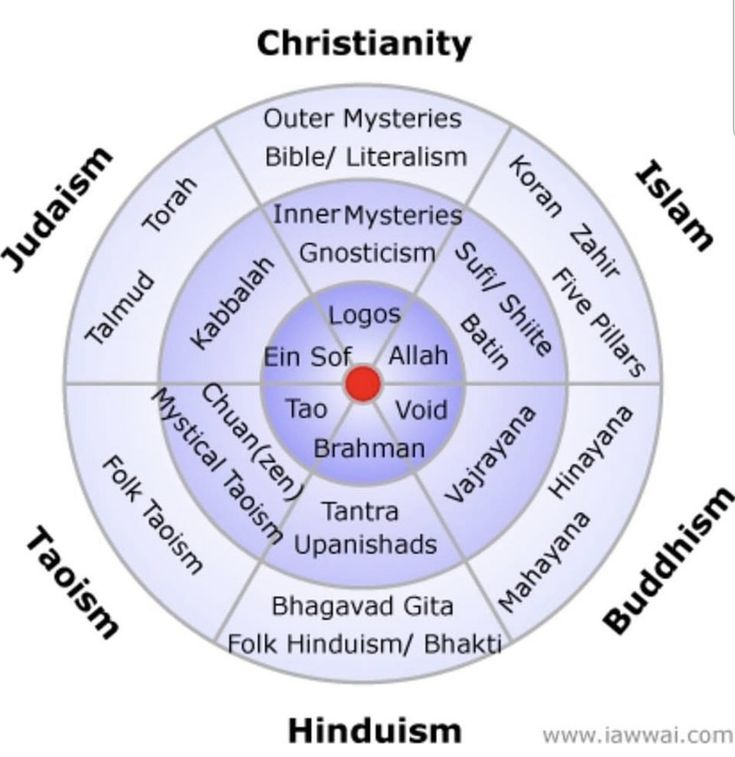
Source: ‘Everyone is God’ is the common truth behind all World Religion.
At the very centre: a single red dot. The source. Brahman, Allah, Logos, Void, Tao, Ein Sof. Different names, same essence.
From Separation to Oneness
This is the journey of both the individual and the collective.
We start separate. We evolve. We remember.
And what we remember is this:
We are not merely humans seeking God. We are God remembering itself through human experience.
So What Now?
This truth isn’t just for mystics or monks. It’s for all of us. Right now.
We don’t need more dogma. We need more awakening.
What would change if we saw ourselves—and one another—as divine?
Maybe everything.
Let that land.
Let that grow.
And let’s walk each other home.
 Academy of Life Planning