
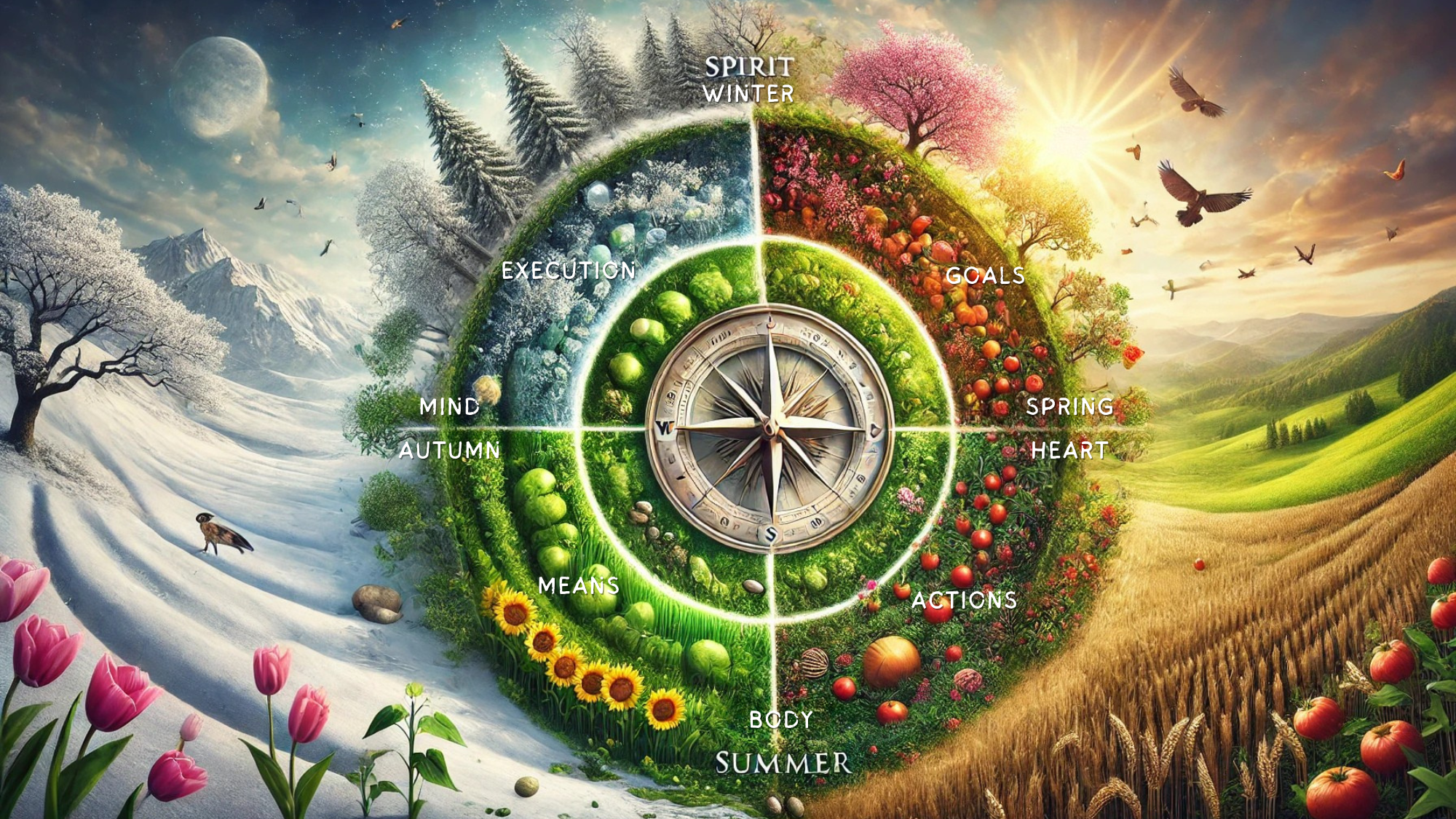
Life is a journey of growth, change, and renewal. The personal development cycle is a timeless framework that mirrors the ancient cycles of nature, guiding us from inspiration to manifestation. Just as the seasons flow seamlessly into one another, so too does the journey of personal and professional growth follow a productive, clockwise path—a cycle that fosters balance, clarity, and progress. Let’s explore this cycle step by step, aligning it with the rhythms of nature and the compass directions to reveal its transformative power.
Winter Solstice: Creating an Inspiring Vision
Our journey begins in the stillness of winter, at the Winter Solstice. This is a time of introspection and creation, where we envision what we wish to manifest. It’s about aligning our goals with our core values and purpose, setting the foundation for everything to come. Think of this phase as the ‘spirit’ of the process, where universal principles such as connection, purpose, and universalism come into focus. The clarity of this vision determines the strength of the cycle—much like the farmer’s winter planning shapes the success of the harvest.
Spring Equinox: Planting Seeds of Action
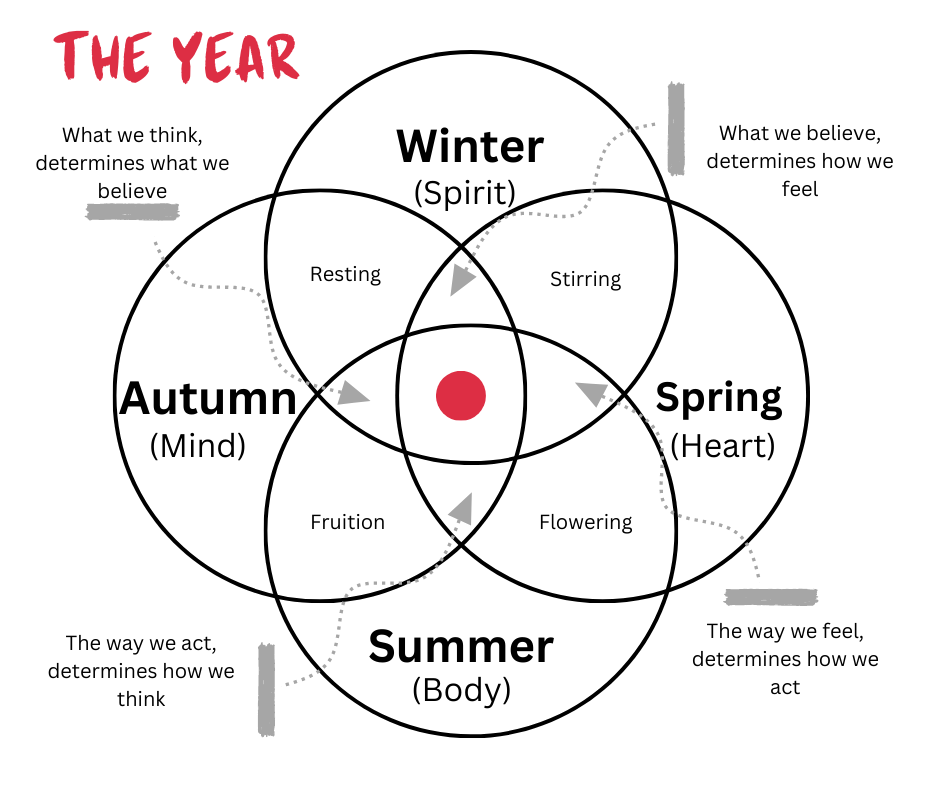
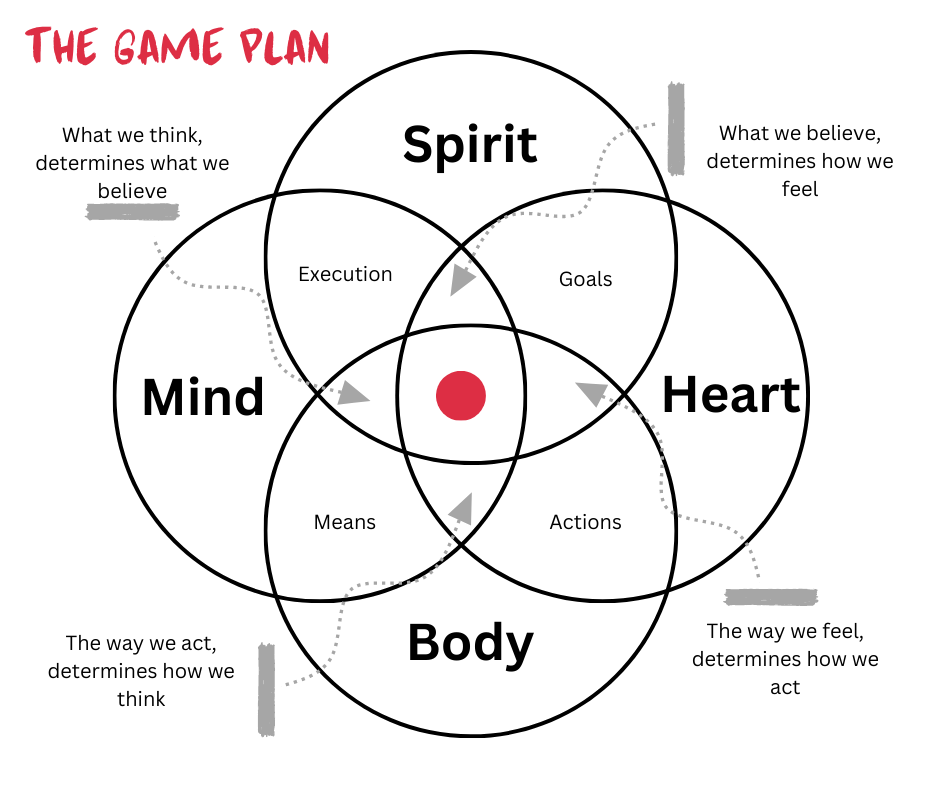
As we move from North to East on the compass, we arrive at the Spring Equinox. This is the season of planting seeds—the phase of goal-setting and socialising ideas. The focus here is on action driven by the heart, infused with love and passion. It’s about nurturing what you’re good at and sharing your aspirations with others. In the context of the GAME Plan (Goals, Actions, Means, Execution), this is where goals are established—ideas are planted and begin to germinate. Just as the farmer carefully sows seeds, we must cultivate our ideas with care and intention.
Summer Solstice: Bringing Ideas to Fruition
Moving towards the South, we reach the Summer Solstice, the peak of physical manifestation. This is the season of action, where ideas are brought down to earth and nurtured through consistent effort. Feeding, watering, and weeding become metaphors for the attention and energy we give to our projects. This is the phase of ‘body,’ where the fruit of our labour begins to appear. Just as pollination transforms flowers into fruit, our dedication transforms our vision into tangible results.
Autumn Equinox: Harvest and Reflection
As we transition from South to West, the Autumn Equinox marks the time of analysis and harvest. This is the ‘mind’ phase of the cycle, where we assess the means we have employed and the outcomes achieved. It’s a moment to celebrate the fruits of our labour while reflecting on lessons learned. Clearing and rest follow, as we prepare for the next cycle. The farmer reaps what they have sown, but they also clear the fields and let the soil rest. Similarly, we must honour the need for rest and renewal in our personal development journey.
Returning to the Winter Solstice: Rest and Renewal
The cycle completes as we return to the Winter Solstice, ready to create anew. This pause is vital—a time to integrate what we’ve learned, recalibrate our vision, and begin again with renewed energy and insight. Each iteration of the cycle brings growth and evolution, propelling us forward on our journey of transformation.
The Importance of Balance in the Cycle
One of the profound lessons of the personal development cycle is the importance of balance. Each phase—spirit, heart, body, and mind—is equally important. Skipping a step or neglecting a value can disrupt the entire process. For instance, if a farmer neglects to weed or water, the harvest suffers. Similarly, if we overlook any phase of the cycle, our efforts to manifest our goals may falter.
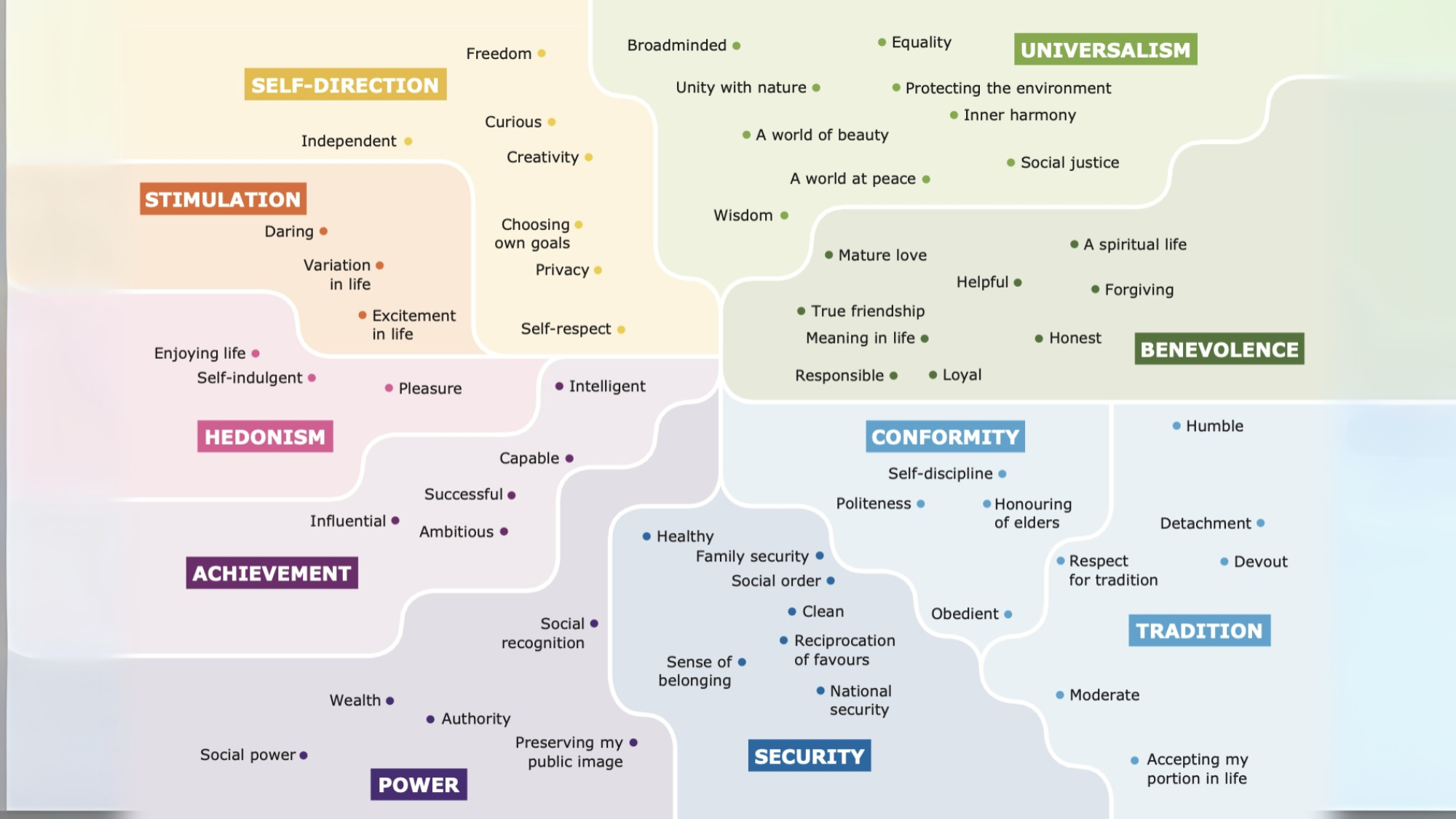
The Schwartz Values Wheel beautifully illustrates this balance, with values placed at each compass point. Universalism in the North aligns with spirit, benevolence and tradition in the East with heart, security and power in the South with body, and achievement and self-direction in the West with mind. Honour every part of the cycle, and the process flows seamlessly, leading to meaningful and lasting results.
A Cycle as Old as Time
The personal development cycle isn’t just a modern concept; it’s as old as time. From the farming calendar to the story of creation in Genesis—with its sequence of void, light, life, and rest—the cycle of creation to manifestation has always been a universal truth. It reminds us of our inherent power as creators, capable of shaping our reality when we align with the rhythms of life.
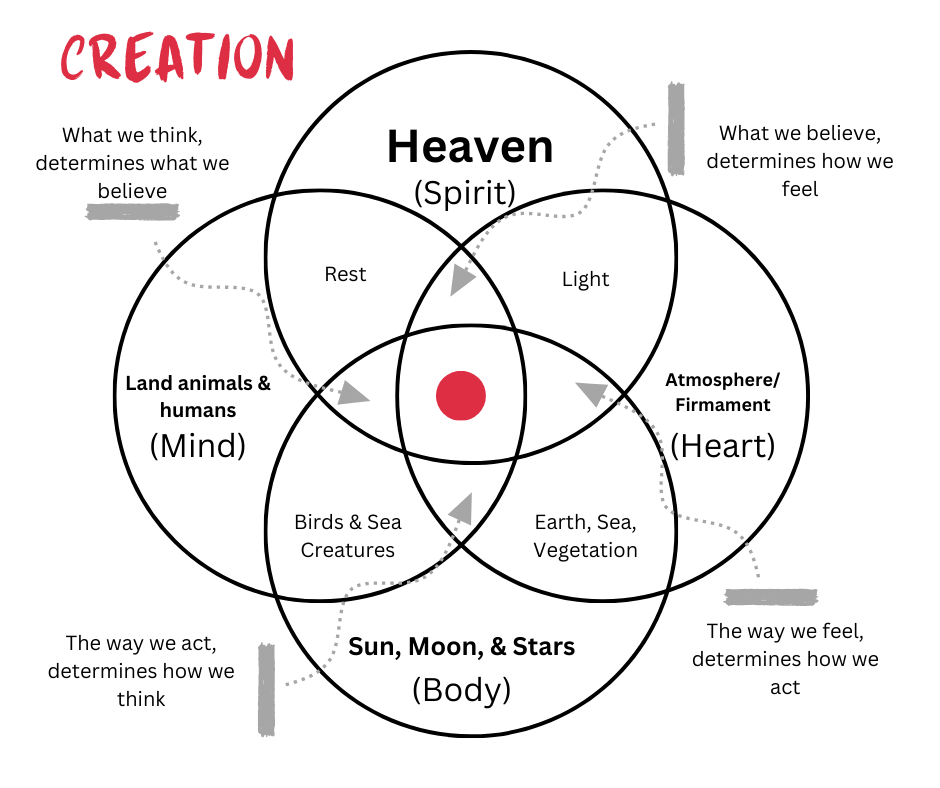
Bringing It All Together: The Life Plan
The LIFE Plan—Goals, Actions, Means, and Execution—aligns perfectly with this ancient cycle. It provides a practical framework for applying these timeless principles to modern life. By following this cycle and giving focused attention to each phase, you can bring your vision to life and achieve meaningful change, both personally and professionally.
Embrace the cycle, honour the process, and watch as your aspirations transform into reality. Just like the seasons, your journey will flow with grace and purpose, leading you to the life you envision.
Mastering the Cycle of Needs: A Holistic Approach to Fulfilment
In the journey of personal and psychological development, the master understands the importance of addressing each need in a structured and intentional way. By following the ancient cycle of creation to manifestation—starting in the North and moving clockwise—we ensure that all needs are met, one at a time, before progressing to the next stage. This approach fosters balance and harmony, helping us maintain fulfilment across all levels of the seven stages of psychological development.
The Schwartz Values Wheel serves as a guiding compass for this process, showing where to focus and what to prioritise as we move through the cycle. In alignment with the GAME Plan (Goals, Actions, Means, Execution), the focus shifts systematically, ensuring that both basic needs and soul desires are fulfilled. As above, so below: meeting soul desires naturally supports meeting basic needs. Here, all stages are interconnected and continuously maintained.
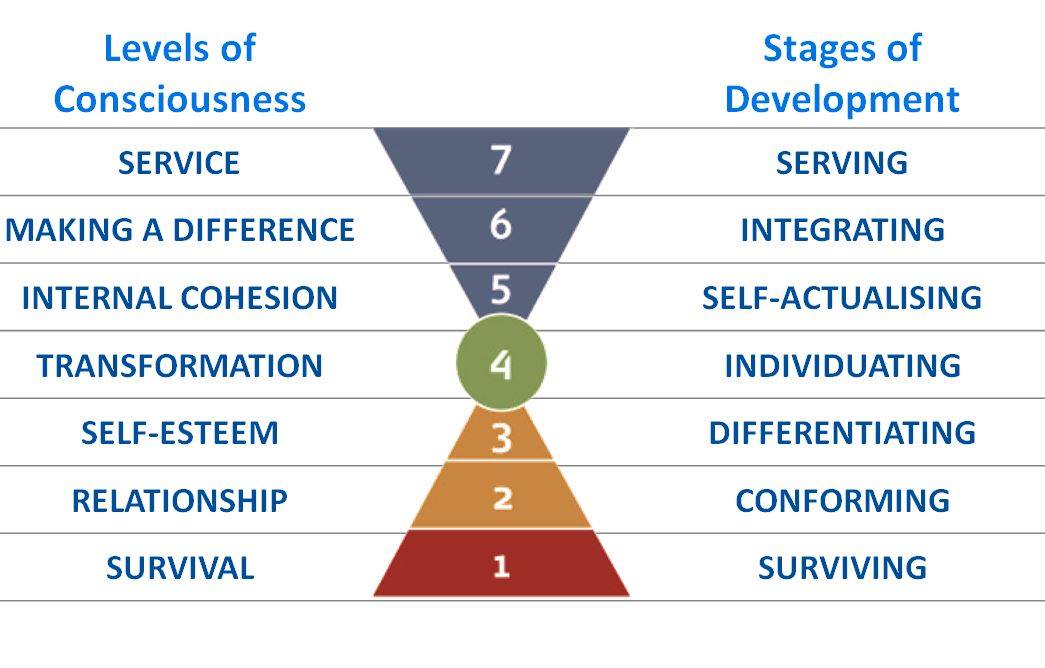
Richard Barrett’s Seven Stages of Psychological Development
- Surviving: This stage focuses on basic needs and safety. Individuals at this level seek security and stability, addressing essential physical and emotional requirements.
- Conforming: The focus here is on building connections and fostering a sense of belonging within groups. This stage is often influenced by societal norms and traditions, providing a foundation of social integration.
- Differentiating: At this stage, individuals establish independence, self-expression, and their unique identity. It’s a time for exploration and asserting individuality.
- Individuating: This stage aligns actions with personal values, helping individuals explore their sense of purpose and live with greater authenticity.
- Self-Actualising: Here, individuals realise their potential, living authentically and being driven by inspiration, creativity, and a desire to achieve their highest aspirations.
- Integrating: This stage focuses on balancing all aspects of life, finding harmony, and embracing interdependence. It’s about achieving wholeness and cohesion.
- Serving: The pinnacle of psychological development, this stage is characterised by contributing to the greater good. Individuals are driven by a desire to make a positive impact on others and the world, living a purpose-led, values-driven life.
The Master’s Cycle of Attention
In Barrett’s stages of psychological development, the cycle of attention for a master follows a distinct path. The journey begins at Stage 7 (Serving), focusing on making a meaningful contribution to humanity and the planet. From there, attention shifts to:
- Stage 6 (Integrating): Balancing all aspects of life and embracing interdependence.
- Stage 5 (Self-Actualising): Realising potential and living authentically.
- Stage 4 (Individuating): Aligning actions with personal values and exploring purpose.
- Stage 3 (Differentiating): Establishing independence and self-expression.
- Stage 2 (Conforming): Building connections and fostering belonging.
- Stage 1 (Surviving): Addressing basic needs and ensuring safety and stability.
Once this progression is complete, the cycle reverses, moving back through the stages:
- Returning to Stage 2, then 3, 4, 5, 6, and finally 7 again.
This cyclical approach ensures that all needs are revisited and sustained, creating a comprehensive and balanced foundation for growth. By maintaining focus on the interconnectedness of these stages, the master supports their own development while contributing to the well-being of others.
A Unified Cycle of Growth
This cyclical approach ensures that every need is addressed and sustained, creating a strong foundation for personal growth and fulfilment. By aligning with the cycle of creation to manifestation and using the Schwartz Values Wheel as a guide, we maintain balance across all stages. This holistic process supports individuals in their journey to live authentically, meet their needs, and contribute meaningfully to humanity and the planet.
Wherever you are in your journey, remember that each stage matters. By embracing the cycle, you can create a life of purpose, harmony, and impact, one step at a time.
Case Study: Overcoming the Fear of Financial Insecurity

Background
Sarah, a 38-year-old low-paid worker for a local charity, came to us with a deep-seated fear of financial insecurity. Her early childhood was marked by financial instability, witnessing her parents frequently struggle to make ends meet. This experience ingrained an early maladaptive schema in Sarah: a belief that money was a source of stress and conflict. Over time, this evolved into an aversion to money and a limiting belief that desiring financial success was inherently bad.
Sarah is passionate about her charitable work and finds immense fulfilment in helping others. However, her avoidance of financial matters left her feeling stuck and unable to meet her own needs fully. She lived paycheque to paycheque and resisted opportunities to improve her financial situation, feeling that doing so would compromise her values.
Identifying the Challenge
During our initial sessions, Sarah shared:
- A strong association between money and negativity, rooted in her childhood experiences.
- A belief that focusing on money contradicted her altruistic values.
- Feelings of guilt when considering ways to improve her financial position, fearing it would make her appear selfish or materialistic.
These beliefs created a cycle of avoidance and anxiety around financial planning, leaving Sarah unable to achieve a sense of security or freedom.
The Approach
Our work with Sarah focused on:
- Exploring and Reframing Beliefs:
- We guided Sarah in examining her beliefs about money, uncovering their origins in her childhood experiences.
- Through compassionate dialogue, we helped her see that money is a tool, not a moral indicator. It can align with her values and empower her to make a greater impact in her charitable work.
- Creating a Vision for Financial Well-being:
- We encouraged Sarah to visualise what financial security could look like for her, emphasising how it could enhance her ability to give back and support her own well-being.
- Together, we crafted a purpose-driven financial plan, focusing on balance and sustainability.
- Practical Steps and Empowerment:
- Sarah began tracking her income and expenses, gaining clarity and control over her finances.
- We identified opportunities for her to monetise her skills in a way that felt aligned with her values, such as offering workshops for the charity’s beneficiaries.
- Sarah started an emergency savings fund, reframing it as a foundation for stability rather than an act of selfishness.
Results
Over six months, Sarah experienced a profound shift:
- Reframed Perspective: Sarah began to see money as a neutral tool that could align with her values and support her mission.
- Increased Confidence: She developed practical financial skills, giving her a sense of control and security.
- Aligned Contribution: By monetising her expertise in a values-driven way, Sarah was able to contribute more effectively to her charity while meeting her own needs.
- Emotional Freedom: Letting go of guilt around financial matters allowed Sarah to focus on her goals with greater clarity and energy.
Key Takeaways
Sarah’s journey highlights the importance of addressing limiting beliefs and aligning financial well-being with personal values. By embracing a balanced approach, Sarah not only overcame her fear of financial insecurity but also created a foundation for lasting impact and fulfilment.
How We Can Help
If you recognise similar challenges in your life, know that it’s possible to break free from limiting beliefs and create a healthier relationship with money. Our approach is holistic and values-driven, helping you:
- Reframe unhelpful beliefs.
- Build financial skills and confidence.
- Align financial goals with your personal mission.
Let’s work together to empower you on your journey to security and purpose.
 Academy of Life Planning