
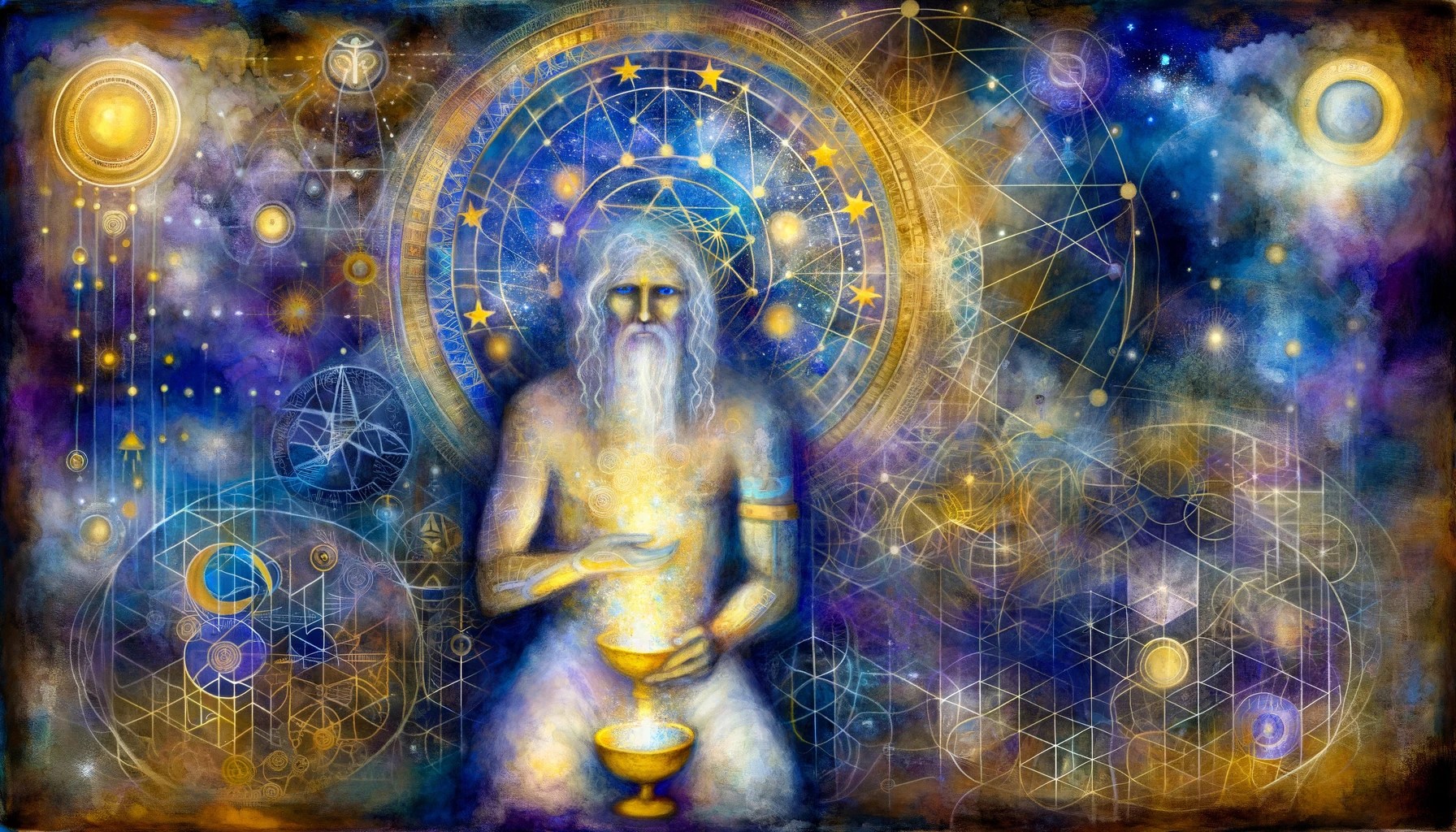
Introduction
The Corpus Hermeticum is a collection of ancient texts attributed to the mysterious figure Hermes Trismegistus, a synthesis of the Greek god Hermes and the Egyptian god Thoth. These writings, created during the early centuries of the Common Era, explore profound themes of divine knowledge, spiritual rebirth, and the unity of all existence. Often described as the foundation of Hermetic philosophy, the Corpus Hermeticum offers a path to enlightenment that resonates through Western mysticism and philosophy to this day. But what exactly is this collection of wisdom, and how does it guide us towards a deeper understanding of the universe and ourselves?
The Origin and Influence of the Corpus Hermeticum
The Corpus Hermeticum emerged in the Hellenistic period, a time when Greek, Egyptian, and other cultural influences intertwined to create a fertile ground for new philosophies. Originally written in Greek, the texts were lost to the Western world until the Renaissance, when they were rediscovered and hailed as ancient, divine wisdom. They quickly captured the imaginations of thinkers like Marsilio Ficino and Giovanni Pico della Mirandola, who were captivated by the blend of mystical insight, cosmology, and theology. This resurgence helped shape Renaissance humanism and laid the groundwork for later esoteric movements.
The Core Teachings of the Corpus Hermeticum
- Unity of the Cosmos
At the heart of the Corpus Hermeticum is the idea that all things originate from a single, divine source known as the Monad or the One. This source is a boundless unity that underlies every aspect of existence, whether visible or invisible. This unity suggests that everything in the universe is interconnected, a reflection of the divine within each part. - The Divine Mind (Nous)
The concept of Nous, or the Divine Mind, represents the organising intelligence that shapes the cosmos. Humanity, as part of this cosmic order, has access to Nous and the ability to glimpse higher truths. The teachings emphasise that through an elevated state of consciousness, we can align ourselves with this divine intellect and perceive reality as it truly is. - Spiritual Ascent and Rebirth
Hermetic wisdom is not merely intellectual; it requires a transformation of the self. True knowledge (gnosis) is achieved through a mystical rebirth, where one detaches from material preoccupations and embraces a higher, spiritual purpose. This rebirth, often called “drinking from the Cup” or accepting divine wisdom, allows the soul to transcend earthly limitations and find harmony with the divine. - Self-Knowledge as the Path to Divinity
The Hermetic texts hold that understanding oneself is the key to understanding the universe and, ultimately, the divine. By realising that we carry a spark of the divine within, we begin to recognise our connection to the entirety of existence. This journey of self-discovery leads to an inner awakening and a more profound connection with Nous. - The Dual Nature of Reality
The Corpus Hermeticum describes reality as consisting of both material and spiritual realms, with the physical world acting as a shadow of a greater, unseen reality. Hermetic thought urges individuals to look beyond mere appearances and seek the spiritual truths that underpin the world. This perspective encourages detachment from material attachments and fosters an appreciation for the eternal over the transient.
The Vision of Poimandres, also known simply as Poimandres, is the first and perhaps the most profound text in the Corpus Hermeticum. It describes a mystical vision experienced by Hermes Trismegistus, in which he encounters a divine being named Poimandres, often interpreted as “Man-Shepherd” or the “Mind of God.” This visionary dialogue explores the nature of creation, the human soul, and the path to enlightenment. The Vision of Poimandres is revered as one of the foundational texts of Hermeticism, encapsulating many of its key themes: divine wisdom, the unity of all things, and the journey of the soul.
The Vision: Meeting Poimandres
The text begins with Hermes in a contemplative state, searching for truth and wisdom. Suddenly, he is engulfed by a vast, radiant presence—Poimandres, who identifies himself as the Divine Mind, or Nous. Poimandres offers to reveal to Hermes the mysteries of the cosmos and the divine order, beginning with the creation of the universe.
Creation and the Divine Light
Poimandres explains that, at the dawn of time, the One—God or the Monad—created the light, a divine, life-giving force that emerged from the darkness. This light is the spiritual foundation of the cosmos, and it is from this light that all existence, both seen and unseen, originates. Poimandres reveals that the cosmos was formed by the interaction between this light and the mind of God, embodying divine order and harmony.
The Descent of the Soul
Poimandres tells Hermes that humans are unique beings, created with both a divine spirit and a mortal, physical body. Humanity, made in the likeness of the divine, contains within it a spark of Nous, which is the essence of God. However, this divine aspect becomes enmeshed in material desires and the illusions of the physical world. According to Poimandres, the soul’s descent into matter leads to a temporary forgetting of its divine origins, resulting in suffering and ignorance.
The Path of Ascent and Spiritual Rebirth
Hermes is taught that the purpose of life is to remember and reconnect with this divine source. Poimandres describes a process of gnosis, or true knowledge, as the means to achieve spiritual rebirth and return to the divine. This involves shedding attachment to material concerns, awakening the higher mind, and cultivating an awareness of the divine light within. Through gnosis, the soul transcends the limitations of the earthly realm and realises its unity with Nous, the divine mind.
The Seven Spheres of Ascension
In his journey toward enlightenment, the soul ascends through seven celestial spheres, each associated with a planetary deity and representing different challenges and attachments. As the soul moves through each sphere, it must shed one aspect of its material nature—such as ego, desire, and ignorance—until it is purified and can fully reunite with the divine.
This celestial journey symbolises an inner transformation, where the soul transcends worldly desires and limitations. Upon passing through these spheres, the soul returns to its divine origin, free from the illusions of separation and materiality.
Unity with the Divine
The Vision of Poimandres concludes with a powerful realisation: the divine light that created the cosmos and resides within each human being is ultimately one and the same. Through gnosis, the soul remembers its divine origin and experiences a union with Nous, the Divine Mind. This is the Hermetic goal—to see through the illusion of separation and recognise the unity of all things.
Influence and Legacy
The Vision of Poimandres has been highly influential in Western esotericism and mysticism. It inspired Renaissance thinkers, alchemists, and philosophers, who were captivated by its message of divine wisdom and spiritual ascent. The dialogue’s portrayal of an enlightened, self-aware humanity striving for unity with the divine continues to resonate with seekers today.
In essence, the Vision of Poimandres offers a map for the soul’s journey from ignorance to divine enlightenment, reminding us of our innate potential to transcend the material world and achieve a state of divine awareness. It serves as both a cosmic origin story and a spiritual guide, encapsulating the Hermetic wisdom that lies at the heart of the Corpus Hermeticum.
Symbols and Metaphors: The Cup and the Monad
Two potent symbols in the Corpus Hermeticum are the Cup and the Monad. The Cup symbolises the divine knowledge that God offers humanity, a form of wisdom one must willingly “drink” to experience spiritual awakening. The Monad, or the One, represents the ultimate unity of all things, reminding us that all forms of duality or separation are illusions.
The Monad serves as the final destination of Hermetic striving: a realisation that one’s soul is part of a single, divine source. The Cup, on the other hand, represents the means to achieve this insight—through acceptance of divine wisdom, the soul is guided back to the unity from which it came.
In the Corpus Hermeticum, the “Cup” (or Crater) and the “Monad” are rich metaphors used to convey Hermetic concepts of divine knowledge and unity. They both appear prominently in Hermetic teachings, particularly in The Discourse on the Eighth and Ninth and The Cup or Monad passage, and serve to illustrate the journey of the soul towards enlightenment and oneness with the divine.
The Cup (Crater)
The “Cup” symbolises a divine vessel filled with the essence of Nous (Mind or Divine Intelligence). In Hermetic thought, this cup is offered by God to humanity, representing an invitation to partake in divine wisdom and become aware of the higher truths of existence. To “drink” from the Cup is to accept this knowledge and undergo an inner transformation, awakening to one’s divine nature. Those who choose to drink from this Cup symbolically immerse themselves in the wisdom of the divine, setting themselves on a path to enlightenment.
Hermes Trismegistus describes how, through this act of “drinking,” the soul becomes infused with Nous, enabling it to transcend ordinary, material concerns and see reality from a higher, spiritual perspective. This metaphor also conveys the notion that spiritual insight is a gift or grace offered to humanity; it’s not forced upon anyone but is available to those who willingly seek it.
The Monad
The “Monad” in Hermeticism represents the unity of all things—an indivisible, singular source from which all existence emanates. In the Hermetic worldview, the Monad is synonymous with the One or the Absolute, the ultimate reality that is both the source and substance of everything in the universe. The concept of the Monad reflects the Hermetic principle of “as above, so below,” suggesting that all parts of the universe, including each individual soul, are reflections or manifestations of this single, all-encompassing unity.
The Monad symbolises the end goal of spiritual striving in Hermeticism: to realise one’s essential unity with the divine source. By partaking in the Cup (or acquiring divine knowledge), the soul becomes aware of its own origins in the Monad, recognising that it is not separate from the divine but an expression of it. This recognition leads to a state of spiritual liberation, where the soul no longer sees itself as an isolated entity but as part of the universal oneness.
In Summary
The Cup and the Monad together outline the Hermetic path of awakening. The Cup represents the means—divine knowledge and enlightenment—offered by the divine to help the soul remember its origins in the Monad. The Monad is the ultimate destination, the realisation of unity with the divine source. Together, these symbols illustrate the Hermetic journey of inner transformation, where, through divine wisdom, the soul realises its oneness with the entirety of existence.
Practical Wisdom for Spiritual Seekers
While the Corpus Hermeticum is dense with mystical language and abstract philosophy, its teachings offer practical guidance for those on a spiritual path. Here are a few key principles:
- Pursue Self-Knowledge: The texts encourage introspection and self-awareness, guiding seekers to uncover their true nature and divine origin.
- Embrace Unity: Recognising the interconnectedness of all things can transform our relationships and our perception of life’s purpose.
- Seek Inner Transformation: True wisdom requires more than intellectual understanding; it calls for a personal, spiritual rebirth and alignment with the divine order.
- Balance Earthly and Spiritual Life: The Hermetic teachings promote a balanced approach to life, honouring our responsibilities while cultivating a spiritual perspective.
The Sacred Sermon, also known as The Holy Sermon, is one of the texts within the Corpus Hermeticum. It presents a conversation between Hermes Trismegistus and his pupil Tat, in which Hermes imparts profound teachings on the nature of the cosmos, humanity’s divine origins, and the path to spiritual enlightenment. This sermon serves as both a philosophical treatise and a guide to mystical knowledge, exploring themes central to Hermetic thought, such as the unity of all things, the divine order of the universe, and humanity’s potential for spiritual ascent.
The sermon opens with a reflection on the interconnectedness of everything, highlighting that the universe is infused with the divine essence, or Nous (Mind). Hermes explains that the cosmos, humanity, and even physical matter are all part of a divine unity. According to him, the soul is a spark of this universal divinity, capable of rising to a higher level of understanding and, ultimately, reuniting with the divine source.
A central theme in the Sacred Sermon is the concept of spiritual rebirth. Hermes teaches that enlightenment or true knowledge (gnosis) requires an inner transformation—referred to as being “reborn” into divine consciousness. This rebirth involves shedding the illusions and attachments of the material world and aligning oneself with the higher spiritual truths. Through this process, the soul moves beyond mere intellectual understanding to a direct, experiential union with the divine.
Hermes also discusses the significance of Nous, or divine intellect, which plays a guiding role in this spiritual ascent. He encourages Tat to cultivate a pure, inward-looking focus to access this higher aspect of consciousness. In this elevated state, one perceives the divine order in all things, recognising that the physical world is only a partial reflection of a greater spiritual reality. By achieving this perspective, a person can attain a state of inner peace, wisdom, and divine insight.
The Sacred Sermon concludes with Hermes urging Tat to pursue this path diligently, emphasising that true wisdom comes from understanding one’s place within the divine order. This understanding transforms the individual, who is no longer bound by ego or earthly desires, but instead becomes a channel for divine love, wisdom, and creativity.
In essence, the Sacred Sermon is a meditation on the journey from ignorance to enlightenment, underscoring the Hermetic idea that the purpose of life is to seek unity with the divine, to realise our inherent connection with all of creation, and to experience the peace and wisdom that this realisation brings.
Lasting Influence of the Corpus Hermeticum
The influence of the Corpus Hermeticum has been far-reaching, inspiring not only Renaissance scholars but also countless mystics, philosophers, and artists. Its blend of Greek philosophy, Egyptian mysticism, and spiritual symbolism shaped early forms of alchemy, astrology, and Western esotericism. Today, the teachings still attract those who seek a holistic approach to life and a deeper understanding of the cosmos.
Hermeticism’s core principles—unity, self-knowledge, and spiritual rebirth—continue to resonate, bridging ancient wisdom with modern spiritual exploration. The Corpus Hermeticum offers us a path to transcend duality, embrace divine wisdom, and awaken to the interconnectedness of all life.
Conclusion
The Corpus Hermeticum is more than an ancient text; it is a guide to inner transformation, inviting us to see beyond the physical and access a divine wisdom that illuminates our place within the universe. Whether one approaches it as philosophy, mysticism, or both, the Corpus Hermeticum remains a timeless source of inspiration, helping seekers to uncover the divine within themselves and harmonise with the greater cosmic order. Its messages of unity and self-realisation are as relevant today as they were centuries ago, encouraging us to explore the mysteries of existence with curiosity, courage, and reverence.
Here are the top 10 key takeaways from the Corpus Hermeticum:
- Unity of All Things: The universe is a singular, interconnected whole, with everything originating from and returning to the divine source, often called the Monad or the One.
- Divine Mind (Nous): Nous, or the Divine Mind, is the underlying intelligence and order of the cosmos. Human beings have the capacity to connect with Nous, enabling them to perceive deeper truths about reality.
- Spiritual Ascent and Rebirth: True knowledge (gnosis) requires a personal transformation or “spiritual rebirth,” where one sheds material attachments to access higher understanding.
- Knowledge of Self and the Divine: Self-knowledge and knowledge of the divine are inseparable; understanding oneself is a path to understanding the divine essence of the universe.
- Material vs. Spiritual Reality: The physical world is only a shadow or reflection of a higher, spiritual reality. Hermetic wisdom encourages transcending the material to attain spiritual insight.
- The Role of Free Will: Humanity is granted free will to choose between the material and the spiritual. Choosing the spiritual path allows for enlightenment, while attachment to the material leads to ignorance and suffering.
- The Cup of Wisdom: The Cup symbolises divine knowledge offered by God, which the soul can “drink” to partake in Nous. Accepting this wisdom leads to a life aligned with divine truth.
- Unity of Opposites: All dualities (light and dark, good and evil) are part of the same divine whole, and recognising this unity is essential for achieving spiritual enlightenment.
- Purpose of Humanity: Humans are seen as a bridge between the material and spiritual realms, tasked with caring for the world while striving to return to their divine origins.
- Transcendence through Love and Wisdom: Attaining wisdom and divine love enables the soul to ascend beyond physical limitations, realising its unity with the cosmos and attaining spiritual freedom.
These points capture the essence of Hermetic thought in the Corpus Hermeticum, focusing on self-discovery, spiritual ascent, and the unity of all existence.
There are more modern translations of the Corpus Hermeticum that are more accessible than G.R.S. Mead’s version. One popular choice is the translation by Brian P. Copenhaver, published in the 1990s. Copenhaver’s translation, titled Hermetica: The Greek Corpus Hermeticum and the Latin Asclepius in a New English Translation, is widely respected for its clarity and accuracy, accompanied by extensive scholarly notes and commentary. This version aims to retain the philosophical depth of the original while making it more readable for contemporary audiences.
Another option is Walter Scott’s translation, which, although older (originally published in the 1920s), is often considered more straightforward than Mead’s. Scott’s version tends to focus on the philosophical aspects and might be easier to follow without as much archaic language.
If you’re looking for a version that’s even more interpretive and approachable, Timothy Freke and Peter Gandy offer a more paraphrased take in their book The Hermetica: The Lost Wisdom of the Pharaohs. This version isn’t a direct translation; instead, it rephrases the texts to highlight their spiritual and mystical meanings. It may lack the scholarly precision of Copenhaver’s or Scott’s work, but it makes the Hermetic teachings accessible to those interested in the essence rather than the detailed textual fidelity.
For serious study, Copenhaver’s translation is the recommended choice, balancing accessibility with scholarly rigour.
The Corpus Hermeticum is often closely associated with the concept of Prisca Theologia because Renaissance scholars considered it one of the primary sources of this “Ancient Theology.” They believed that the Corpus Hermeticum, along with texts from other ancient traditions, held remnants of a primordial, divine wisdom that predated and informed all major religious and philosophical systems. This perspective elevated the Hermetic writings as vital keys to understanding the original, pure form of divine knowledge that Prisca Theologia seeks to recover.
See: The Timeless Truth: Uncovering the Universal Framework of Human Spirituality.
Key Connections Between the Corpus Hermeticum and Prisca Theologia
- Ancient Wisdom: The Corpus Hermeticum presents teachings attributed to Hermes Trismegistus, who was revered as a sage combining Egyptian and Greek wisdom, embodying a figure of enlightened knowledge. Renaissance thinkers saw Hermes as an ancient prophet, akin to biblical prophets, who received divine insights directly from God. This belief aligned with the Prisca Theologia idea that the earliest teachings of divine origin were revealed to enlightened figures, whose wisdom spread and influenced future religious traditions.
- Unity of Religions: In Hermetic philosophy, as conveyed in the Corpus Hermeticum, there is an emphasis on the unity of all existence and the interconnectedness of divine truths. This fits with Prisca Theologia, which posits that all religions are expressions of a single, ancient theology. The Hermetic texts were thought to reflect the core truths present in other religious systems, including elements of Platonic philosophy, early Christian mysticism, Jewish Kabbalah, and Eastern spirituality.
- Revelation of Divine Knowledge: The Corpus Hermeticum describes Hermes Trismegistus receiving a revelation from Nous (Divine Mind), which embodies the kind of direct, original knowledge that Prisca Theologia values. This divine revelation is portrayed as a glimpse into the very structure and purpose of the cosmos, offering wisdom about creation, the nature of the soul, and the path to spiritual ascent. The text’s transmission of this knowledge supports the idea that divine wisdom was directly revealed to ancient figures and passed down through mystical traditions.
- Renaissance Rediscovery and Interpretation: When Renaissance scholars rediscovered the Corpus Hermeticum, they believed it contained insights from the world’s oldest and most venerable sources of knowledge. Thinkers like Marsilio Ficino and Giovanni Pico della Mirandola saw Hermetic writings as validating their belief in Prisca Theologia. They studied and translated these texts, convinced that they held keys to universal truths that would reconcile and illuminate the wisdom of Christianity, Judaism, and other traditions. This rediscovery thus shaped the Renaissance idea that ancient texts were vessels of a unified, divine knowledge.
- Hermeticism as the Original Religion: Some Renaissance thinkers believed that Hermeticism might represent a proto-religion or the original religious framework from which all others descended. They saw the teachings within the Corpus Hermeticum as a pure theological vision that predated even Judaism and other early religions, claiming that its universal principles were later adopted by various religious systems. This viewpoint gave Hermeticism a privileged place within Prisca Theologia as a source closest to the “true” theology.
Lasting Impact on Perceptions of Universal Theology
The Corpus Hermeticum’s teachings on the unity of the divine, the potential for direct knowledge of God, and the transformative journey of the soul deeply resonated with the ideals of Prisca Theologia. Hermetic philosophy’s focus on esoteric knowledge and enlightenment through inner understanding has continued to shape beliefs in a universal wisdom tradition. It reinforces the idea that all spiritual paths are interconnected expressions of the same fundamental truths, a belief that lies at the heart of Prisca Theologia.
In summary, the Corpus Hermeticum was seen as a vital link to an original source of divine wisdom, aligning closely with Prisca Theologia’s aim to uncover a universal theology that unites all faiths. Its rediscovery during the Renaissance was pivotal, providing a philosophical and mystical basis for the belief in a shared ancient wisdom that could bridge religious differences and revive humanity’s connection to its spiritual origins.
 Academy of Life Planning